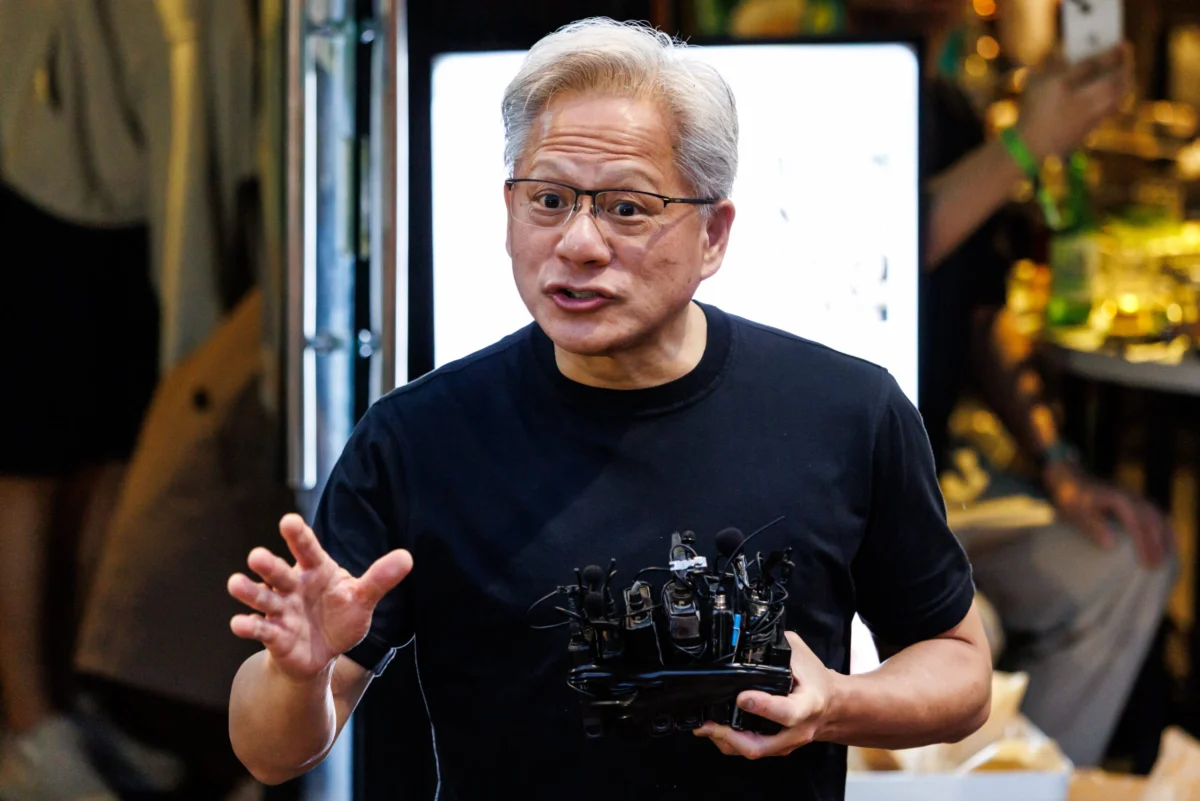
In the history of global finance, few shifts have been as audacious as the one currently spearheaded by Jensen Huang. The Nvidia co-founder and CEO, having already steered his company to the apex of the global stock market, is now attempting to rewrite the fundamental rules of corporate valuation and capital expenditure. By orchestrating a massive $500 billion financing pipeline backed by the world’s most powerful asset managers, Huang is making a high-stakes bet that artificial intelligence hardware is no longer a depreciating consumer electronic, but a durable, long-term infrastructure asset akin to a bridge, a power plant, or a commercial skyscraper.
This pivot represents a radical departure from traditional technology cycles. Historically, hardware—from the mainframe computers of the 1970s to the server blades of the early 2000s—has been treated as a rapidly wasting asset. Accounting standards typically dictate that such equipment be depreciated over three to five years, reflecting the relentless pace of Moore’s Law. However, Huang’s new alliance with BlackRock, Blackstone, Apollo, KKR, Brookfield, and Goldman Sachs seeks to formalize a different reality. This consortium of private credit and infrastructure giants is signaling a willingness to provide the massive liquidity needed to build out the global AI "factory" network, treating Nvidia’s Graphics Processing Units (GPUs) as the bedrock of a new industrial era.
The mechanics of this $500 billion initiative are designed to bridge a widening gap in the capital markets. While "hyperscalers" like Microsoft, Amazon, and Google possess the balance sheets to purchase hundreds of thousands of H100 or Blackwell chips outright, a second tier of the economy—comprising sovereign states, specialized "neocloud" providers, and ambitious AI startups—lacks the immediate cash or investment-grade credit ratings to compete. By creating dedicated financing platforms, Nvidia and its partners are effectively democratizing access to high-end compute, allowing these smaller players to lease or finance the hardware over extended periods.
At the heart of this strategy is the concept of the "AI Factory." Huang argues that an Nvidia-powered data center is not merely a collection of servers, but a productive, revenue-generating facility that remains "fungible." Because Nvidia’s CUDA software platform is the industry standard, a GPU cluster repossessed from a failing startup in San Francisco can, in theory, be instantly repurposed for a research lab in London or a sovereign wealth fund in Riyadh. This fungibility is what transforms a chip into an investable asset. If the hardware can be easily liquidated or redeployed, the risk to the lender is significantly mitigated, allowing for the massive debt loads required to fund the AI revolution.
However, this financial engineering faces a formidable and potentially existential threat: the geopolitical and industrial might of China. The primary risk to the "GPU-as-infrastructure" thesis is not necessarily a lack of demand for AI, but a potential collapse in the secondary market value of the hardware itself. In the world of asset-backed finance, the lender’s safety net is the collateral value. If a borrower defaults, the bank takes the asset. But if that asset’s value has plummeted due to external market forces, the entire financial structure begins to crumble.
Economic analysts point to China’s rapidly accelerating domestic semiconductor industry as the most likely catalyst for such a disruption. Despite stringent U.S. export controls and the placement of firms like Huawei on the Entity List, Beijing has funneled hundreds of billions of dollars into its "Big Fund" and other state-sponsored initiatives to achieve silicon self-sufficiency. If China succeeds in mass-producing "good enough" AI chips at a significantly lower price point, it could flood the global market with low-cost compute capacity.
In such a scenario, the price of an hour of GPU compute—the "rent" that justifies the $500 billion in financing—could face a precipitous decline. If Chinese silicon drives down the global price of inference and training, the premium currently commanded by Nvidia hardware could evaporate. This would lead to a "collateral erosion" event, where the debt owed on a data center exceeds the market value of the chips housed within it. For asset managers like Apollo or KKR, this would transform a supposedly safe infrastructure play into a high-risk distressed debt scenario.
Market veterans draw parallels to the fiber-optic bubble of the late 1990s. At the time, billions were poured into laying undersea cables and terrestrial fiber under the assumption that data demand would make the physical glass an invaluable asset. While the demand for data did indeed explode, an oversupply of fiber led to a "glut," crashing the price of bandwidth and bankrupting the companies that had financed the build-out. The risk today is that AI compute becomes a commodity faster than the debt used to buy it can be serviced.
To account for this volatility, the private credit market is already pricing in a significant "risk premium." Experts suggest that while traditional real estate might be financed at mid-single-digit interest rates, these GPU-backed loans are likely to command high-yield returns in the range of 11% to 17%. This "junk bond" pricing reflects the reality that many borrowers are non-investment grade entities. If the AI "gold rush" slows down, or if the "scaling laws" of LLMs hit a plateau, these borrowers—often referred to as "neoclouds"—could find themselves unable to meet their interest payments, forcing Wall Street to become the world’s largest pawnbroker of used silicon.
Nvidia’s defense against this depreciation risk lies in its software moat. Huang has frequently highlighted that Nvidia is not just a hardware company, but a full-stack computing platform. Through constant updates to the CUDA layer, Nvidia can squeeze more performance out of older chips years after they have been installed. By making hardware more productive through software, Nvidia aims to extend the "economic life" of its GPUs beyond the standard three-year replacement cycle. If a four-year-old H100 chip can still run the latest AI models efficiently thanks to software optimizations, its resale value remains high, protecting the lenders’ collateral.
Furthermore, the current market dynamics still heavily favor Nvidia. In the race for AI supremacy, the scarcity of high-end compute has actually driven up rental rates. In late 2025, the hourly rate for an H100 GPU sat at approximately $1.70; by 2026, that figure had climbed toward $2.35. This upward trend in "yield" is what has attracted the likes of BlackRock and Goldman Sachs. For these firms, the AI build-out represents the largest capital expenditure cycle in human history, and they cannot afford to sit on the sidelines.
The global economic implications of this $500 billion plan are profound. If successful, it will cement the GPU as the "new oil"—the fundamental commodity that powers the modern economy. It would also signal a shift in power from traditional commercial banks to the "shadow banking" sector of private equity and alternative asset managers, who are increasingly filling the role of industrial financiers.
Yet, the shadow of China remains the great unknown. While Huawei’s Ascend chips currently face hurdles due to U.S. sanctions and software compatibility issues, the history of industrial development suggests that technical gaps eventually close. Should China find a way to circumvent lithography bottlenecks or innovate in chiplet architecture, the "Nvidia premium" will be tested.
Ultimately, the $500 billion financing pipeline is a testament to the belief that the AI revolution is permanent and that its physical infrastructure is the most valuable real estate of the 21st century. It is a marriage of Silicon Valley innovation and Wall Street financial engineering, designed to fund a future that is being built at breakneck speed. Whether this model holds firm or falls victim to the cycles of oversupply and geopolitical competition will determine the fate of hundreds of billions of dollars and the trajectory of the global digital economy for decades to come. The world is watching to see if Jensen Huang can truly turn silicon into gold, or if the rapid depreciation of technology will once again prove to be the gravity that brings even the highest-flying financial structures back to earth.