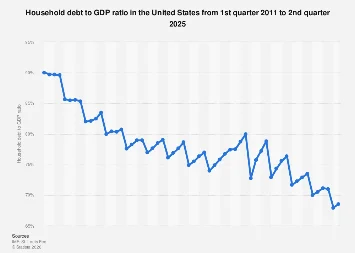
In the second quarter of 2025, the United States recorded a household debt-to-Gross Domestic Product (GDP) ratio of slightly over 68.55 percent, a figure that, while representing a significant aggregate, signals a nuanced trend in the nation’s financial landscape. While historical patterns often indicate a slight uptick in household indebtedness towards year-end, the prevailing data suggests a broader, albeit gradual, deleveraging is underway, influenced by a combination of robust economic expansion and shifts in specific debt categories. This ratio, a critical barometer of household financial health and its contribution to the overall economic output, offers a window into the solvency and spending power of American consumers.
The observed decrease in the household debt-to-GDP ratio in recent years is not an isolated phenomenon but rather a consequence of the sustained growth of the U.S. economy. As the nominal GDP expands, it acts as a denominator that can shrink the debt-to-GDP ratio, even if the absolute volume of household debt continues to grow, provided it does so at a slower pace. This dynamic is crucial for understanding the sustainability of national debt levels. For instance, a 3% increase in GDP can offset a 2% increase in debt, leading to a lower ratio. The U.S. economy, buoyed by technological innovation, strong consumer spending, and a resilient labor market, has consistently delivered positive GDP growth, creating a more favorable environment for managing debt burdens.
A significant component of this trend is the trajectory of mortgage debt. Historically the largest segment of household liabilities, mortgage debt experienced a notable decline from 2012 through the third quarter of 2014. This period coincided with the lingering effects of the 2008 financial crisis, leading to a more cautious lending environment and a reduction in outstanding mortgage balances as homeowners refinanced or paid down loans. However, the subsequent years have witnessed a rebound in mortgage debt, driven by factors such as rising housing prices, increased home purchases, and a generally more accommodative interest rate environment until recent tightening cycles. This fluctuating pattern within the largest debt category underscores the complexity of the overall household debt picture.
Beyond the household sector, it is imperative to consider the parallel narrative of public debt in the United States. In stark contrast to the gradual deleveraging observed in household finances, U.S. public debt, representing the aggregate borrowing by the federal government to finance budget deficits, has exhibited a consistent upward trajectory. Projections indicate this trend is likely to persist in the coming years, driven by ongoing government spending, social programs, and defense expenditures. As of December 2024, the primary holders of this burgeoning U.S. government debt were the Federal Reserve and government accounts, followed by foreign and international investors. This concentration of ownership has implications for monetary policy and international economic relations.
When juxtaposed with other major global economies, the United States’ national debt-to-GDP ratio, while substantial, has historically remained lower than that of Japan, a nation grappling with an aging population and prolonged periods of low economic growth. However, it has generally been higher than many other developed economies. Countries like Liechtenstein, Brunei, and Tuvalu have consistently reported some of the lowest national debt-to-GDP ratios globally, often attributed to their small economic size, significant sovereign wealth funds, or specific fiscal policies. The comparison highlights the diverse fiscal challenges and policy responses adopted by nations worldwide in managing their public finances.
The implications of these debt dynamics extend beyond national statistics. For households, a manageable debt-to-GDP ratio generally correlates with greater financial security, increased disposable income for consumption and investment, and a reduced risk of widespread defaults. Conversely, an escalating ratio can signal potential strain, leading to reduced consumer spending, heightened vulnerability to economic shocks, and a drag on economic growth. For policymakers, the interplay between household and public debt presents a continuous balancing act. Strategies aimed at fostering sustainable economic growth, managing inflation, and ensuring fiscal discipline are paramount in navigating these complex financial currents. The ability of the U.S. economy to continue generating robust GDP growth will be a key determinant in the future trajectory of its household debt-to-GDP ratio and its overall economic resilience. Furthermore, understanding the composition of this debt – the proportion of mortgages, student loans, auto loans, and credit card debt – provides deeper insights into the specific pressures and opportunities facing American households. A shift towards lower-interest, longer-term debt, for instance, can be more manageable than a surge in high-interest, short-term liabilities. The ongoing evolution of the U.S. debt landscape, therefore, warrants continuous monitoring by economists, investors, and policymakers alike.