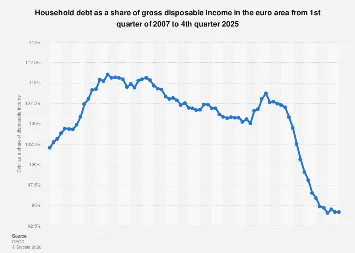
The aggregate household debt in the euro area is projected to stand at a significant percentage of gross disposable income by the final quarter of 2025, signaling a crucial juncture in consumer financial health across the single currency bloc. While specific figures remain behind a paywall, historical trends and expert analysis suggest a period of recalibration following a surge in borrowing during the initial phases of the COVID-19 pandemic. The peak of household indebtedness, measured against disposable income, was observed around the fourth quarter of 2010. Following this apex, a sustained period of deleveraging occurred, reflecting a more cautious approach to borrowing by households and potentially tighter credit conditions.
However, this trend saw an interruption with a notable rebound in debt levels during 2020 and the early part of 2021. This surge was likely a confluence of factors, including government stimulus measures, increased demand for housing, and potentially a response to economic uncertainty, where borrowing might have been seen as a way to maintain consumption or secure assets. Since that mid-pandemic spike, there has been a discernible pattern of households within the eurozone actively reducing their debt burdens. This deleveraging effort is a critical indicator of financial resilience and could pave the way for more sustainable economic growth.
The dynamics of household debt are a key barometer for the health of an economy. High debt-to-income ratios can amplify economic shocks, as households with substantial debt obligations are more vulnerable to interest rate hikes, job losses, or unexpected expenses. Conversely, a declining ratio can indicate improved financial stability, increased savings, and greater capacity for future consumption and investment. For the euro area, a region grappling with diverse economic conditions across its member states, the aggregate picture offers a broad insight into the collective financial posture of its citizens.
Globally, household debt levels have been a subject of intense scrutiny by central banks and international financial institutions. In the United States, for instance, household debt has also seen fluctuations, influenced by factors such as mortgage rates, student loan burdens, and consumer credit availability. While the US debt-to-income ratio may follow different trajectories due to distinct economic structures and monetary policies, the underlying principle of managing household leverage remains a universal concern. Similarly, in emerging economies, the rapid expansion of credit markets has led to rising household debt, prompting concerns about financial stability and consumer protection.
The projected moderation in euro area household debt by the end of 2025, if it materializes as indicated by preliminary data, can be attributed to several interwoven economic forces. Firstly, the European Central Bank’s (ECB) monetary policy stance, characterized by interest rate hikes aimed at curbing inflation, directly impacts the cost of borrowing. Higher interest rates make new loans more expensive and increase the servicing costs for existing variable-rate debt, thereby incentivizing households to reduce their outstanding balances. This policy tightening is a deliberate effort to cool down an overheating economy and bring inflation back within the ECB’s target range.
Secondly, elevated inflation itself, while a burden on household budgets, can also contribute to a statistical reduction in the debt-to-income ratio if incomes rise commensurately. As nominal incomes increase, the existing debt burden becomes a smaller fraction of that income. However, the real impact depends on whether wage growth keeps pace with inflation, which has been a challenge for many in the euro area. The real disposable income of households is a crucial determinant of their ability to service debt and save.
Furthermore, a heightened awareness of economic risks, spurred by geopolitical uncertainties and the lingering effects of the pandemic, may be fostering a more prudent approach to personal finance. Households might be prioritizing savings and debt repayment over new borrowing, seeking to build financial buffers against potential future downturns. This behavioral shift, if sustained, can have a profound impact on long-term economic stability.
The implications of these debt dynamics extend beyond individual households. For financial institutions, a stable or declining household debt ratio generally signifies lower credit risk. Banks and other lenders benefit from a populace that can reliably meet its debt obligations. Conversely, a sharp increase in defaults or delinquencies can strain the banking sector, potentially leading to a credit crunch that chokes off economic activity.
For governments and policymakers, managing household debt is a delicate balancing act. While encouraging responsible borrowing can fuel economic growth, unchecked debt accumulation can sow the seeds of future financial crises. Regulatory frameworks governing mortgage lending, consumer credit, and debt collection play a vital role in ensuring that borrowing remains sustainable. Policies aimed at enhancing financial literacy and providing support for indebted households are also critical components of a robust economic strategy.
The euro area’s experience with household debt offers valuable lessons. The period following the 2008 global financial crisis underscored the systemic risks associated with excessive leverage. The subsequent deleveraging in many European countries, while painful in the short term, contributed to greater financial stability in the years leading up to the pandemic. The recent rebound and subsequent projected moderation highlight the cyclical nature of debt and the continuous need for vigilance.
Looking ahead, the trajectory of euro area household debt will be influenced by a complex interplay of monetary policy, inflation trends, labor market conditions, and consumer confidence. A sustained period of deleveraging, coupled with robust income growth, would provide a solid foundation for future economic expansion. Conversely, any renewed surge in borrowing without corresponding income increases could reignite concerns about financial vulnerabilities. The precise figures for the end of 2025 will offer a clearer picture, but the emerging trend suggests a cautious optimism regarding the financial resilience of households across the euro area. The ongoing efforts to manage debt burdens are not merely an accounting exercise; they are fundamental to the economic well-being of millions and the overall stability of the eurozone economy.