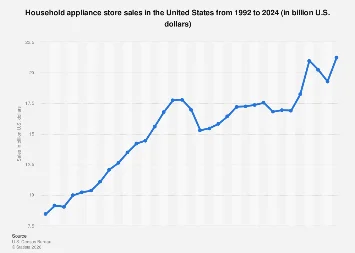
The United States household appliance retail sector is projecting a sustained upward trajectory in sales for 2024, building on a period of significant growth that saw a notable surge during the COVID-19 pandemic. While precise, granular data for the full year remains subject to finalization, preliminary indicators and historical trends suggest that the market is poised to continue its expansion, albeit with evolving consumer dynamics. Industry analysts anticipate that sales within this segment will surpass previous benchmarks, reflecting a robust demand for essential and upgrade-driven home goods.
Historically, the U.S. household appliance market has demonstrated resilience, adapting to economic fluctuations and technological advancements. Data spanning back to 1992 illustrates a consistent, albeit sometimes modest, increase in annual sales. However, the period between 2020 and 2021 marked an unprecedented surge, driven by a confluence of factors. Widespread lockdowns and a dramatic shift towards remote work and learning compelled consumers to invest more heavily in their home environments. This included not only replacing aging appliances but also upgrading to newer, more energy-efficient, and feature-rich models. This pandemic-induced boom significantly elevated the market’s baseline, creating a new normal for consumer spending in this category.
Following this peak, the market experienced a natural recalibration. As economies reopened and consumer spending patterns diversified, the explosive growth rate of the pandemic years began to moderate. Yet, this moderation should not be misconstrued as a decline. Instead, it represents a return to more sustainable growth, influenced by underlying economic conditions, consumer confidence, and ongoing product innovation. For 2024, projections indicate a continued increase in sales value, with estimates pointing to a nearly two-billion-dollar uplift compared to the preceding year. This suggests that the demand for household appliances remains strong, fueled by factors such as an aging housing stock requiring replacements, a growing interest in smart home technology, and evolving consumer preferences for enhanced functionality and design.
The economic implications of this sector’s performance extend far beyond retail shelves. The manufacturing, logistics, and installation components of the appliance industry also benefit from sustained demand. For manufacturers, robust sales translate into increased production volumes, potentially leading to job creation and investment in research and development. The supply chain, from raw material sourcing to final delivery, experiences a ripple effect, supporting a broad ecosystem of businesses. Furthermore, the installation and repair services associated with appliances represent a significant segment of the service economy, providing employment and contributing to local economies.
Several key trends are shaping the current landscape of the U.S. household appliance market. The persistent interest in energy efficiency continues to be a major driver, influenced by both environmental consciousness and the desire to reduce long-term utility costs. Government incentives and evolving energy standards further encourage consumers to opt for more sustainable appliances. The integration of smart technology is another transformative force. Refrigerators that can track inventory, ovens with remote preheating capabilities, and washing machines controlled via smartphone apps are no longer niche products but increasingly standard offerings. This "connected home" phenomenon not only enhances convenience but also opens up new revenue streams for manufacturers through software updates and subscription services.
Geographically, the U.S. market for household appliances is diverse, with regional variations in consumer preferences and economic conditions. Areas experiencing strong population growth or significant new housing construction often exhibit higher demand for appliances. Conversely, regions with older housing stock may see a greater emphasis on replacement purchases. The competitive landscape is characterized by a mix of established global brands and emerging players, all vying for market share through product differentiation, pricing strategies, and marketing efforts.
Globally, the U.S. appliance market is a significant contributor to the worldwide industry. While other regions, particularly in Asia, are experiencing rapid growth due to burgeoning middle classes and urbanization, the U.S. market remains a mature and high-value segment. Its trends and innovations often set the pace for global product development and consumer expectations. Comparing the U.S. market’s trajectory with that of other developed economies reveals similar patterns of post-pandemic recalibration and a continued focus on technological integration and sustainability. However, the sheer scale of the U.S. consumer base and its disposable income provide a unique dynamism to its appliance sector.
Looking ahead, the U.S. household appliance retail sector is likely to face both opportunities and challenges. Economic headwinds, such as inflation and interest rate fluctuations, could temper consumer spending on discretionary upgrades. Supply chain disruptions, though seemingly easing, remain a potential concern, impacting product availability and pricing. Nevertheless, the fundamental drivers of demand – population growth, home improvement trends, and the continuous evolution of appliance technology – are expected to underpin continued market expansion. The industry’s ability to innovate, adapt to changing consumer needs, and navigate the macroeconomic environment will be critical in sustaining its growth trajectory in the coming years. The ongoing shift towards connected living and the increasing importance of sustainability are not mere fads but fundamental aspects that will shape the future of how Americans equip their homes.