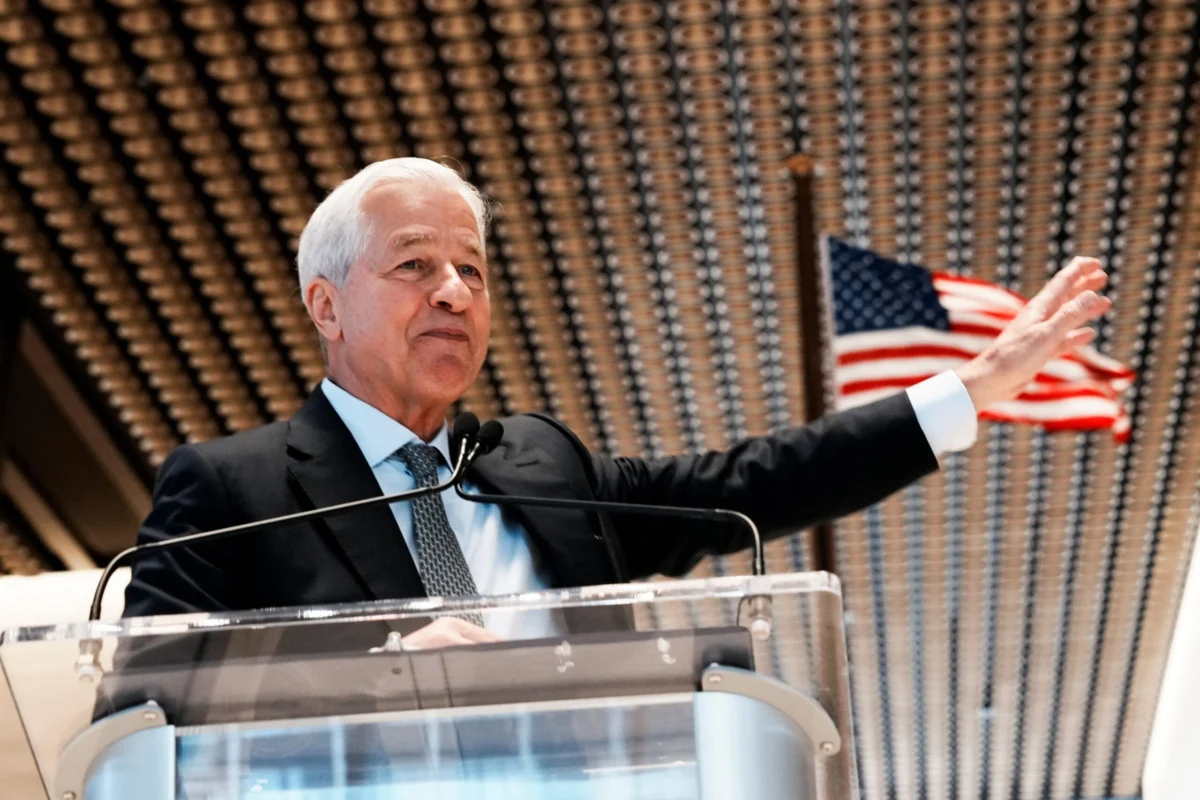
The revitalization of the United States’ maritime industrial capacity received a significant private-sector catalyst this week as Jamie Dimon, Chairman and CEO of JPMorgan Chase, announced a $24 million commitment aimed at bolstering domestic shipbuilding. This strategic allocation, while a fraction of the bank’s broader capital capabilities, represents a targeted strike at one of the most critical bottlenecks in the American defense supply chain: the production of advanced naval vessels and the development of the skilled workforce required to build them. The move is the latest deployment under JPMorgan’s ambitious $1.5 trillion security project, an initiative designed to channel massive tranches of capital into industries deemed essential to the economic and national security of the United States and its allies.
The investment package is specifically tailored to address both infrastructure and ecosystem health. Of the total $24 million, $18 million is structured as loans and $6 million as grants. The primary beneficiary of this funding is Rhoads Industries, a heavy industrial fabrication and maintenance firm based at the historic Philadelphia Navy Yard. The capital is earmarked for the construction of a new, state-of-the-art submarine manufacturing facility, a move that aligns directly with the U.S. Navy’s urgent requirement to increase the cadence of its underwater fleet production. Beyond the primary facility, the bank’s initiative includes provisions to expand lending to maritime-related small businesses and to fortify regional suppliers, ensuring that the "Tier 2" and "Tier 3" companies within the industrial base have the liquidity necessary to scale alongside major contractors.
Jamie Dimon’s rhetoric surrounding the announcement evokes the industrial mobilization of the mid-20th century, specifically referencing the "Arsenal of Democracy." In the current geopolitical climate, characterized by the prolonged conflict in Ukraine, volatility in the Middle East, and escalating tensions in the Indo-Pacific, the concept of industrial capacity as a deterrent has returned to the forefront of economic policy. Dimon’s assertion that this arsenal has been "reignited" reflects a growing consensus among financial leaders and policymakers that the era of "just-in-time" supply chains and the outsourcing of heavy industry has left the West vulnerable.
The choice of the Philadelphia Navy Yard as the focal point for this investment is both symbolic and strategic. Once the heartbeat of American naval power, the yard has undergone a massive transformation into a multi-use industrial and commercial campus. The presence of Hanwha, the South Korean defense and shipbuilding conglomerate, at the site further underscores the internationalization of the effort to rebuild American capacity. Hanwha’s involvement, which includes a significant $100 million investment in Philly Shipyard, highlights a new era of "friend-shoring," where the U.S. leverages the expertise and capital of allied nations to bridge the gap in its own domestic manufacturing capabilities.
To understand the urgency behind JPMorgan’s move, one must look at the stark disparity between American and Chinese shipbuilding output. According to data from the United States Naval Institute and the Office of Naval Intelligence, China currently possesses the world’s largest navy by ship count and holds a staggering lead in commercial shipbuilding capacity, accounting for nearly 50% of global output. In contrast, the United States produces less than 1% of the world’s commercial vessels. This atrophy in the commercial sector has bled into the defense sector, leading to a shortage of dry docks, a shrinking pool of specialized labor, and a fragile network of sub-component manufacturers.
The U.S. Navy’s current long-range plan calls for a fleet of 355 ships, yet achieving this goal has been hampered by delays in the Virginia-class and Columbia-class submarine programs. These vessels are the cornerstones of the U.S. nuclear deterrent and undersea dominance, but the industrial base has struggled to meet the "two-per-year" production cadence required. By injecting capital into Rhoads Industries for submarine-specific infrastructure, JPMorgan is effectively de-risking a critical node in the Navy’s procurement strategy.

The $1.5 trillion security project launched by JPMorgan Chase last year represents a fundamental shift in how global financial institutions view "ESG" (Environmental, Social, and Governance) and "Impact" investing. While traditional impact investing focused heavily on green energy and social equity, Dimon’s vision expands this to include "National Security" as a pillar of corporate responsibility. The project focuses on five key areas: energy security, food security, cybersecurity, health security, and defense industrial resilience. Earlier this year, the bank announced an expansion of this program into Europe, acknowledging that the defense requirements of NATO allies are inextricably linked to American economic stability.
The economic impact of revitalizing the Philadelphia Navy Yard extends far beyond the shipyard gates. Economic multipliers for shipbuilding are among the highest in the manufacturing sector. For every job created in a shipyard, an estimated 2.5 to 3.5 additional jobs are supported in the broader economy through the procurement of steel, electronics, specialized machinery, and engineering services. Furthermore, the grants included in Dimon’s announcement are intended to address the "skills gap." The maritime industry faces a looming crisis as a generation of master shipfitters and welders nears retirement. JPMorgan’s support for workforce development programs is a recognition that hardware is useless without the human capital to operate it.
From a market perspective, JPMorgan’s move signals to other private equity and institutional investors that the defense industrial base is a viable, long-term asset class. Historically, private capital has been wary of the defense sector due to the "lumpy" nature of government contracts, heavy regulation, and long development cycles. However, as the Department of Defense increasingly looks to commercial technology and private-sector efficiency to modernize its operations, the barriers between "Silicon Valley" and "The Pentagon" are dissolving. Dimon is positioning JPMorgan as the primary financial architect of this bridge.
Global comparisons further illuminate the necessity of this pivot. Nations like Japan and South Korea have maintained robust shipbuilding sectors through a combination of government subsidies, close ties between banking and industry, and a focus on high-tech vessel construction. The U.S., under the Jones Act, has maintained a protected but domestic-focused maritime industry that has struggled to achieve the scale of its Asian counterparts. The infusion of private banking capital, combined with foreign expertise from partners like Hanwha, suggests a new hybrid model for American industrial policy—one that relies less on direct government "picking of winners" and more on creating the financial conditions for industrial growth.
The geopolitical stakes cannot be overstated. The AUKUS agreement—a trilateral security pact between Australia, the United Kingdom, and the United States—relies heavily on the U.S. being able to produce and maintain nuclear-powered submarines for its partners. Failure to expand the submarine industrial base would not only undermine the U.S. Navy’s readiness but would also damage the credibility of American security guarantees in the Pacific. By targeting the submarine supply chain in Philadelphia, JPMorgan is providing a necessary lubricant to the gears of international diplomacy.
As the program scales, the focus is expected to shift toward the integration of advanced technologies. The shipyards of the future will require high levels of automation, 3D printing for spare parts, and AI-driven logistics to compete globally. Part of the $1.5 trillion initiative is expected to flow into these "dual-use" technologies that have applications in both the commercial and defense sectors.
Ultimately, Jamie Dimon’s $24 million announcement is a high-profile signal of a deeper structural realignment within the American economy. It acknowledges that the era of peaceful globalization has transitioned into an era of "geoeconomic competition," where the strength of a nation’s balance sheet is once again tied to the strength of its factory floors. By anchoring this effort in Philadelphia, a city with a deep naval pedigree, JPMorgan is attempting to prove that the "Arsenal of Democracy" is not a relic of history, but a scalable model for the 21st century. The success of this initiative will be measured not just in the number of hulls launched into the Delaware River, but in the resilience of the American industrial spirit and its ability to adapt to a more volatile world order.