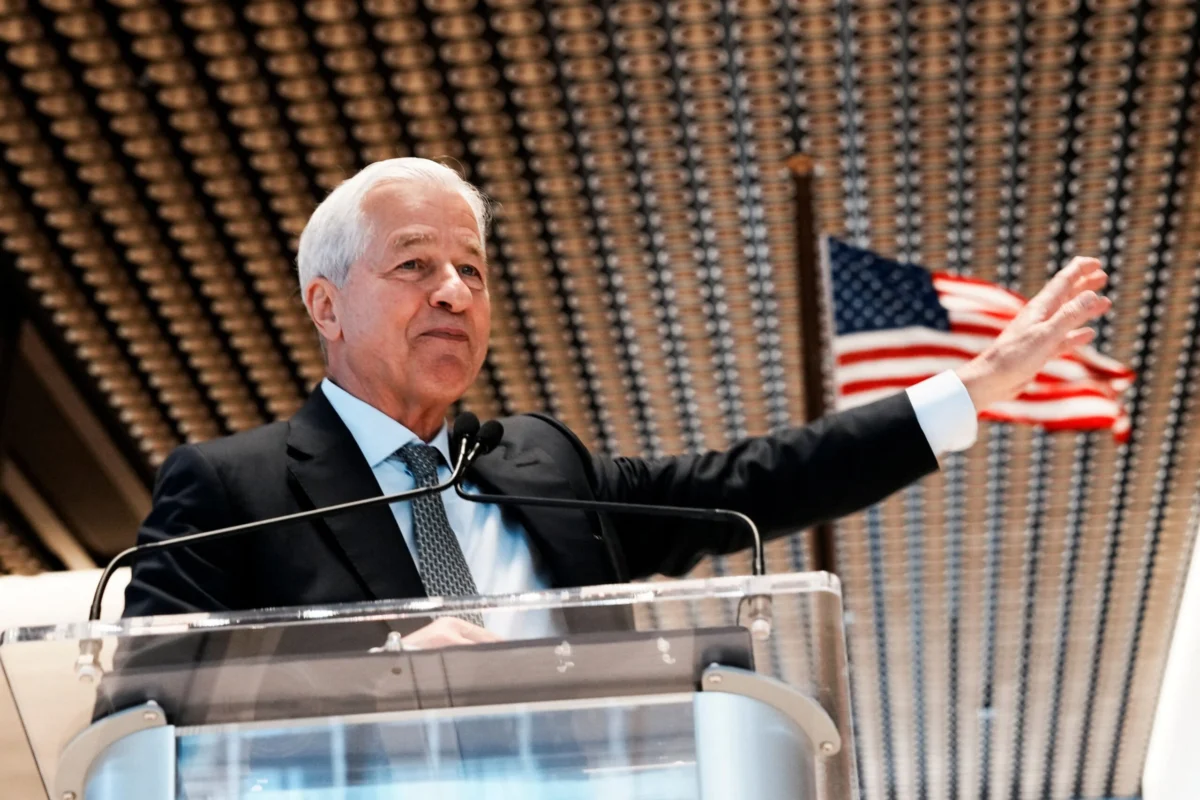
The concept of the "Arsenal of Democracy," a phrase famously coined by Franklin D. Roosevelt to describe the industrial might of the United States during World War II, is experiencing a 21st-century resurgence. In a move that signals a deepening intersection between Wall Street finance and Pentagon priorities, JPMorgan Chase CEO Jamie Dimon recently unveiled a $24 million initiative specifically targeted at the revitalization of American shipbuilding. This investment, centered on the historic Philadelphia Navy Yard, represents a tactical pivot for the nation’s largest bank as it seeks to fortify the domestic industrial base against a backdrop of escalating global volatility.
The funding package is structured to address both immediate infrastructure needs and long-term supply chain resilience. Of the total commitment, $18 million will be allocated as loans, complemented by $6 million in grants. The primary beneficiary of this capital injection is Rhoads Industries, a heavy industrial fabrication and maintenance firm that has become a cornerstone of the maritime economy in Pennsylvania. The funds are earmarked for the construction of a state-of-the-art submarine manufacturing facility, a project deemed critical to the U.S. Navy’s efforts to modernize its undersea fleet.
Beyond the brick-and-mortar expansion at Rhoads Industries, the JPMorgan initiative aims to stimulate the broader maritime ecosystem. A portion of the capital is dedicated to expanding lending for small businesses within the maritime sector and strengthening regional suppliers who provide the specialized components necessary for naval construction. This "bottom-up" approach to industrial policy reflects a growing recognition that national security is inextricably linked to the health of localized manufacturing hubs.
This $24 million commitment is not an isolated philanthropic gesture but rather a component of JPMorgan’s massive $1.5 trillion security project. Launched last year, this ambitious program is designed to channel capital into sectors that the bank deems vital to U.S. economic and national security, ranging from energy and semiconductors to defense and critical infrastructure. During a recent discussion regarding the project, Dimon emphasized that the "arsenal of democracy has been reignited," suggesting that the era of deindustrialization is being forcibly reversed by the realities of modern geopolitics.
The urgency behind this investment is underscored by a sobering reality: the United States’ shipbuilding capacity has withered significantly over the last four decades. At the height of World War II, the U.S. could produce thousands of vessels a year. Today, the nation struggles to maintain a consistent cadence of even a dozen major naval hulls. In contrast, China has undergone a massive naval expansion, boasting the world’s largest navy by ship count and a commercial shipbuilding industry that commands nearly 50% of the global market share. Recent reports from the Office of Naval Intelligence suggest that China’s shipbuilding capacity is over 200 times greater than that of the United States, a disparity that has sent ripples of concern through Washington’s defense establishment.
The Philadelphia Navy Yard serves as a poignant backdrop for this revival. Once a decommissioned relic of the Cold War era, the yard is being transformed into a multi-national industrial hub. Dimon specifically highlighted the presence of Hanwha, the South Korean defense and shipbuilding giant, which recently made waves with its $100 million acquisition of Philly Shipyard. The entry of South Korean expertise and capital into the U.S. market represents a shift toward "friend-shoring"—a strategy where the U.S. collaborates with allied nations to rebuild its domestic industrial capabilities. By integrating South Korean manufacturing efficiency with American strategic requirements, the Philadelphia Navy Yard is becoming a test case for a new model of Western industrial cooperation.
The economic implications of this revitalization extend far beyond the shipyard gates. Shipbuilding is a labor-intensive industry that requires a highly skilled workforce, including specialized welders, pipefitters, electrical engineers, and systems integrators. The JPMorgan grants are expected to support workforce development programs, addressing a chronic labor shortage that has plagued the defense industry. According to industry estimates, the U.S. submarine industrial base needs to hire roughly 100,000 new workers over the next decade to meet the production goals set by the Navy and the AUKUS security pact—a trilateral agreement between Australia, the U.K., and the U.S. that necessitates the construction of nuclear-powered submarines.

Furthermore, the focus on submarines is particularly strategic. The U.S. undersea advantage is considered its most significant qualitative edge over near-peer competitors. However, maintaining that edge requires a consistent production rate of at least two Virginia-class submarines per year, plus the massive Columbia-class ballistic missile submarines. Currently, the U.S. is falling short of these targets due to supply chain bottlenecks and facility constraints. The new facility at Rhoads Industries is designed to alleviate some of these pressures, providing the specialized space required for the fabrication of complex submarine modules.
The broader JPMorgan security project also reflects a shift in how the financial sector views risk. For years, "security" was the purview of the government, while banks focused on traditional market returns. However, the disruption of global supply chains during the pandemic, coupled with the invasion of Ukraine and rising tensions in the Taiwan Strait, has redefined the concept of market stability. Dimon has been vocal about the fact that economic prosperity cannot exist without national security. By committing $1.5 trillion to these "hard" industries, JPMorgan is essentially betting that the future of global finance will be defined by the "re-shoring" of critical production.
This strategy is also expanding geographically. Earlier this year, JPMorgan announced that it would extend its security-focused lending and investment program into Europe. This expansion comes at a time when European nations are grappling with the need to significantly increase defense spending in response to Russian aggression. The bank’s involvement suggests a growing role for private capital in financing the massive rearmament efforts currently underway across the NATO alliance.
From a market perspective, the revitalization of shipbuilding offers a unique opportunity for long-term industrial growth. While the sector is often characterized by long lead times and high capital intensity, the current geopolitical climate provides a level of demand certainty that has been absent for decades. Government contracts are increasingly being structured to provide multi-year stability, encouraging private firms and lenders to commit the necessary resources. The integration of advanced technologies, such as artificial intelligence in design and robotic automation in welding, further promises to improve the productivity and competitiveness of American yards.
However, challenges remain. The U.S. regulatory environment, characterized by complex permitting processes and stringent environmental standards, can often slow the pace of industrial expansion. Additionally, the global maritime industry is still heavily influenced by subsidies provided by foreign governments to their domestic shipbuilders, making it difficult for U.S. firms to compete on price alone. Dimon’s "Arsenal of Democracy" vision requires not just capital, but a coordinated effort between the private sector and the federal government to streamline the industrial base.
As the $24 million project in Philadelphia breaks ground, it serves as a microcosm of a much larger transformation. The partnership between a global financial titan like JPMorgan, a regional powerhouse like Rhoads Industries, and international allies like Hanwha suggests that the path to American industrial renewal is being paved with a mix of domestic investment and global collaboration. While the "Arsenal of Democracy" once relied on the sheer scale of American factories, its modern iteration will rely on the strategic deployment of capital, the mastery of high-end technology, and the resilience of a decentralized, well-funded supply chain.
In the final analysis, Jamie Dimon’s announcement is more than a business transaction; it is a statement of intent regarding the role of American finance in a fragmented world. By directing billions toward the hulls of submarines and the floors of shipyards, the financial sector is acknowledging that the foundations of the global economy are only as strong as the security structures that protect them. The rebirth of the Philadelphia Navy Yard may well be the first chapter in a long-term effort to ensure that the U.S. remains not just a leader in global markets, but a dominant force in the industrial sectors that define national power.