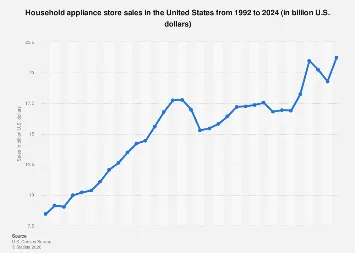
The United States household appliance retail sector has demonstrated a consistent upward trajectory in recent years, experiencing a notable surge in sales during the COVID-19 pandemic in 2021. Projections indicate this trend is set to continue, with estimated sales for 2024 reaching approximately $75 billion, representing a near $2 billion increase from the preceding year. This sustained expansion underscores the enduring demand for home appliances, even as economic conditions and consumer behaviors evolve.
The market’s strength is rooted in several fundamental factors. Homeownership rates, while subject to cyclical fluctuations, generally provide a stable base for appliance purchases. Furthermore, the natural lifecycle of appliances necessitates periodic replacement, ensuring a consistent demand stream. Beyond replacement cycles, consumer desire for upgraded features, enhanced energy efficiency, and aesthetically pleasing designs also drives sales, particularly in a market as dynamic as the U.S.
Looking at historical data, the appliance retail landscape has seen significant transformation. From 1992 through the early 2000s, sales exhibited steady, albeit moderate, growth. The advent of the internet and the subsequent rise of e-commerce began to reshape how consumers shopped for major household items. While brick-and-mortar appliance stores remained dominant for a considerable period, the digital revolution gradually eroded their market share, prompting a strategic shift towards omnichannel retail models.
The pandemic acted as a significant catalyst, accelerating pre-existing trends and creating new ones. With households spending more time at home due to lockdowns and remote work mandates, consumers invested heavily in improving their living spaces. This included the replacement of aging appliances and the acquisition of new ones to support enhanced home-based activities, from cooking and baking to laundry and entertainment. This surge in demand pushed sales to record highs in 2021.
Post-pandemic, the market has navigated a complex environment characterized by inflationary pressures, supply chain disruptions, and changing consumer spending priorities. Despite these headwinds, the U.S. appliance market has shown remarkable resilience. The projected $75 billion in sales for 2024 suggests a market that is not only recovering but also expanding beyond its pre-pandemic trajectory. This growth can be attributed to a combination of factors, including pent-up demand, continued investment in home improvement, and the introduction of innovative, high-value products.
The product mix within the appliance sector is also evolving. While core categories like refrigerators, ovens, dishwashers, and washing machines continue to form the backbone of sales, there is increasing consumer interest in specialized appliances and smart home integration. Connected appliances, offering features such as remote control, diagnostics, and personalized settings, are gaining traction, particularly among younger demographics and tech-savvy households. This trend is likely to fuel future growth as manufacturers continue to innovate in the smart home space.
Geographically, the U.S. market is diverse, with regional variations in consumer preferences and economic conditions influencing appliance sales. States with higher disposable incomes and a greater proportion of new home construction often lead in appliance expenditures. Conversely, markets experiencing economic downturns or lower rates of home sales may show more subdued growth.
Globally, the U.S. remains one of the largest and most sophisticated appliance markets. While other regions, such as Asia and Europe, also represent significant markets, the U.S. is often at the forefront of technological adoption and consumer trends. This leadership position is driven by a combination of robust consumer spending power, a competitive retail landscape, and a strong emphasis on innovation by manufacturers.
The economic impact of the appliance retail sector extends beyond direct sales. It supports a vast ecosystem of manufacturers, suppliers, logistics providers, and service technicians. Investments in research and development, manufacturing facilities, and retail infrastructure create jobs and stimulate economic activity. Furthermore, the drive for energy-efficient appliances contributes to broader environmental goals by reducing household energy consumption and carbon footprints.
Looking ahead, several factors will shape the future of the U.S. appliance retail market. Continued innovation in energy efficiency and smart home technology will be crucial. The growing emphasis on sustainability and the circular economy may also lead to increased demand for repair services and refurbished appliances. Economic stability, interest rate policies, and consumer confidence will play significant roles in determining the pace of growth.
Retailers are increasingly adopting a multifaceted approach, blending online convenience with the tangible experience of in-store shopping. Showrooming, where customers browse in-store but purchase online, remains a factor, but retailers are enhancing their physical spaces with interactive displays and expert consultations to provide added value. The integration of artificial intelligence and data analytics is also becoming vital for understanding consumer behavior, personalizing offers, and optimizing inventory management.
The resilience of the U.S. household appliance market, as evidenced by its projected growth in 2024, highlights the essential nature of these products in modern living. Despite a dynamic economic landscape, consumer demand for functional, efficient, and increasingly sophisticated home appliances continues to drive significant retail activity. The sector’s ability to adapt to technological advancements and evolving consumer expectations suggests a promising outlook for continued expansion in the years to come.