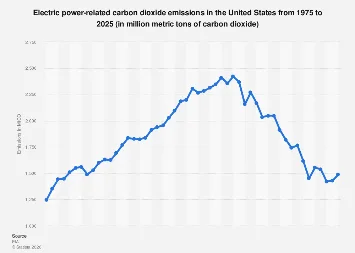
The landscape of energy production in the United States has undergone a profound transformation over the past five decades, particularly evident in the dramatic shifts in carbon dioxide (CO2) emissions from the electric power sector. From the mid-1970s, when fossil fuels largely dominated electricity generation, to projections for the mid-2020s, the industry’s environmental impact has been in constant flux, driven by evolving regulatory frameworks, technological advancements, and fluctuating market dynamics. Understanding this historical trajectory is crucial for grasping the current state of energy policy, the challenges of climate change mitigation, and the future direction of the U.S. power grid.
In the 1970s, the U.S. electric power industry was overwhelmingly reliant on coal and, to a lesser extent, natural gas and oil, to meet its energy demands. This reliance translated into substantial CO2 emissions, a byproduct of combustion that has since become a primary focus of global environmental concern. Data from the period, when accessible, typically paints a picture of rising emissions as energy consumption grew in tandem with economic expansion. The energy crises of the 1970s, while prompting some diversification efforts, did not immediately dislodge fossil fuels from their dominant position. Instead, they spurred greater interest in domestic energy sources, including coal, which was abundant and relatively inexpensive. This era was characterized by a steady, often upward, trend in CO2 output from power plants.
The 1980s and 1990s witnessed a more complex interplay of factors influencing emissions. While industrial growth continued, environmental awareness began to gain traction. The Clean Air Act amendments and other regulatory measures started to impose stricter controls on pollutants, indirectly influencing the operational efficiency and fuel choices of power generators. However, the sheer scale of electricity demand meant that emissions remained a significant concern. Coal continued to be the workhorse of the grid, though advancements in combustion technology aimed to improve efficiency and reduce other air pollutants like sulfur dioxide and nitrogen oxides. The transition to natural gas as a cleaner-burning alternative also began to accelerate during this period, particularly as domestic production increased and pipeline infrastructure expanded. This gradual shift contributed to a plateauing, and in some instances, a slight decline in CO2 emissions from certain segments of the power sector.
The dawn of the 21st century marked a significant turning point. The growing scientific consensus on climate change, coupled with international agreements like the Kyoto Protocol, intensified the focus on CO2 reduction. In the U.S., the electric power sector became a focal point for policy interventions. The Energy Information Administration (EIA) and other governmental bodies began to meticulously track and report emissions data, providing a clearer picture of the industry’s environmental performance. This period saw a more pronounced decline in CO2 emissions from power generation, driven by several key factors.
One of the most impactful developments was the shale gas revolution. The widespread adoption of hydraulic fracturing and horizontal drilling techniques unlocked vast reserves of natural gas, making it significantly cheaper and more accessible. Natural gas-fired power plants emit roughly half the CO2 per unit of electricity generated compared to coal-fired plants. This economic and environmental advantage led to a substantial displacement of coal power, a phenomenon often referred to as the "dash for gas." As utilities retired older, less efficient coal plants and invested in new, cleaner natural gas facilities, CO2 emissions from the sector saw a notable and sustained decrease.
Simultaneously, the renewable energy sector began its ascent. Driven by supportive government policies, tax incentives, and declining technology costs, solar and wind power installations saw exponential growth. While still a smaller portion of the overall generation mix compared to natural gas and coal, renewables contribute zero direct CO2 emissions. Their increasing penetration into the grid effectively displaced generation from fossil fuels, further contributing to the downward trend in emissions. By the late 2010s and early 2020s, the U.S. electric power sector was emitting significantly less CO2 than it had in decades, a testament to the combined impact of regulatory pressure, technological innovation, and market forces.
Looking ahead to projections for 2025, the trend of declining CO2 emissions from the U.S. electric power sector is expected to continue, albeit with potential moderating factors. The Biden administration’s ambitious climate goals, including targets for decarbonizing the power sector by 2035, are likely to further accelerate the transition away from fossil fuels. Investments in renewable energy, battery storage, and grid modernization are expected to increase. Furthermore, the ongoing electrification of other sectors, such as transportation and buildings, could lead to increased electricity demand, but the assumption is that this demand will be met increasingly by clean sources.
However, challenges remain. The pace of renewable energy deployment needs to be rapid and sustained to offset the continued reliance on natural gas, which, while cleaner than coal, is still a fossil fuel. The intermittency of solar and wind power necessitates significant investment in energy storage solutions and grid flexibility. Moreover, policy uncertainties and economic headwinds can impact the pace of investment in clean energy infrastructure. The debate over the role of nuclear power, a carbon-free energy source, also continues, with its future uncertain and dependent on economic viability and public perception.
Globally, the U.S. experience in decarbonizing its power sector offers valuable lessons. Countries like Germany, with its Energiewende (energy transition) policy, have made significant strides in renewable energy integration, though they have also faced challenges related to grid stability and the phasing out of coal. China, the world’s largest emitter, is simultaneously investing heavily in renewables and expanding its coal capacity, presenting a complex global picture. The U.S. trend of declining power sector emissions is a positive development in the fight against climate change, but it represents only one piece of a larger, global puzzle.
The economic implications of this transition are substantial. The shift away from coal has had significant impacts on coal-producing regions and communities, necessitating strategies for economic diversification and worker retraining. Conversely, the growth of the renewable energy sector has created new jobs and spurred innovation. Investments in grid infrastructure, energy efficiency, and new generation technologies represent significant economic opportunities. The long-term economic benefits of mitigating climate change, including reduced healthcare costs associated with air pollution and avoided damages from extreme weather events, are also increasingly recognized.
In essence, the trajectory of U.S. electric power CO2 emissions over the past half-century is a story of adaptation, innovation, and evolving priorities. From the heavy reliance on fossil fuels in the 1970s to the projected cleaner energy mix of the mid-2020s, the sector has navigated technological shifts, regulatory pressures, and market forces. While significant progress has been made, the journey towards a fully decarbonized power sector remains a complex and ongoing endeavor, requiring sustained commitment and strategic investment to achieve a sustainable energy future. The data, when fully accessible, will provide precise figures to quantify these profound changes, offering a clear benchmark for past achievements and future targets in the critical fight against climate change.