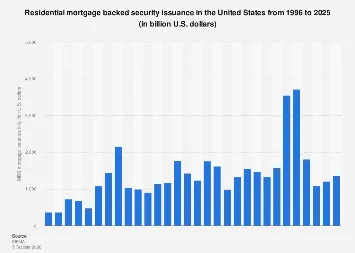
The landscape of the U.S. mortgage-backed securities (MBS) market is undergoing a significant recalibration, with issuance levels experiencing a notable contraction following a record-setting peak in 2021. While 2021 witnessed an unprecedented surge in MBS issuance, reaching an all-time high of $3.0 trillion U.S. dollars, the subsequent years have seen a deceleration. Projections for 2025 indicate a further reduction in issuance, with the market anticipated to settle around $1.5 trillion U.S. dollars. This downward trend reflects a confluence of factors, including evolving interest rate environments, shifting housing market dynamics, and a broader reevaluation of risk appetites among investors.
At its core, a mortgage-backed security represents a financial instrument where a pool of individual residential mortgages is bundled together and then sold to investors. The underlying principle of MBS is risk diversification; by aggregating numerous mortgages, the potential impact of any single loan default is diluted across the entire pool. This pooling mechanism is designed to create a more stable and attractive investment, effectively transforming illiquid mortgage assets into tradable securities. However, this inherent stability is contingent upon the broader economic climate. A sharp and rapid increase in the foreclosure rate, for instance, can significantly undermine the value and performance of MBS, exposing investors to substantial losses.
The inherent risk associated with mortgages, while often perceived as relatively low due to the underlying collateral of a physical asset (the home), is intrinsically tied to the long-term nature of these loans. Maturities can extend for decades, necessitating that lenders and investors meticulously account for potential shifts in the economic environment over these extended periods. This long-term commitment directly influences interest rate structures. Consequently, longer-term mortgages typically carry higher interest rates compared to their shorter-term counterparts. A key benchmark influencing these rates is the yield on the 10-year U.S. Treasury security. This long-term rate is widely accepted by investors as a proxy for a risk-free return, and its movements serve as a crucial indicator for pricing longer-duration fixed-income instruments, including MBS.
Beyond interest rate considerations, the concept of homeowner equity plays a pivotal role in mortgage risk. When the value of a home declines, homeowners can find themselves in a precarious position, owing more on their mortgage than the property is currently worth – a situation colloquially referred to as being "underwater." This diminished equity increases the likelihood of default, particularly if the homeowner faces financial distress, as the incentive to maintain mortgage payments diminishes when there is no equity to protect. The stability of the housing market and the sustained growth of homeowner equity are therefore critical underpinnings for the health of the MBS market.
The contraction in MBS issuance observed since 2021 is not an isolated phenomenon but rather a symptom of broader macroeconomic forces. The aggressive monetary policy tightening by the U.S. Federal Reserve, aimed at curbing inflation, has led to a substantial increase in benchmark interest rates. This has made new mortgage origination significantly more expensive for homebuyers, dampening demand and subsequently reducing the supply of new mortgages available for securitization. For existing homeowners with lower interest rates, the incentive to refinance has evaporated, further constricting the pipeline of securitizable assets.
Globally, the U.S. MBS market is a bellwether for the health of the global financial system, given its sheer size and interconnectedness. While other developed economies also have MBS markets, the scale and depth of the U.S. market are unparalleled. For example, countries like Canada and the United Kingdom have their own mortgage securitization frameworks, but they operate on a considerably smaller scale. The U.S. market’s influence extends to international investors seeking exposure to the U.S. real estate sector and its associated debt instruments. The current contraction, therefore, has ripple effects that can be felt in international capital flows and investment strategies.
Market data illustrates the shift. Following the record issuance in 2021, 2022 saw a notable decline as interest rates began their ascent. The pace of MBS issuance in 2023 continued this downward trajectory, with a greater emphasis on government-sponsored enterprise (GSE) MBS (issued by Fannie Mae and Freddie Mac) and agency mortgage-backed securities, which are perceived as having implicit government backing, thus carrying lower credit risk. Non-agency MBS, which are not backed by GSEs and carry a higher degree of credit risk, have seen a more pronounced slowdown, reflecting increased investor caution.
Economic impact analyses highlight the critical role of a functioning MBS market. It provides essential liquidity to the mortgage market, enabling lenders to originate more loans and thereby supporting housing affordability and economic growth. A robust MBS market facilitates the flow of capital from investors to homeowners, fueling homeownership and contributing to wealth creation. Conversely, a constricted MBS market can lead to tighter lending standards, reduced mortgage availability, and potentially a cooling effect on the housing sector. This, in turn, can impact construction, employment in related industries, and overall consumer confidence.
Looking ahead, the future trajectory of the U.S. MBS market will be heavily influenced by several key variables. The path of inflation and the Federal Reserve’s monetary policy decisions will be paramount. A sustained moderation in inflation could lead to a stabilization or even a decrease in interest rates, potentially reigniting demand for mortgages and increasing securitization activity. Furthermore, the overall health of the U.S. economy, including employment levels and wage growth, will dictate homeowners’ ability to service their debt and their willingness to undertake new mortgage obligations.
Technological advancements and evolving investor preferences are also shaping the MBS landscape. Innovations in data analytics and risk modeling are enabling more sophisticated assessment and pricing of mortgage-related risks. Additionally, there is a growing interest in sustainable finance and Environmental, Social, and Governance (ESG) factors, which may lead to the development of new types of MBS incorporating green mortgage criteria or other sustainability-linked features.
The current period of adjustment in the U.S. MBS market, characterized by reduced issuance, underscores the cyclical nature of financial markets and their sensitivity to macroeconomic conditions. While the peak of 2021 may have represented an unsustainable surge, the current contraction, projected to continue into 2025, signifies a market recalibrating to a new reality of higher interest rates and evolving risk perceptions. The ability of the market to adapt to these changes, driven by innovation and sound risk management, will be crucial for its long-term health and its continued role in facilitating U.S. housing finance and broader economic prosperity. The interplay between monetary policy, housing market fundamentals, and investor confidence will dictate the pace and extent of any future recovery in MBS issuance.