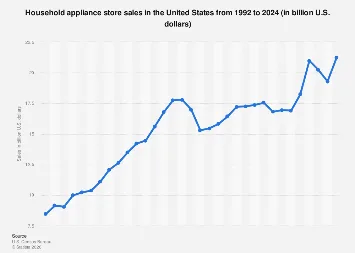
The United States household appliance retail sector has demonstrated resilience and continued expansion in the post-pandemic era, with sales reaching an estimated $***** billion in 2024. This figure represents a notable increase of nearly $2 billion compared to the preceding year, signaling sustained consumer demand for home essentials and upgrades. While the extraordinary surge experienced in 2021, driven by pandemic-related lifestyle shifts and stimulus measures, has naturally moderated, the market is now charting a course of steady, albeit less explosive, growth.
This sustained upward trajectory underscores the fundamental importance of household appliances in American homes, transcending economic fluctuations. Factors contributing to this ongoing demand include an aging housing stock requiring replacements, a persistent desire for energy-efficient and technologically advanced models, and the ongoing trend of home renovation and improvement projects. Furthermore, demographic shifts, such as an increasing number of households, also play a significant role in bolstering the market.
The period between 1992 and 2024 has witnessed significant transformations in the U.S. appliance market. Early years were characterized by more basic functionality and a slower pace of innovation. However, the advent of digital technologies, growing environmental consciousness, and evolving consumer expectations have spurred a rapid evolution in product offerings. Today’s appliances are not only more energy-efficient, often carrying ENERGY STAR certifications, but also boast smart capabilities, allowing for remote control, diagnostics, and integration into broader home automation systems. This technological integration has become a key differentiator and a significant driver of sales for higher-end models.
The COVID-19 pandemic acted as a powerful, albeit temporary, catalyst for the appliance market. Lockdowns and the widespread shift to remote work meant consumers spent more time at home, leading to an increased focus on home comfort, functionality, and aesthetics. This resulted in a surge in demand for everything from refrigerators and washing machines to ovens and dishwashers, as people invested in upgrading their living spaces. Retailers reported unprecedented sales figures during this period, with many struggling to keep up with inventory due to supply chain disruptions.
While 2024’s growth is more measured than the pandemic peak, it reflects a healthy and maturing market. The nearly $2 billion increase from the previous year indicates that consumers are still willing to invest in their homes. This growth can be attributed to several underlying economic and social trends. For instance, a stable, albeit sometimes fluctuating, employment market provides consumers with the disposable income necessary for significant purchases. Additionally, the increasing availability of flexible financing options and buy-now-pay-later schemes can make higher-priced appliances more accessible to a broader segment of the population.
Market analysts point to the replacement cycle as a consistent driver of sales. Many appliances have a lifespan of 10-15 years, and a substantial portion of the U.S. housing stock falls within or beyond this range, necessitating regular upgrades. Moreover, the push for greater energy efficiency, driven by both environmental concerns and the desire to reduce utility bills, encourages consumers to replace older, less efficient models even when they are still functional. Government incentives and utility rebates for purchasing energy-efficient appliances can further stimulate this replacement demand.
Geographically, the U.S. appliance market is diverse, with regional variations in consumer preferences and purchasing power. However, national trends tend to dominate, influenced by macroeconomic conditions and broad consumer sentiment. The retail landscape itself has also evolved, with a significant shift towards online sales channels complementing traditional brick-and-mortar stores. While physical showrooms remain crucial for consumers to experience products firsthand, e-commerce platforms offer convenience, wider selection, and competitive pricing, playing an increasingly vital role in the overall sales equation.
Looking ahead, the U.S. household appliance market is expected to continue its growth trajectory, albeit at a more sustainable pace. Key factors that will shape future sales include ongoing technological innovation, particularly in the realm of smart home integration and artificial intelligence; increasing consumer focus on sustainability and eco-friendly products; and the broader economic climate, including inflation rates, interest rates, and consumer confidence.
The industry is also grappling with evolving supply chain dynamics, learning from the disruptions experienced during the pandemic. Manufacturers and retailers are investing in more resilient supply chains, diversifying sourcing, and exploring localized production to mitigate future risks. This focus on operational efficiency and adaptability will be crucial for maintaining sales momentum and profitability.
Furthermore, the competitive landscape is intense, with both established global brands and emerging players vying for market share. Differentiation through product innovation, customer service, and sustainable practices will be key to success. The increasing consumer awareness of the environmental impact of products also presents an opportunity for brands that can demonstrate a commitment to sustainability throughout their product lifecycle.
In conclusion, the U.S. household appliance retail market is demonstrating robust health, characterized by steady sales growth that has surpassed pre-pandemic levels. While the exceptional circumstances of 2021 have subsided, the market’s underlying drivers – replacement cycles, technological advancements, energy efficiency demands, and evolving consumer lifestyles – continue to fuel its expansion. As the industry navigates ongoing economic shifts and technological innovations, its resilience and adaptability suggest a promising future, solidifying its position as a vital sector within the broader U.S. economy.