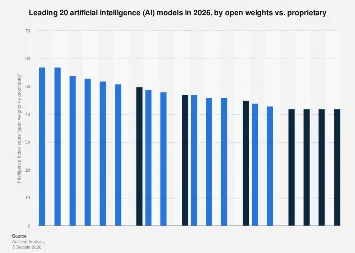
The artificial intelligence sector is poised for a significant transformation by 2026, with the prevailing debate centering on the accessibility of AI model weights – the crucial parameters that define a model’s capabilities. A projected analysis indicates that leading AI models will be assessed across a comprehensive "intelligence index" encompassing reasoning, knowledge acquisition, mathematical prowess, and coding proficiency. Early indications suggest that models like Google’s Gemini Pro Preview, alongside OpenAI’s GPT-4 and GPT-4 Codex, are set to dominate these rankings, showcasing advanced overall intelligence. This burgeoning landscape is increasingly bifurcating into two primary development paradigms: proprietary models, developed and controlled by specific entities, and those with open weights, offering greater transparency and collaborative potential. Understanding this dichotomy is critical for investors, researchers, and businesses navigating the future of AI.
The distinction between proprietary and open-weight models has profound implications for innovation, market competition, and the democratization of AI technology. Proprietary models, often the result of substantial private investment and extensive research and development within corporations, typically offer highly refined performance and specialized applications. Companies like OpenAI, Google DeepMind, and Anthropic are at the forefront of developing these closed-source systems, where the underlying architecture and training data are closely guarded secrets. This approach allows for a tightly controlled user experience, robust security measures, and the ability to monetize AI services directly through subscriptions or API access. However, it also limits external scrutiny, potentially fostering vendor lock-in and concentrating AI power within a few large organizations.
Conversely, the open-weight movement represents a significant shift towards a more collaborative and accessible AI ecosystem. Projects that release their model weights allow researchers and developers worldwide to inspect, modify, and build upon their foundational AI capabilities. This fosters rapid iteration, encourages diverse applications, and can significantly lower the barrier to entry for smaller entities and academic institutions. The economic benefits of open-weight models are manifold. They can spur a vibrant secondary market for fine-tuned models, specialized applications, and consulting services. Furthermore, by enabling broader access to advanced AI tools, they can accelerate innovation across various sectors, from healthcare and education to manufacturing and creative industries, potentially leading to increased productivity and novel solutions to complex global challenges.
Market dynamics are already reflecting this divergence. While major tech giants continue to invest heavily in proprietary AI, a growing number of startups and research labs are embracing the open-weight philosophy. This trend is supported by the increasing availability of powerful open-source frameworks and the growing community of AI practitioners who advocate for transparency and shared progress. The economic impact of this trend is likely to be substantial. For proprietary models, the revenue streams will largely be driven by direct service provision, enterprise solutions, and licensing agreements. The market for these models will be characterized by intense competition based on performance, security, and integration capabilities.
In the realm of open-weight models, the economic ecosystem is more distributed. The value is often derived from the community that forms around a particular model, leading to innovation in areas such as hardware optimization, specialized fine-tuning for niche applications, and the development of complementary tools and platforms. This can create significant opportunities for smaller businesses and individual developers to carve out their own market share. For instance, a company might specialize in fine-tuning an open-weight large language model for legal document analysis or medical transcription, offering a cost-effective and tailored solution that might be prohibitively expensive if developed from scratch or licensed from a proprietary provider.
Global comparisons highlight the varying approaches to AI development. In regions with strong open-source traditions, such as parts of Europe and Asia, the adoption of open-weight models is often more pronounced. This can lead to a more decentralized AI landscape, fostering local innovation and reducing reliance on a few dominant international players. Conversely, in markets where intellectual property protection and centralized control are highly valued, proprietary AI solutions may see greater traction. The interplay between these two approaches will ultimately shape the global AI market, influencing investment patterns, talent migration, and the pace of technological adoption.
The development of robust benchmarks and evaluation metrics is crucial for understanding the true capabilities of AI models, regardless of their licensing. The projected "intelligence index" for 2026, which evaluates reasoning, knowledge, math, and coding, represents a move towards more comprehensive and standardized assessments. Models that excel across these diverse benchmarks will likely command significant attention and market share. For proprietary models, strong performance on these metrics validates their substantial R&D investments and justifies premium pricing. For open-weight models, high benchmark scores can attract a larger community of users and contributors, further accelerating their development and adoption.
The availability of AI model weights is not merely a technical detail; it has direct economic consequences. Open weights can democratize access to advanced AI, enabling smaller businesses and researchers to compete with larger, well-funded organizations. This can lead to a more vibrant and diverse AI market, fostering innovation and potentially driving down costs for AI-powered services. The economic impact of this democratization could be far-reaching, enabling new business models and creating opportunities for individuals and organizations that might otherwise be excluded from the cutting edge of AI development.
However, the open-weight model also presents challenges. Ensuring responsible development and deployment, mitigating potential misuse, and establishing clear guidelines for intellectual property and licensing within open-source AI communities are ongoing concerns. The rapid pace of AI advancement means that regulatory frameworks often lag behind technological capabilities. Therefore, the ethical considerations surrounding AI, particularly for widely accessible open-weight models, will require continuous attention from policymakers, developers, and the broader public.
Looking ahead to 2026 and beyond, the balance between proprietary and open-weight AI models will likely continue to evolve. Hybrid approaches, where companies offer both proprietary solutions and make certain components or older versions of their models open-source, may become increasingly common. This strategy could allow them to capture market share in both the enterprise and the developer communities, fostering a broad ecosystem around their technology. The economic implications of this evolving landscape are immense, promising significant growth and disruption across numerous industries. The decision of whether to invest in proprietary AI or to contribute to and leverage open-weight models will be a strategic imperative for businesses aiming to thrive in the AI-driven future. The competition and collaboration between these two paradigms will undoubtedly define the next era of artificial intelligence.