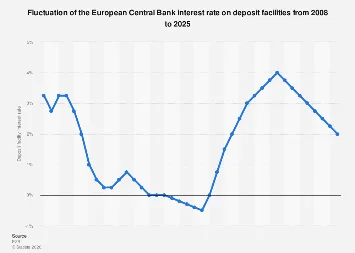
In a significant recalibration of its monetary policy, the European Central Bank (ECB) commenced a series of interest rate reductions in mid-2024, marking a departure from its preceding tightening cycle. The pivotal moment arrived in June 2024 with the first decrease in the deposit facility interest rate in over two years. This initial move, while measured, signaled a potential shift in the central bank’s strategy, moving away from its sustained campaign to combat inflation.
Following this initial adjustment, the ECB continued to fine-tune its monetary stance throughout the latter half of 2024. By October of that year, the deposit facility rate had been lowered to 3.25 percent, reflecting an incremental approach to monetary easing. This pace of adjustment was further accelerated by an additional rate cut implemented in December 2024, which brought the benchmark rate down to 3.00 percent. This trajectory indicated a growing conviction within the ECB that inflationary pressures were sufficiently abating to warrant a more pronounced easing of financial conditions.
The first half of 2025 witnessed a more aggressive phase of monetary accommodation. The ECB executed a series of four further rate cuts, demonstrating a commitment to stimulating economic activity. This cumulative reduction culminated in the deposit facility rate reaching 2.00 percent by June 2025. This significant decline from the previous year’s higher levels underscores a strategic pivot, aiming to foster investment, consumption, and overall economic growth across the Eurozone.
This period of rate reductions followed a protracted phase of aggressive rate hikes initiated by the ECB to counter surging inflation. The central bank’s approach leading up to mid-2024 was characterized by a steadfast commitment to price stability, employing its primary monetary policy tools to anchor inflation expectations. The subsequent easing cycle suggests a delicate balancing act, with the ECB now prioritizing support for economic expansion while remaining vigilant against any resurgence of inflationary pressures.
The historical trajectory of the ECB’s deposit facility rate offers a stark contrast to the preceding years. For much of the period from 2014 to mid-2022, the deposit facility rate remained in negative territory, a reflection of the ECB’s efforts to stimulate a sluggish Eurozone economy and combat deflationary risks. During this era, rates dipped as low as -0.50 percent, a move designed to incentivize banks to lend rather than hold excess reserves at the central bank. This unconventional monetary policy stance was a hallmark of the post-Global Financial Crisis era, aimed at spurring investment and consumption in an environment of persistently low inflation.
The dramatic shift occurred in July 2022, when the ECB moved the deposit facility rate back to 0 percent, ending an extended period of negative rates. This marked the beginning of a new policy regime, driven by a sharp and persistent rise in inflation across the Eurozone. The subsequent months saw a rapid succession of rate increases, moving from 0.75 percent in September 2022 to a peak of 4.00 percent by September 2023. This aggressive tightening cycle was a direct response to the highest inflation rates seen in decades, fueled by a confluence of factors including post-pandemic supply chain disruptions, energy price shocks, and strong demand.
The ECB’s decision-making process is heavily influenced by a range of economic indicators and forecasts. Key among these are inflation figures, including the Harmonised Index of Consumer Prices (HICP), which provides a standardized measure of inflation across the Eurozone. Core inflation, which excludes volatile energy and food prices, is also closely scrutinized as it offers a clearer picture of underlying price pressures. Labor market data, such as unemployment rates and wage growth, are also critical inputs, as robust wage increases can contribute to inflationary pressures.
Furthermore, the ECB monitors a wide array of economic activity indicators, including Gross Domestic Product (GDP) growth, industrial production, retail sales, and business and consumer confidence surveys. These metrics help the Governing Council assess the overall health and momentum of the Eurozone economy. The bank’s forward guidance, which communicates its intentions regarding future monetary policy, plays a crucial role in shaping market expectations and influencing financial conditions.
The impact of these interest rate adjustments extends beyond the immediate financial markets. Lower interest rates can stimulate borrowing by businesses for investment and by households for consumption, potentially boosting economic growth. For governments, lower borrowing costs can reduce the burden of debt servicing. However, a prolonged period of low rates can also lead to asset price inflation and potentially encourage excessive risk-taking in financial markets. Conversely, higher interest rates are designed to cool down an overheating economy and curb inflation, but they can also dampen economic activity and increase the cost of borrowing for businesses and consumers.
The ECB’s actions are also viewed within a global context. Other major central banks, such as the U.S. Federal Reserve and the Bank of England, have also been navigating complex inflation dynamics and adjusting their own monetary policies. Divergences in policy paths between major central banks can influence exchange rates and international capital flows. The Eurozone’s economic performance is intrinsically linked to global trade and economic trends, making international comparisons and coordination of policy responses increasingly important.
The transition from a prolonged period of ultra-loose monetary policy to a more restrictive stance, and now to a measured easing cycle, represents a significant chapter in the ECB’s history. The effectiveness of these policy shifts will be determined by their ability to achieve the ECB’s primary mandate of price stability while fostering sustainable economic growth in the Eurozone. The journey through 2024 and into 2025 demonstrates the central bank’s adaptive approach, responding to evolving economic landscapes and striving to maintain a delicate equilibrium between inflation control and economic vitality. The implications of these rate decisions will continue to be analyzed and felt across the Eurozone’s diverse economies for years to come.