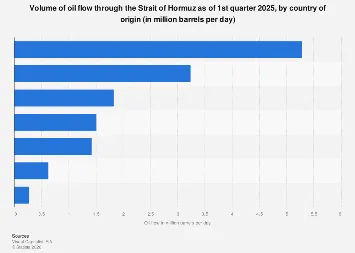
The Strait of Hormuz, a vital chokepoint for global oil supply, is projected to see significant volumes of crude oil and refined products transiting its waters in 2025. While precise figures remain dynamic, influenced by geopolitical events and evolving energy demand, analyses point to a continued reliance on this waterway for a substantial portion of the world’s seaborne oil trade. Understanding the origin of this oil is crucial for comprehending the intricate web of global energy security, international trade dynamics, and the economic health of numerous nations.
The majority of oil traversing the Strait of Hormuz originates from Persian Gulf producers, with Saudi Arabia, Iraq, the United Arab Emirates (UAE), Kuwait, and Iran being the principal exporters. Saudi Arabia, as the world’s largest oil exporter, consistently dominates this traffic. Its vast production capacity and strategic location make the Strait indispensable for reaching key markets in Asia, particularly China, India, and Japan, which are the primary destinations for its crude. In 2025, these Asian economies are expected to continue their robust demand for Middle Eastern crude, driven by industrial growth and expanding consumer bases. China, in particular, relies heavily on Middle Eastern oil for its energy needs, often sourcing a significant percentage of its imports from this region. India, similarly, views Persian Gulf crude as a cornerstone of its energy security strategy.
Iraq, despite facing internal challenges, remains a significant oil producer and exporter. Its southern oil terminals are located on the Persian Gulf, necessitating the use of the Strait of Hormuz for its exports. The country’s production levels and its ability to maintain consistent export volumes are closely watched by market analysts, as disruptions can have ripple effects on global supply. The UAE, with its substantial oil reserves and strategic port infrastructure, also plays a pivotal role. Its export terminals on the Persian Gulf, including those in Abu Dhabi and Dubai, contribute a considerable volume of oil to the global market via the Strait. Kuwait, another major OPEC producer, similarly utilizes the Strait to ship its crude to international buyers.
Iran, a unique case due to its geopolitical positioning and sanctions, also contributes to the oil flow through the Strait. The volume of Iranian oil exports can fluctuate significantly based on international sanctions regimes and the country’s ability to find buyers. However, even with potential constraints, Iran’s production capacity means its oil will continue to be a factor in the overall traffic through the waterway. The dynamics surrounding Iranian oil exports are often a barometer for broader geopolitical tensions in the region and their impact on global energy markets.
Beyond these primary producers, smaller volumes of oil also transit the Strait from countries with access to the Persian Gulf, such as Qatar, although Qatar’s primary focus in recent years has shifted towards liquefied natural gas (LNG) exports. Nevertheless, any crude oil or refined products originating from these Gulf states will utilize this critical maritime route.
The economic implications of oil transit through the Strait of Hormuz are profound. It is estimated that approximately 20-30% of the world’s total oil consumption, and a significant portion of global LNG trade, passes through this narrow waterway. In 2025, the reliable flow of this oil is essential for maintaining global economic stability. Disruptions, whether due to geopolitical conflict, military posturing, or accidents, could lead to severe price volatility, impacting inflation rates, manufacturing costs, and consumer spending worldwide. The energy security of major importing nations is directly tied to the uninterrupted passage of tankers through the Strait.
Market analysts and international energy agencies closely monitor the projected oil flow volumes by origin to forecast global supply and demand balances. This data informs investment decisions in the energy sector, influences the strategies of oil-producing nations, and guides the energy policies of importing countries. For instance, projections of increased demand from emerging Asian economies necessitate sustained or increased supply from the Persian Gulf, reinforcing the strategic importance of the Strait of Hormuz. Conversely, a global economic slowdown could temper demand, potentially leading to reduced transit volumes, although the strategic importance of the Strait would remain undiminished.
The geopolitical landscape surrounding the Strait of Hormuz is complex and often volatile. Tensions between Iran and its regional rivals, coupled with the presence of international naval forces, create a constant undercurrent of risk. The potential for miscalculation or escalation is a persistent concern for global energy markets. Any perceived threat to the Strait’s security can trigger immediate market reactions, with oil prices spiking even in the absence of actual supply disruptions. This sensitivity underscores the critical role of diplomacy and de-escalation efforts in ensuring the continued free flow of oil.
Furthermore, the global energy transition, while a long-term trend, is unlikely to significantly diminish the importance of the Strait of Hormuz by 2025. While renewable energy sources are gaining traction, fossil fuels, particularly oil, will remain a dominant component of the global energy mix for the foreseeable future. The demand for oil in transportation, petrochemicals, and various industrial applications will continue to necessitate significant production and trade, with the Persian Gulf remaining a primary source. Therefore, the origin of oil transiting the Strait will continue to be a critical economic and geopolitical factor.
The projections for 2025 also implicitly account for the ongoing investments in production capacity by major Gulf producers. Saudi Arabia, for example, has consistently aimed to maintain significant spare production capacity, which can be deployed to stabilize markets or meet increased demand. Similar investments are being made by other Gulf states, aiming to bolster their export capabilities. These investments are directly linked to the assumption of continued access to international markets via the Strait of Hormuz.
In conclusion, the origin of oil flowing through the Strait of Hormuz in 2025 will predominantly be the major oil-producing nations of the Persian Gulf, led by Saudi Arabia. The volume and origin of this traffic are not merely statistical data points; they represent the lifeblood of the global economy, influencing everything from commodity prices to international relations. As the world navigates an increasingly complex energy landscape, understanding the dynamics of this critical maritime artery and the sources of its vital cargo remains paramount for policymakers, businesses, and consumers alike. The strategic significance of the Strait of Hormuz, and the oil that flows through it, will undoubtedly continue to shape global energy security and economic stability in the years to come.