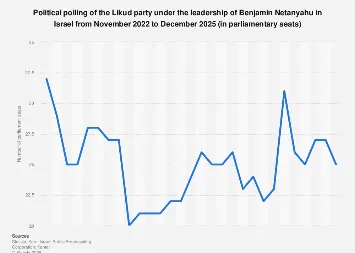
A recent political survey conducted in Israel in December 2025 suggests that the Likud party, under the leadership of Prime Minister Benjamin Netanyahu, would secure an estimated 30 seats in the 120-member Knesset if an election were held at that juncture. This projection represents a slight dip from a comparable poll conducted in November 2025, which indicated a potential for 32 seats. The fluctuations in these figures, while seemingly minor, underscore the dynamic and often volatile nature of Israeli public opinion and the ongoing challenges facing the ruling party as it approaches future electoral contests.
The latter half of 2025 appeared to witness a temporary surge in support for Likud, peaking in June. This uptick was largely attributed by analysts to a perceived strong performance by Prime Minister Netanyahu during the intense, 12-day military confrontation between Israel and Iran. This period, marked by significant regional tensions and direct engagement, seemingly resonated with a segment of the electorate, bolstering the party’s standing to its highest point since the preceding general elections. Such a response highlights the potent influence of national security issues and perceived leadership efficacy on electoral outcomes in Israel, a nation consistently navigating a complex geopolitical environment.
Looking back, the 2022 national parliamentary elections saw the Likud party emerge as the largest bloc in the Knesset, securing 32 seats. This victory paved the way for Prime Minister Netanyahu to assemble a right-wing coalition government, a testament to the party’s enduring appeal among a significant portion of the Israeli electorate. However, the landscape shifted dramatically following the devastating Hamas attacks on October 7, 2023. In the immediate aftermath of this unprecedented security breach, public sentiment, as reflected in various polls, indicated a notable decline in support for the Likud party, reaching its nadir during that period. This period of reduced confidence underscores the profound impact of major security crises on public perception of the incumbent government’s competence and leadership.
The Israeli political system, characterized by a proportional representation electoral model, inherently fosters coalition governments. This necessitates intricate negotiations and often fragile alliances between diverse parties. The Likud party, a cornerstone of the Israeli right-wing political spectrum, has historically played a pivotal role in shaping these coalitions. Its electoral performance, therefore, is not merely a measure of its individual popularity but also a significant indicator of the potential configurations of future governments and the broader political direction of the country. The ability to secure and maintain a stable majority in the Knesset has consistently been a defining challenge for any Israeli prime minister, particularly for Netanyahu, who has navigated these complexities for decades.
Examining the electoral trends within the context of broader economic and social factors provides a more comprehensive understanding of Likud’s standing. While national security often dominates the headlines, domestic economic policies, social cohesion, and the ongoing debate surrounding judicial reform have also been significant drivers of public sentiment. The Israeli economy, a robust and technologically advanced sector, has demonstrated resilience in the face of regional instability. However, inflation, cost of living pressures, and the distribution of economic prosperity remain key concerns for many voters. Policies addressing these issues, alongside the contentious judicial overhaul agenda, have consistently fueled public discourse and influenced party allegiances.
Globally, the trend of incumbent parties facing scrutiny during periods of protracted conflict is not unique to Israel. Many nations experience a ‘rally around the flag’ effect in the initial stages of a crisis, followed by increased criticism and demands for accountability as the conflict evolves or its domestic consequences become more apparent. The Israeli situation, however, is amplified by the deeply entrenched historical and political narratives that shape national identity and security perceptions. The perceived success during the Israel-Iran confrontation, therefore, likely tapped into these deeply held sentiments, providing a temporary boost to the government’s image.
The analysis of polling data requires a nuanced approach. Polls are snapshots in time, reflecting the prevailing mood and immediate reactions to events. They are influenced by methodology, sample size, and the specific questions asked. Therefore, while the December 2025 figures suggest a slight softening of support for Likud compared to the November peak, they do not necessarily portend a definitive electoral outcome. The actual performance in a future election will depend on a multitude of factors, including the unfolding geopolitical situation, the effectiveness of opposition parties, and the campaign strategies employed by all political actors.
The economic impact of regional conflicts on Israel is multifaceted. While periods of heightened tension can disrupt investment and tourism, the country’s strong technological sector and its robust defense industry often demonstrate a degree of insulation. However, sustained conflict or increased military spending invariably places a strain on public finances and can divert resources from other critical areas such as social services and infrastructure development. The government’s ability to manage these economic pressures while addressing security concerns is a crucial element in maintaining public confidence.
Furthermore, the internal political dynamics within the Likud party itself, and the broader coalition landscape, are critical considerations. The retirement of long-standing leaders, the emergence of new political figures, and the shifting priorities of coalition partners can all influence the party’s electoral prospects. The ideological spectrum within Israeli politics is broad, and the ability of the Likud to maintain its coalition partners and appeal to a diverse electorate remains a constant challenge.
In conclusion, the electoral fortunes of the Likud party are intricately linked to the complex interplay of national security, economic performance, and domestic political considerations. The fluctuations observed in recent polling data highlight the inherent unpredictability of the Israeli political arena. While the perceived success during the Israel-Iran conflict provided a temporary uplift, the party, like any incumbent, faces ongoing scrutiny and the challenge of navigating a perpetually evolving regional and domestic landscape. The coming months and years will undoubtedly reveal whether Likud can consolidate its support and translate these poll numbers into tangible electoral success, or if the shifting sands of Israeli public opinion will lead to a different political configuration.