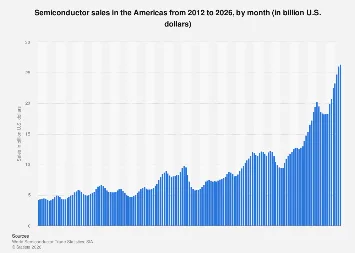
The semiconductor market in the Americas is projecting a robust recovery, with early 2026 data indicating a substantial uptick in sales compared to the preceding year. In January 2026, the region’s semiconductor sales are estimated to reach $26.38 billion USD. This figure represents a notable increase from the $19.54 billion USD recorded for the same month in 2025, signaling a renewed surge in demand for crucial electronic components across the North and South American continents. Globally, January 2026 semiconductor sales are projected to hit $82.54 billion USD, with the Americas contributing a significant portion to this worldwide total.
This projected growth in the Americas is not an isolated event but part of a broader, dynamic global semiconductor landscape. The industry, often characterized by its cyclical nature and susceptibility to macroeconomic shifts, has been navigating a period of adjustment following a period of unprecedented demand and subsequent supply chain challenges. The figures for early 2026 suggest that the market is not only recovering but potentially entering a new phase of expansion.
Analyzing the monthly sales trajectory provides a granular view of this anticipated recovery. Following a projected $26.07 billion in December 2025, the market is expected to maintain its upward momentum into January 2026. This sustained performance through the year-end and into the new year underscores a strengthening demand across various sectors reliant on semiconductor technology. The preceding months of 2025 also show a gradual but consistent increase, moving from $18.33 billion in June to $26.38 billion by January 2026. This trend indicates a healthy recovery trajectory throughout the latter half of 2025.
The semiconductor industry is the bedrock of the modern digital economy, powering everything from consumer electronics and automotive systems to advanced artificial intelligence and telecommunications infrastructure. The health of the Americas market, in particular, is critical given the region’s significant role in technological innovation, manufacturing, and consumption. Key players in the automotive sector, which has been increasingly integrating sophisticated electronic systems, are significant drivers of demand. Similarly, the burgeoning artificial intelligence industry, with its insatiable appetite for high-performance processors, is a major catalyst for growth. The ongoing expansion of cloud computing and data centers also continues to underpin the demand for memory and logic chips.
The historical data paints a picture of this market’s resilience and its inherent volatility. From a baseline of approximately $4.31 billion in January 2012, sales in the Americas have seen considerable fluctuations. The period between 2012 and 2016 saw a relatively steady, albeit modest, growth. However, the market experienced a more pronounced expansion in the years leading up to 2022, with monthly sales frequently exceeding $11 billion and even touching over $12 billion in late 2022. This period of strong growth was followed by a correction, with sales dipping in early 2023, reflecting global economic headwinds and a recalibration of inventory levels by manufacturers and their customers.
The projected figures for 2024 and 2025 suggest a clear recovery from the mid-2023 trough. For instance, sales in January 2024 are projected at $12.78 billion, a significant increase from the $10.51 billion in January 2023. This trend is expected to accelerate through 2024 and 2025, with monthly sales steadily climbing. By December 2025, sales are anticipated to reach $26.07 billion, setting the stage for the $26.38 billion mark in January 2026. This substantial year-over-year growth rate highlights a robust rebound, driven by pent-up demand and the continuous innovation within the semiconductor ecosystem.
Several factors are likely contributing to this optimistic outlook. Firstly, the ongoing digitalization across industries is creating sustained demand for semiconductors. Businesses are investing heavily in upgrading their IT infrastructure, adopting cloud solutions, and enhancing their operational efficiency through automation and data analytics, all of which require advanced chips. Secondly, the automotive industry’s transformation towards electric vehicles and autonomous driving systems is a significant long-term growth driver. These vehicles rely on a far greater number and complexity of semiconductors compared to traditional internal combustion engine cars.
Furthermore, government initiatives in the Americas, such as those aimed at bolstering domestic semiconductor manufacturing and research and development, are beginning to yield results. Investments in building new fabrication plants (fabs) and fostering a more resilient supply chain are crucial for long-term stability and growth. The strategic importance of semiconductors has been highlighted by recent geopolitical events, prompting nations to prioritize self-sufficiency and reduce reliance on single sources. This has spurred increased investment and focus on the semiconductor sector within the Americas.
The consumer electronics market, while often susceptible to discretionary spending fluctuations, also plays a vital role. The release of new generations of smartphones, laptops, gaming consoles, and other smart devices consistently drives demand for processors, memory, and specialized chips. The ongoing evolution of technologies like 5G, the Internet of Things (IoT), and augmented/virtual reality (AR/VR) also necessitates more powerful and efficient semiconductor solutions.
Economists and industry analysts are closely watching the interplay of these factors. The projected sales figures for early 2026 suggest that the semiconductor industry in the Americas is not only overcoming recent challenges but is poised for a period of significant expansion. This growth is critical not only for the semiconductor companies themselves but also for the myriad of industries that depend on their products. A thriving semiconductor sector can translate into job creation, increased exports, and enhanced technological competitiveness for the region on the global stage. The consistent month-over-month increases anticipated from mid-2024 through early 2026 point towards a sustainable recovery, rather than a short-lived spike, indicating a healthy underlying demand that is expected to continue propelling the market forward.