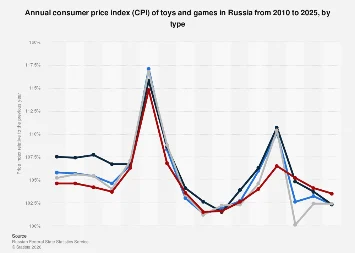
The landscape of consumer goods pricing is perpetually influenced by a complex interplay of economic forces, and Russia’s toy and game sector is no exception. As businesses and consumers alike peer into the near future, understanding projected price index movements for this specific market segment in 2025 becomes crucial for strategic planning, inventory management, and consumer purchasing decisions. While precise figures often necessitate specialized data subscriptions, the general trajectory of price inflation for toys and games in Russia can be inferred from broader economic indicators and an analysis of sector-specific drivers.
Several macroeconomic factors are expected to shape the price index of toys and games in Russia throughout 2025. Foremost among these is the overall inflation rate within the Russian Federation. Consumer price inflation, a key barometer of the general price level of goods and services, has seen fluctuations in recent years, impacted by global supply chain disruptions, geopolitical events, and domestic monetary policy. If inflation remains elevated, it will naturally exert upward pressure on the cost of producing and distributing toys and games, translating into higher retail prices. International organizations, such as the International Monetary Fund (IMF) and the World Bank, provide forecasts for Russian inflation, which offer a foundational understanding of the economic climate. For instance, a projected inflation rate of 4-6% for 2025, if realized, would suggest a commensurate increase in the average price of goods, including those in the toy and game sector.
Beyond general inflation, the specific dynamics of the toy and game industry present additional price determinants. The cost of raw materials is a significant component. Many toys and games are manufactured using plastics, metals, and textiles, the prices of which are subject to global commodity market fluctuations. The price of crude oil, for example, directly impacts the cost of petrochemicals used in plastic production. Similarly, the cost of lumber can affect wooden toy manufacturing. Any sustained increase in these input costs will inevitably be passed on to consumers.
Furthermore, supply chain logistics play a pivotal role. The global nature of toy manufacturing means that components may be sourced from various countries, and finished products are often shipped across continents. Shipping costs, influenced by fuel prices, container availability, and port congestion, can add substantially to the final price. Russia’s reliance on imports for a significant portion of its toy and game offerings means that global shipping trends will have a direct bearing on domestic prices. Disruptions, whether due to natural disasters, trade disputes, or public health crises, can lead to temporary or prolonged price spikes.
The currency exchange rate between the Russian Ruble and major international currencies, such as the US Dollar and the Euro, is another critical factor. A weaker Ruble makes imported toys and games more expensive for Russian consumers. Conversely, a stronger Ruble can mitigate some of the inflationary pressures on imported goods. The geopolitical climate and its impact on international trade and financial markets are key drivers of currency stability. Fluctuations in the Ruble’s value throughout 2025 will therefore be a significant determinant of the price index for imported toys and games, which constitute a substantial segment of the Russian market.
Domestic production costs also contribute to the price index. Labor costs, energy prices, and regulatory compliance expenses within Russia will influence the pricing of locally manufactured toys and games. While Russia has been making efforts to bolster domestic manufacturing capabilities in various sectors, the toy and game industry’s reliance on imported components and designs means that global trends often outweigh purely domestic cost factors.
Analyzing the price index by specific categories within the toy and game market can reveal nuanced trends. For instance, electronic toys and games, which often incorporate advanced microchips and components, are more susceptible to global semiconductor shortages and the rapidly evolving technological landscape. This can lead to higher price volatility compared to simpler, non-electronic toys. Similarly, licensed merchandise, such as toys based on popular movie franchises or cartoon characters, may command premium pricing due to licensing fees and perceived brand value. The demand for these specific items, influenced by entertainment release schedules and consumer trends, can lead to price variations independent of broader economic inflation.
The market for board games and puzzles, often characterized by more stable manufacturing processes and less reliance on advanced technology, might exhibit more modest price increases, primarily driven by material and labor costs. However, the growing popularity of complex strategy board games and collectible card games could introduce niche pricing dynamics based on demand and collector value.
In terms of potential market size and value, the Russian toy and game market has demonstrated resilience. Pre-pandemic data indicated a steady growth trajectory, driven by a young population and increasing disposable incomes in certain segments. While the economic climate has presented challenges, the fundamental demand for play and entertainment among children remains robust. Industry reports, often compiled by market research firms specializing in consumer goods, would typically provide a breakdown of market value by product category and projected growth rates. For 2025, these reports would likely forecast a subdued but positive growth in market value, with price increases being a significant contributor to this nominal growth, especially if real consumer spending power does not keep pace.
Global comparisons offer further context. Many developed and emerging economies have faced similar inflationary pressures in their consumer goods sectors. Countries in Eastern Europe, for instance, often share similar economic sensitivities to commodity prices and currency fluctuations. Examining the price index trends for toys and games in comparable markets, such as Poland or Turkey, could provide an indicative range for potential price movements in Russia, adjusted for local economic conditions. For example, if similar markets are projecting a 7-10% price increase in the toy sector due to a combination of inflation and supply chain costs, it would suggest that Russia could experience a similar or potentially higher magnitude of increase, depending on its specific economic vulnerabilities.
The economic impact of these projected price increases is multifaceted. For consumers, rising toy and game prices can reduce purchasing power, forcing families to prioritize essential goods and potentially cutting back on discretionary spending on entertainment and educational items. This could disproportionately affect lower-income households. For manufacturers and retailers, managing price increases while maintaining sales volume is a significant challenge. They may need to explore cost-saving measures, such as optimizing supply chains, sourcing materials more efficiently, or diversifying their product offerings to include more budget-friendly options.
The role of e-commerce in the Russian toy and game market is also relevant to pricing. Online platforms often offer competitive pricing due to lower overheads compared to brick-and-mortar stores. However, the cost of delivery, particularly in a vast country like Russia, can add to the final price. The growth of e-commerce suggests that price transparency will increase, potentially putting pressure on retailers to remain competitive.
Looking ahead to 2025, the price index for toys and games in Russia will likely be characterized by a gradual upward trend, driven by a combination of persistent global inflation, volatile commodity prices, currency fluctuations, and the ongoing adjustments within global supply chains. While specific percentages require access to proprietary market data, the economic forces at play suggest that consumers should anticipate higher prices across various toy and game categories. Businesses, in turn, will need to navigate this environment with strategic pricing, efficient operations, and a keen understanding of evolving consumer demand. The resilience of the toy and game sector, rooted in the enduring importance of childhood development and play, will be tested as it adapts to these evolving economic realities.