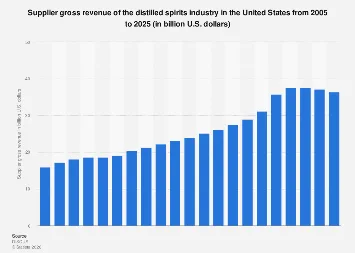
The U.S. distilled spirits industry, a significant contributor to the American economy, is projected to experience a notable recalibration in its supplier gross revenue trajectory. Following an extended period of robust expansion, market data suggests a shift towards a more subdued revenue environment, with projections indicating a potential downturn beginning in 2022 and continuing through 2025. This forecast signals a critical juncture for an industry accustomed to consistent year-over-year gains, necessitating a deeper examination of the underlying economic forces at play and their implications for stakeholders across the value chain.
For nearly two decades, the U.S. spirits market has demonstrated remarkable resilience and growth. From 2005 onwards, supplier gross revenue consistently climbed, reflecting increasing consumer demand, evolving taste preferences, and the successful introduction of new products and premium offerings. This expansion was fueled by a confluence of factors, including a growing millennial demographic entering legal drinking age with a penchant for craft and premium spirits, a burgeoning cocktail culture, and effective marketing strategies by major distillers and importers. The sector’s ability to innovate, adapt to changing consumer trends, and navigate regulatory landscapes has been instrumental in its sustained success.
However, the landscape is showing signs of change. While specific figures for 2025 remain subject to granular analysis and are often subject to revisions based on real-time market performance, the overarching trend indicated by industry analysis points to a deceleration. The period leading up to 2022 was characterized by strong, predictable growth. Post-2022, however, a discernible trend suggests that the market may be reaching a plateau, or even entering a phase of modest contraction in terms of nominal gross revenue. This shift, if it fully materializes, represents a significant departure from the consistent upward momentum observed for years.
Several macroeconomic and industry-specific factors could be contributing to this projected revenue recalibration. Inflationary pressures, for instance, have impacted consumer spending power across various sectors. While premium spirits often exhibit a degree of price inelasticity, sustained high inflation can eventually affect discretionary spending, leading consumers to re-evaluate their purchasing habits, potentially trading down or reducing consumption frequency. Furthermore, shifts in consumer preferences, such as a growing interest in non-alcoholic beverages or a renewed focus on at-home consumption versus on-premise dining and drinking, could also influence overall sales volumes and revenue.
The competitive dynamics within the spirits industry itself are also evolving. The proliferation of craft distilleries and the increasing diversity of product offerings have intensified competition. While this innovation is generally beneficial for consumers, it can also lead to market fragmentation and put pressure on established brands to maintain market share and revenue growth. The rise of ready-to-drink (RTD) beverages, encompassing a wide range of alcoholic and non-alcoholic options, presents both an opportunity and a challenge, potentially diverting some consumer spending away from traditional spirits categories.
Globally, the U.S. spirits market is one of the largest and most influential. Its performance often serves as a bellwether for the broader alcoholic beverage industry. While other major markets, such as Europe and parts of Asia, have their own unique growth drivers and challenges, the U.S. market’s size and sophistication mean that any significant shifts here have ripple effects. For example, global supply chain disruptions, which have affected numerous industries, can also impact the cost of raw materials, production, and distribution for spirits, indirectly influencing supplier revenues.
From an economic impact perspective, the distilled spirits industry is a substantial employer and taxpayer. It supports jobs in agriculture (for grains, fruits, and botanicals), manufacturing, packaging, logistics, marketing, and retail. A slowdown in revenue growth could translate into slower job creation, reduced investment in capacity expansion, and potentially lower contributions to government revenue through excise taxes and corporate taxes. However, it is important to note that the industry’s resilience often means that even periods of slower growth can still represent substantial economic activity.
Industry analysts suggest that the projected revenue trends are not necessarily indicative of a terminal decline but rather a maturation of the market. After years of rapid expansion, it is natural for growth rates to moderate. The focus for companies will likely shift from aggressive volume growth to optimizing profitability, enhancing brand equity, and strategically targeting specific consumer segments that continue to exhibit strong demand for premium and differentiated products. Innovation in product development, such as the introduction of sustainable packaging, low-calorie options, or unique flavor profiles, will remain crucial.
Moreover, the on-premise versus off-premise sales dynamic remains a critical indicator. While the pandemic significantly boosted off-premise sales, the ongoing recovery of bars and restaurants is likely to influence overall revenue. The interplay between these channels, alongside evolving consumer habits regarding social gatherings and entertainment, will be a key determinant of future revenue performance.
The projected shift in the U.S. spirits industry’s revenue trajectory underscores the dynamic nature of consumer markets. While the prolonged period of growth has been a hallmark of the sector, the anticipated moderation highlights the importance of strategic agility, market foresight, and a deep understanding of evolving consumer behaviors. Companies that can effectively navigate these changing tides, by focusing on value creation, targeted innovation, and operational efficiency, are best positioned to thrive in the years ahead. The industry’s ability to adapt will be the ultimate measure of its continued success and its contribution to the broader economic landscape.