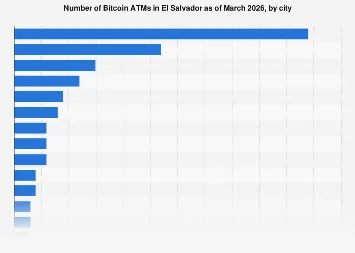
As El Salvador continues its ambitious journey integrating Bitcoin as legal tender, the nation’s digital currency infrastructure is poised for significant expansion. Projections for March 2026 indicate a growing network of Bitcoin Automated Teller Machines (ATMs) across its cities, signaling a deepening adoption of cryptocurrency for everyday transactions. While precise figures for every municipality remain under detailed observation, the trend points towards a strategic deployment designed to facilitate easier access to Bitcoin for both citizens and tourists. This development is a critical component of the government’s broader strategy to foster financial inclusion, attract foreign investment, and modernize its economic landscape.
The rollout of Bitcoin ATMs represents a tangible step in bridging the gap between traditional financial systems and the burgeoning world of digital assets. These machines offer a crucial on-ramp and off-ramp for individuals looking to convert fiat currency into Bitcoin and vice versa, bypassing some of the complexities often associated with online cryptocurrency exchanges. For a nation that has historically faced challenges with remittance flows and banking access for a segment of its population, the proliferation of these ATMs could democratize financial services, enabling more seamless and cost-effective ways to send and receive money.
The strategic placement of these ATMs is paramount to their success. While specific city-by-city data for March 2026 is a forward-looking projection, the general approach is expected to focus on areas with higher population density, significant tourist traffic, and economic activity. Major urban centers such as the capital, San Salvador, are likely to be primary hubs, boasting a concentration of these machines to serve a larger user base. Beyond the capital, other key cities and towns with active commercial districts, transportation hubs, and popular tourist destinations are anticipated to see a substantial presence. This distributed approach aims to ensure that a significant portion of the population can access Bitcoin services within a reasonable proximity.
The underlying data, as of the March 2026 projection, is derived from operator self-reporting, a methodology that acknowledges potential limitations. While operators are encouraged to provide comprehensive data, there’s an inherent possibility that not every single ATM, especially those operated by smaller entities or individual entrepreneurs, may be captured in official tallies. This caveat underscores the dynamic nature of the cryptocurrency ecosystem, where innovation and deployment can occur rapidly. Nevertheless, the available data provides a valuable snapshot of the intended and operational network.
El Salvador’s embrace of Bitcoin is not merely a technological experiment; it is a carefully considered economic policy. The nation became the first country in the world to adopt Bitcoin as legal tender in September 2021. This bold move was accompanied by the launch of the Chivo wallet, a government-backed digital wallet that also facilitates Bitcoin transactions and provides access to Bitcoin ATMs. The integration of these ATMs into the national financial fabric is intended to complement the Chivo wallet, creating a robust ecosystem where Bitcoin can be used for remittances, daily purchases, and savings.
The economic implications of this strategy are multifaceted. On one hand, proponents argue that Bitcoin adoption can significantly reduce remittance costs, a vital source of income for many Salvadoran families. Traditional remittance services can be expensive, with fees often eroding a substantial portion of the transferred amount. By facilitating Bitcoin remittances, El Salvador aims to put more money back into the hands of its citizens. Furthermore, the nation hopes to attract foreign direct investment from cryptocurrency businesses and enthusiasts, positioning itself as a hub for blockchain innovation.
However, the initiative is not without its challenges and critics. Volatility in Bitcoin’s price is a primary concern, raising questions about its stability as a currency for everyday transactions and as a store of value. The technical infrastructure required to support a widespread Bitcoin ATM network also presents an ongoing challenge, including reliable internet connectivity and electricity access in all areas. Moreover, regulatory frameworks surrounding cryptocurrency are still evolving globally, and El Salvador’s pioneering approach necessitates continuous adaptation and refinement of its own policies to ensure consumer protection and financial stability.
Globally, El Salvador’s Bitcoin ATM network stands out. While other countries have seen a rise in Bitcoin ATMs, the scale and the national legal tender status in El Salvador create a unique case study. The country’s experience is closely watched by other developing nations exploring digital currencies as a means to leapfrog traditional financial infrastructure limitations. The success or challenges encountered in El Salvador could inform policy decisions and adoption strategies elsewhere. For instance, countries with high remittance inflows and a significant unbanked population might find parallels and lessons in the Salvadoran experiment.
The projected growth in Bitcoin ATMs by 2026 suggests a sustained commitment from the Salvadoran government and a gradual, yet determined, increase in user adoption. As more machines become operational across a wider array of cities, the convenience factor for users will undoubtedly rise. This increased accessibility could lead to a broader spectrum of use cases, moving beyond remittances to encompass everyday retail transactions, micro-payments, and potentially even tourism-related spending, where visitors can utilize Bitcoin for services and purchases.
The data points, though preliminary for the 2026 horizon, are indicative of a strategic plan. The intention is to embed Bitcoin into the daily economic life of Salvadorans. This involves not just the physical presence of ATMs but also the education and awareness campaigns necessary to foster trust and understanding of cryptocurrency. The government’s role in this process is crucial, ensuring that citizens are equipped with the knowledge to navigate the digital currency landscape safely and effectively.
In conclusion, the projected expansion of Bitcoin ATMs across El Salvador by March 2026 signifies a critical phase in the nation’s embrace of digital currency. While the exact distribution across every city remains a point of ongoing development and data collection, the overarching trend points towards a deliberate effort to enhance accessibility and integration. This initiative, rooted in the ambition to foster financial inclusion and modernize the economy, serves as a prominent global experiment in national cryptocurrency adoption, the outcomes of which will continue to be a subject of intense economic and financial scrutiny. The interplay between technological advancement, regulatory adaptation, and public acceptance will ultimately determine the long-term success of El Salvador’s unique digital currency strategy.