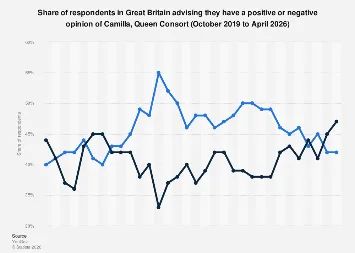
As the United Kingdom navigates a new era under King Charles III, the public perception of Queen Camilla remains a subject of keen interest, reflecting broader societal attitudes towards the monarchy and its evolving role. Recent data, tracking opinions from October 2019 through projections to April 2026, offers a nuanced portrait of her standing among the British public, illustrating a period of significant transition and adjustment. While her favorability ratings have shown fluctuations, the overarching trend suggests a gradual, albeit sometimes challenging, consolidation of her public image.
The data reveals that in October 2019, prior to the full embrace of her role as Queen Consort (and later Queen), Camilla’s net approval stood at a modest 40% positive versus 44% negative. This initial period was marked by a segment of the population still processing her integration into the royal family’s core narrative. However, a discernible upward trajectory began to emerge in the months that followed. By January 2020, positive opinions had climbed to 42%, with negative sentiment receding to 37%. This period, characterized by a more consistent public presence and engagement, appeared to lay groundwork for a more favorable reception.
The year 2020, despite its global challenges, saw a modest but steady increase in positive sentiment, reaching 44% by October. This suggests that her public duties and perceived resilience during a turbulent year resonated with a portion of the electorate. The early months of 2021, however, presented a slight dip, with positive opinions falling to 40% in March, accompanied by a rise in negative views to 45%. This could be attributed to various factors, including the ongoing pandemic’s impact on public discourse and perhaps a re-evaluation of royal roles in a time of national crisis.
A significant turning point appears to have occurred in early 2022. By February of that year, positive opinions had surged to 49%, with negative sentiment dropping to 38%. This dramatic shift likely correlates with the lead-up to Queen Elizabeth II’s Platinum Jubilee and the increasing anticipation of her becoming Queen Consort. The public’s focus on the continuity and future of the monarchy may have contributed to a more charitable view of its key figures. The September 2022 period, immediately following Queen Elizabeth II’s passing and Charles’s accession, saw Camilla’s highest recorded favorability in the dataset, with a remarkable 55% positive and a low of 33% negative. This surge can be directly linked to her assumption of the title of Queen and the national moment of reflection and respect for the departing monarch, which often extends a degree of goodwill to her successor and their consort.
Following this peak, the data indicates a period of recalibration. Throughout late 2022 and into 2023, her positive ratings hovered in the mid-to-high 40s (e.g., 52% in November 2022, 48% in March and April 2023), with negative opinions also stabilizing in the high 30s and low 40s. This suggests that the initial surge of goodwill following the accession had settled into a more sustained, albeit slightly less enthusiastic, level of public acceptance. The period from January 2024 to August 2024 shows a consistent approval rating of around 49-50%, with negative opinions holding steady at 38-39%. This indicates a relatively stable period of public regard, where her presence and role appear to be accepted by a solid majority.
However, the projections for late 2024 and into 2025 and early 2026 paint a more complex picture. By December 2024, positive opinions are forecast to dip to 46%, with negative sentiment rising to 42%. This trend continues into 2025, with fluctuations but a persistent upward trend in negative views. The projection for April 2026 sees positive opinions at 42%, while negative opinions are anticipated to reach 47%. This projected decline in favorability warrants careful examination.
Several economic and social factors could contribute to such a forecast. As the initial period of mourning and accession celebrations fades, the public may begin to scrutinize the monarchy and its associated costs more critically. In an environment of economic constraint, particularly in the UK, questions surrounding the public funding of the Royal Family and the perceived value for money could intensify. A 2023 report by the Centre for Economics and Business Research (CEBR) estimated the UK monarchy’s contribution to the economy through tourism and brand value at approximately £1.7 billion annually. However, public sentiment often decouples from pure economic impact, focusing instead on perceived relevance and necessity.
Furthermore, global trends in republicanism and the evolving nature of celebrity and influence could play a role. As younger generations increasingly question traditional institutions, the monarchy faces the challenge of maintaining relevance and appeal across a diverse demographic spectrum. The digital age, with its rapid dissemination of information and opinion, means that any perceived missteps or controversial narratives can quickly gain traction and influence public perception.
In broader international comparisons, the standing of national figureheads is often subject to similar patterns of initial curiosity, followed by sustained scrutiny and eventual acceptance or rejection. Monarchies in countries like Spain and the Netherlands have also navigated periods of fluctuating public opinion, often tied to economic conditions and the personal conduct of royal family members. The British monarchy, with its long history and global recognition, operates under a unique spotlight, making public perception a critical, albeit often intangible, asset.
The projected decline in favorability towards Queen Camilla by early 2026 suggests that the challenges of maintaining broad public support for the monarchy are ongoing. Her role, while evolving, remains intrinsically linked to the institution’s broader narrative. As the King and Queen continue their reign, their ability to connect with the public on issues of national importance, demonstrate fiscal responsibility, and adapt to the changing social landscape will be crucial in shaping long-term perceptions. The data indicates that while Queen Camilla has gained a level of acceptance and respect, particularly following the significant transition of power, sustained positive public opinion will require continued effort and adaptation to the evolving expectations of the British populace. The period ahead will undoubtedly test the monarchy’s enduring appeal and its capacity to retain the public’s favor in an increasingly complex world.