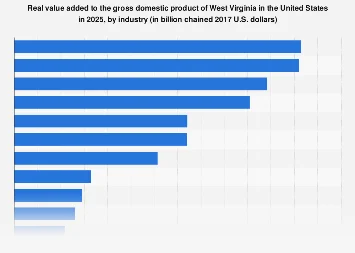
In the projected economic landscape of West Virginia for 2025, the government and government enterprises sector is poised to be the most significant contributor to the state’s real Gross Domestic Product (GDP), accounting for an estimated $12.28 billion in chained 2017 U.S. dollars. This figure highlights the substantial role of public administration, defense, and other government functions in underpinning the state’s economic activity. Following closely is the finance, insurance, real estate, rental, and leasing sector, projected to add $12.22 billion to the state’s GDP. These two sectors collectively represent a significant portion of West Virginia’s economic output, emphasizing the importance of both public services and financial and property markets.
The educational services, health care, and social assistance sector is also a major economic engine, expected to contribute $10.86 billion. This substantial figure underscores the growing importance of the service economy, particularly in areas that cater to human well-being and development. Meanwhile, the traditional backbone of West Virginia’s economy, mining, quarrying, and oil and gas extraction, is projected to contribute $10.1 billion. While still a substantial contributor, its position reflects a broader national and global energy transition and evolving market dynamics. Manufacturing, another key industrial sector, is anticipated to generate $7.43 billion, with professional and business services closely trailing at $7.41 billion, indicating a dynamic interplay between production and specialized service provision.
The retail trade sector is projected to contribute $6.15 billion, reflecting consumer spending patterns within the state. Wholesale trade follows with $3.3 billion, illustrating the movement of goods within the supply chain. The construction sector is estimated to add $2.93 billion, signaling activity in infrastructure development and building projects. The arts, entertainment, recreation, accommodation, and food services sector, a crucial component of the hospitality and tourism industry, is expected to generate $2.62 billion. The information sector, encompassing communication and data processing, is projected to contribute $2.17 billion, while utilities, providing essential services, are expected to add $2.1 billion. Transportation and warehousing, critical for the movement of goods and people, are forecast to contribute $2.01 billion. At the lower end of the spectrum, agriculture, forestry, fishing, and hunting are projected to contribute $0.46 billion, representing a smaller but vital segment of the state’s diverse economy.
These figures paint a picture of an economy undergoing diversification, with service-oriented sectors, including government and healthcare, playing an increasingly dominant role alongside established industries like energy and manufacturing. The methodology of using chained 2017 U.S. dollars allows for a more accurate representation of real economic growth by adjusting for inflation over time. However, it is important to note that these chained-dollar estimates are typically not perfectly additive due to the formula used for calculating quantity indexes, which employs weights from multiple periods.
Analyzing the economic contributions by industry offers a granular view of West Virginia’s economic structure and its reliance on various sectors. The dominance of government and government enterprises and the finance, insurance, real estate, rental, and leasing sectors suggests a significant public sector presence and a robust financial infrastructure. The strong performance of educational services, health care, and social assistance points to a growing demand for human capital development and healthcare services, aligning with national demographic trends and increasing life expectancies.
The $10.1 billion contribution from mining, quarrying, and oil and gas extraction, while substantial, places it as the fourth-largest sector. This position reflects the cyclical nature of commodity markets and the ongoing global shift towards renewable energy sources. West Virginia’s historical reliance on coal has been a defining characteristic of its economy, and while it remains a significant player, its relative contribution to overall GDP may be influenced by market forces and regulatory environments. The state’s efforts to diversify its economy may be reflected in the growth of other sectors.
Manufacturing’s $7.43 billion contribution indicates its continued importance, potentially encompassing a range of sub-sectors from chemical production to durable goods. The proximity of professional and business services ($7.41 billion) suggests a symbiotic relationship, where specialized knowledge-based services support broader industrial and commercial activities. The retail trade sector’s $6.15 billion output is a direct indicator of consumer confidence and spending power within West Virginia.
The global economic context provides a valuable lens through which to view West Virginia’s industrial performance. Many developed economies are witnessing a secular shift towards service-based economies, with technology, healthcare, and finance leading the charge. Emerging economies, on the other hand, often exhibit stronger contributions from manufacturing and resource extraction as they industrialize. West Virginia’s economic profile appears to be following the broader trend of developed nations, with a notable emphasis on public services and specialized financial activities.
The impact of these industrial contributions extends beyond mere GDP figures. Government spending directly supports public services, infrastructure, and employment. The financial sector facilitates investment, lending, and economic stability. Healthcare and education are crucial for a productive workforce and societal well-being. The energy sector, while facing transitions, remains a critical source of revenue and employment, impacting regional economies and national energy security. Manufacturing contributes to job creation, innovation, and exports, while retail and services reflect the day-to-day economic activity and consumer demand.
Understanding the nuances of each sector’s contribution is vital for policymakers seeking to foster sustainable economic growth. Investments in education and workforce development can bolster the performance of sectors like professional services and advanced manufacturing. Support for small businesses and entrepreneurship can invigorate retail and hospitality. Strategic infrastructure development can enhance the efficiency of transportation and warehousing. Moreover, adapting to the evolving energy landscape by investing in new technologies and industries will be crucial for long-term prosperity.
The economic outlook for West Virginia in 2025, as indicated by these industry-specific GDP contributions, suggests an economy that is balancing its traditional strengths with the growth imperatives of the modern global marketplace. The interplay between government, finance, services, and industry will shape its trajectory, with opportunities and challenges arising from technological advancements, global market fluctuations, and domestic policy initiatives. The state’s ability to foster innovation, attract investment, and develop its human capital will be key determinants of its economic success in the coming years.