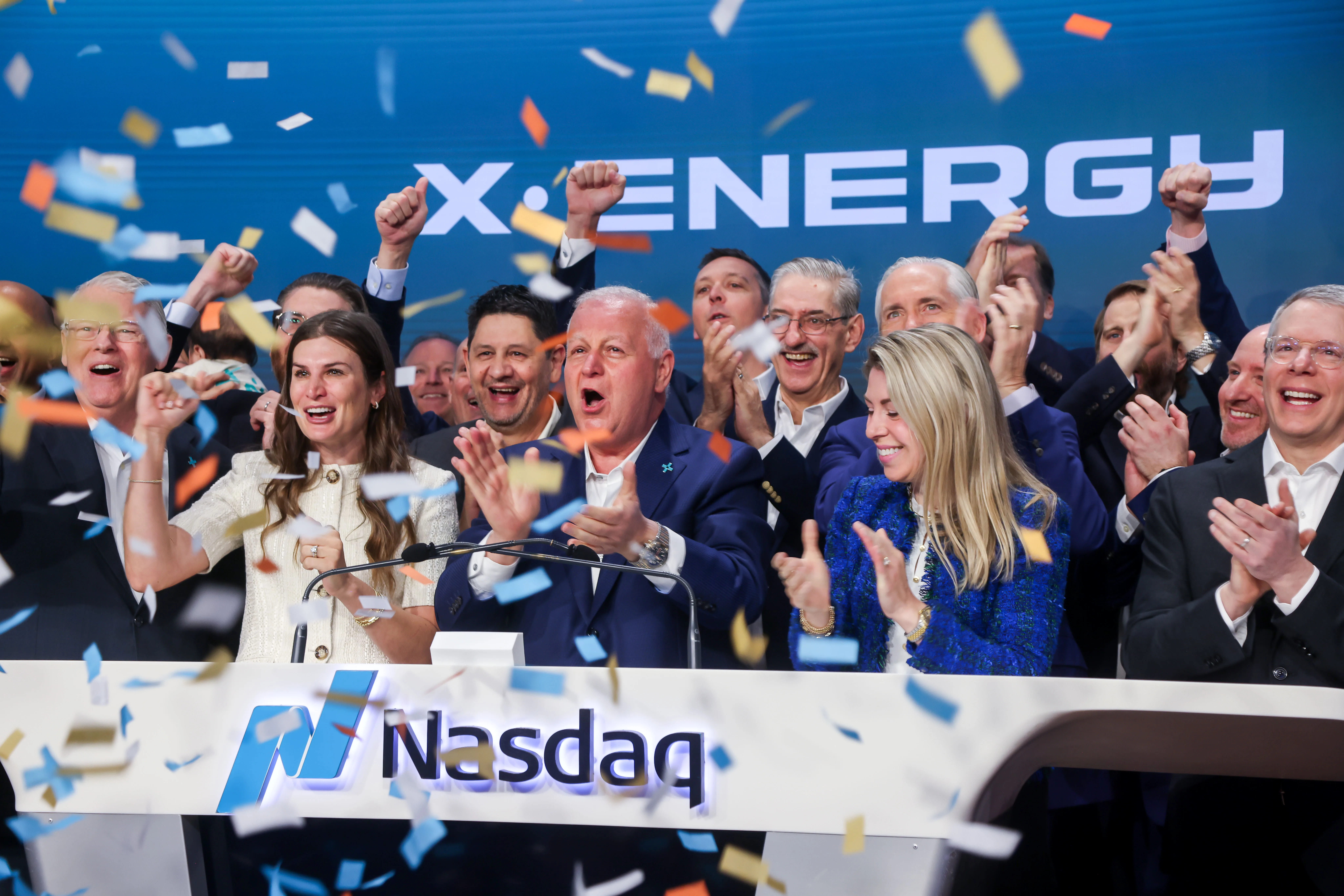
In a landmark moment for the advanced nuclear sector, X-energy successfully transitioned to the public markets on Friday, marking the largest nuclear-related initial public offering in history. The company’s stock, trading under the ticker symbol XE, debuted at $30.11 after an aggressive pricing strategy that saw the offering upsized to $23 per share—significantly higher than the anticipated range of $16 to $19. By the closing bell, shares had surged 27% to finish at $29.20, valuing the company at several billion dollars and signaling a robust appetite among institutional investors for carbon-free, baseload power solutions.
The timing of the listing is no coincidence. As the global economy pivots toward the massive computational requirements of artificial intelligence (AI), the energy landscape is undergoing a structural shift. Hyperscale data centers, the engines of the generative AI revolution, require immense, uninterrupted power supplies that traditional renewable sources like wind and solar cannot always provide without prohibitively expensive battery storage. This "energy gap" has thrust small modular reactors (SMRs) and advanced nuclear technology into the spotlight, transforming what was once a niche corner of the utility sector into a cornerstone of the modern tech-driven economy.
X-energy’s flagship technology, the xe-100, represents a departure from the massive, multi-billion-dollar light-water reactors that have defined the nuclear industry for decades. The xe-100 is a high-temperature gas-cooled reactor (HTGR) designed to produce 80 megawatts of electricity. Its modularity is its primary selling point; the units are designed to be "plug-and-play," allowing customers to bundle reactors together to reach a capacity of up to 960 megawatts. This flexibility makes nuclear power accessible to a broader range of industrial clients and regional utilities that lack the capital or the grid infrastructure to support traditional large-scale plants.
Beyond mere electricity generation, X-energy’s technology addresses one of the most difficult challenges in the global race to net-zero: the decarbonization of heavy industry. Unlike the light-water reactors currently operating across the United States, the xe-100 operates at much higher temperatures. This high-grade thermal energy can be diverted for industrial processes such as hydrogen production, chemical manufacturing, and petroleum refining. This dual-use capability has already attracted significant corporate interest, most notably from Dow, which plans to use X-energy’s technology to power and provide heat for its Seadrift, Texas, manufacturing site.

The financial success of the IPO is underpinned by a massive order pipeline that currently exceeds 11 gigawatts. This backlog is supported by a "who’s who" of corporate and financial heavyweights. Amazon, which has been aggressively securing carbon-free energy to power its AWS data centers, is a primary partner and backer. The e-commerce and cloud giant has committed to deploying 5 gigawatts of X-energy capacity across the U.S. by 2039. Other notable supporters include the British energy firm Centrica, the quantitative trading firm Jane Street, Cathie Wood’s ARK Invest, and Ken Griffin’s Citadel.
The decision to pursue a traditional IPO distinguishes X-energy from its primary competitors, Oklo and NuScale, both of which entered the public markets via special purpose acquisition companies (SPACs). While X-energy had previously explored a SPAC merger in 2023, the company ultimately abandoned those plans in favor of a traditional listing. This move appears to have paid off, providing a level of transparency and institutional vetting that has become increasingly prized in a market wary of pre-revenue "hard tech" companies. Before the IPO, the company had already secured over $1.4 billion in private funding, including a critical $700 million Series D round and substantial support from the U.S. Department of Energy’s Advanced Reactor Demonstration Program (ARDP).
Economically, X-energy’s business model is designed to mitigate the risks that have historically plagued the nuclear industry—namely, massive cost overruns and construction delays. Rather than acting as a utility that owns and operates the plants, X-energy functions as a technology licensor and fuel supplier. This "asset-light" approach shifts the operational risk to the owners while creating a recurring revenue stream for X-energy through the sale of its proprietary fuel.
The fuel itself is a critical component of the company’s value proposition. X-energy is currently constructing a commercial-scale fabrication facility in Oak Ridge, Tennessee, to produce TRISO-X (Tri-structural Isotropic) fuel. Often described as "the most robust nuclear fuel on earth," TRISO particles are encased in ceramic layers that prevent the release of radioactive materials even under extreme temperatures. This inherent safety feature allows the reactors to be sited closer to population centers and industrial hubs, potentially reducing the need for extensive transmission infrastructure.
From a global perspective, the rise of companies like X-energy is being viewed as a geopolitical necessity. For years, China and Russia have led the world in the deployment of advanced nuclear technologies. China recently commissioned its own high-temperature gas-cooled reactor (the HTR-PM), marking the first commercial operation of its kind. For the United States and its allies, the success of X-energy is seen as a vital step in regaining leadership in a sector that is increasingly tied to national security and energy independence.

The regulatory environment remains the most significant hurdle for the company. In March 2025, X-energy and Dow submitted their construction permit application to the U.S. Nuclear Regulatory Commission (NRC) for the Texas project. The NRC’s review is expected to take approximately 18 months, followed by a separate application for an operating license. Historically, the NRC’s licensing process has been criticized for being slow and optimized for traditional light-water reactors. However, recent legislative efforts, such as the ADVANCE Act, aim to modernize the regulatory framework to better accommodate the unique safety profiles of SMRs and HTGRs.
Market analysts suggest that the success of X-energy could trigger a broader wave of investment into the nuclear supply chain. As data center demand is projected to grow by 160% by 2030, according to some estimates from Goldman Sachs, the strain on the electrical grid will necessitate a diversified energy mix. While solar and wind will continue to expand, the need for "firm" power—energy that can be turned on or off regardless of weather conditions—is driving a revaluation of nuclear assets. This is evident not just in new reactor startups, but also in the recent deals made by companies like Microsoft to restart dormant reactors at Three Mile Island.
Despite the euphoria surrounding the IPO, the road ahead for X-energy is not without challenges. The company has yet to begin actual construction on a commercial facility, and the transition from design to physical deployment is notoriously difficult in the nuclear sector. Supply chain bottlenecks for specialized components and the availability of High-Assay Low-Enriched Uranium (HALEU)—the fuel required for many advanced reactors—remain persistent concerns.
Nevertheless, the 27% jump in share price on day one serves as a powerful validation of the "Nuclear 2.0" thesis. By successfully navigating a traditional IPO and raising over $1 billion, X-energy has demonstrated that the capital markets are ready to fund the next generation of energy infrastructure. As the world’s largest tech companies compete for the power necessary to fuel the AI era, the modular, high-temperature reactors developed in facilities like those in Oak Ridge may well become the silent partners in the digital future, providing the steady, carbon-free heat and light required to sustain a high-tech global economy.