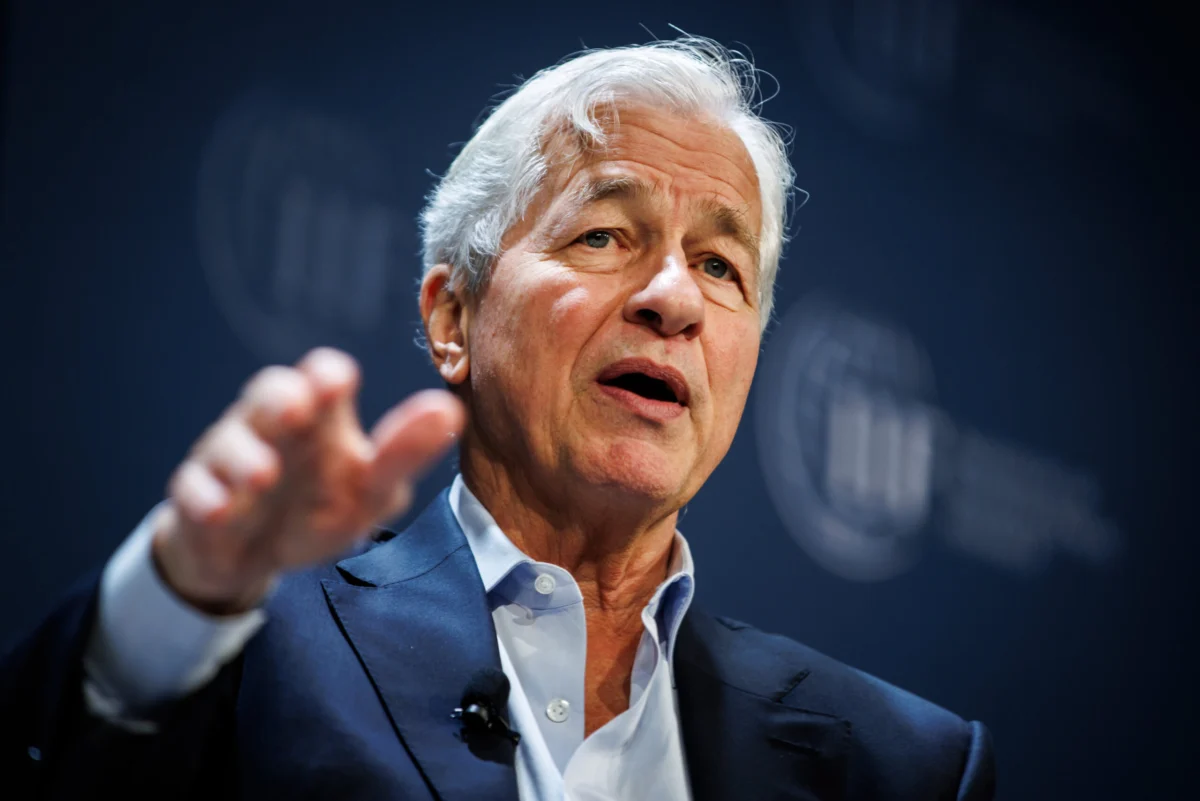
In an era defined by a relentless bull market and a collective sigh of relief over a potential "soft landing" for the American economy, Jamie Dimon, the long-standing Chairman and CEO of JPMorgan Chase, is once again casting a shadow over the festivities. During a comprehensive discussion regarding the state of global finance, the leader of the world’s largest bank by market capitalization delivered a sobering assessment of current asset valuations, asserting that investors are significantly underestimating a convergence of geopolitical and fiscal threats. Dimon’s primary thesis is one of caution: he signaled a definitive "no" on purchasing long-dated U.S. Treasurys and expressed deep skepticism toward the broader equity market at its current price points.
The divergence between Dimon’s outlook and the prevailing sentiment on Wall Street is stark. While the S&P 500 has climbed approximately 10% this year, fueled by cooling inflation data and a speculative frenzy surrounding artificial intelligence, Dimon remains preoccupied with the "underlying plumbing" of the global order. He argues that the market is pricing in a perfection that rarely survives contact with reality. For Dimon, the current environment is not merely a period of transition but a potentially volatile inflection point where the "straws on the camel’s back" are accumulating at an unsustainable rate.
Central to Dimon’s apprehension is the deteriorating geopolitical landscape, which he views as the most significant risk factor facing the global economy since World War II. The ongoing conflicts in Ukraine and the Middle East, coupled with the increasingly fractious relationship between the United States and China, represent more than just humanitarian crises; they are fundamental disruptions to the global trade and security architecture that has underpinned economic growth for decades. Dimon noted that while markets have shown a remarkable ability to look past these "shocks," the long-term consequences of rising military spending and the fragmentation of global supply chains are not yet fully reflected in asset prices.
The fiscal trajectory of the United States serves as another pillar of Dimon’s bearishness. As the national debt continues its climb toward unprecedented levels, Dimon warns that the era of low interest rates—once sustained by central bank interventions and global demand for "safe-haven" assets—may be coming to a permanent end. He pointed specifically to the inevitable return of the "bond vigilantes," a term used to describe bond market investors who protest inflationary or fiscally irresponsible government policies by selling bonds, thereby driving up yields.
Dimon’s refusal to touch long-dated Treasurys is rooted in this expectation of structurally higher rates. Even if the Federal Reserve successfully manages to bring inflation down to its 2% target, Dimon posits that the 10-year Treasury note should naturally settle between 4% and 4.5%. At current prices, he sees almost no upside for investors in long-term government debt, suggesting that the market is failing to account for the massive supply of bonds the U.S. Treasury must issue to fund its ballooning deficits. This fiscal reality creates a "crowding out" effect that could keep borrowing costs elevated for corporations and consumers alike, regardless of the Fed’s short-term policy moves.
On the equity side, the CEO’s critique is equally pointed. While JPMorgan Chase recently reported stellar quarterly results—driven by a resurgence in investment banking and robust trading revenue—Dimon remains wary of the broader market’s valuation. The S&P 500’s forward price-to-earnings (P/E) ratio has climbed well above historical averages, a trend driven largely by a handful of mega-cap technology stocks. While Dimon acknowledged that he would still consider individual stocks if they presented exceptional value, he characterized the general market as being overextended.

The current obsession with generative artificial intelligence (AI) has drawn comparisons from Dimon to the dot-com bubble of the late 1990s. While he is a firm believer in the transformative power of AI—stating that the technology will eventually "pay off" in a manner similar to the internet—he cautioned that the current spending boom is fraught with risk. He reminded investors that the early winners of the internet era, such as Netscape and Yahoo, were eventually eclipsed by companies like Google and Meta that emerged later. The massive capital expenditures currently being poured into AI infrastructure by "Big Tech" may not yield the expected returns on the timeline the market is currently anticipating. "Will it pay off the way you expect and the timetable you expect? Definitely not," Dimon warned, suggesting a period of "irrational exuberance" may be masking future volatility.
Despite these warnings, Dimon did acknowledge the surprising resilience of the U.S. economy. This resilience is partly due to a structural shift in energy dynamics; the United States has moved from being a net energy importer to a leading producer, reducing its vulnerability to the kind of oil price shocks that crippled the economy in the 1970s. Furthermore, the American consumer has proven to be more durable than many economists predicted, supported by a strong labor market and residual savings from the pandemic era.
However, Dimon views this resilience not as an insurance policy, but as a delay of the inevitable. He utilized the metaphor of a "tipping point," suggesting that while the economy has absorbed several major shocks without collapsing, there is a limit to its capacity. The cumulative weight of persistent inflation, high interest rates, and geopolitical instability could eventually reach a threshold where the system snaps. "You may need more straws in the camel’s back to cause that tipping point," he noted, "but even this current war starting up again, maybe that’s not enough to do it—yet."
This cautious stance is a trademark of Dimon’s leadership style, which prioritizes a "fortress balance sheet" designed to withstand extreme economic stress. While other financial institutions may be leaning into the current momentum, JPMorgan Chase has historically maintained higher capital buffers and a more conservative lending posture during periods of high uncertainty. This strategy has allowed the bank to act as a stabilizer during crises, such as its acquisition of First Republic Bank during the regional banking turmoil of early 2023.
From a global perspective, Dimon’s concerns resonate with broader economic trends. In Europe, stagnating growth and high energy costs continue to hamper a full recovery, while in China, a real estate crisis and demographic shifts are slowing the world’s second-largest economy. If the U.S. fiscal situation deteriorates further, the global "risk-free rate"—which is based on U.S. Treasurys—will rise, increasing the cost of capital for emerging markets and developed nations alike. This creates a feedback loop of economic pressure that could stifle global growth for years.
The economic impact of Dimon’s "higher-for-longer" interest rate thesis cannot be overstated. If 10-year yields remain above 4%, the traditional 60/40 investment portfolio faces a challenging environment. Real estate, private equity, and venture capital—sectors that thrived on cheap debt—will have to undergo painful deleveraging. Furthermore, if the U.S. government is forced to spend a larger portion of its budget on interest payments, there will be less capital available for infrastructure, education, and the green energy transition, potentially lowering the long-term growth potential of the nation.
Ultimately, Jamie Dimon’s latest remarks serve as a reminder that market prices are a reflection of consensus, not a guarantee of the future. By highlighting the disconnect between buoyant stock indices and a fracturing global order, he is urging investors to look beyond the immediate gains of the AI trade and the "soft landing" narrative. Whether his "hurricane" arrives or the economy continues to defy gravity remains to be seen, but for the head of the world’s most powerful bank, the risks are simply too high to ignore. In his view, the prudent path is not to follow the herd into overvalued assets, but to prepare for a world where the only certainty is volatility.