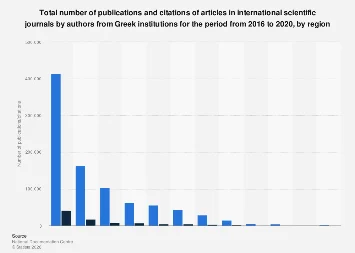
Greece’s academic landscape in 2020 showcased a dynamic distribution of scholarly output and research influence across its various regions. While specific granular data requires subscription access, the broader trends reveal a concentration of academic activity in key urban centers, mirroring global patterns of research hubs. Understanding this geographical distribution is crucial for policymakers, funding bodies, and academic institutions aiming to foster equitable research development and maximize national intellectual capital.
The production of academic publications, a fundamental metric of research activity, is intrinsically linked to the presence of universities, research institutes, and the availability of skilled researchers. In Greece, as in many countries, the capital city and major metropolitan areas tend to be epicenters of higher education and research. Athens, with its numerous universities and research organizations, likely represents the largest contributor to the nation’s total publication output. Similarly, Thessaloniki, home to prominent universities and a significant student population, is expected to feature prominently in regional publication statistics. These urban environments offer a critical mass of academic talent, specialized infrastructure, and interdisciplinary collaboration opportunities that fuel research endeavors.
Beyond sheer publication numbers, the impact of this research, as measured by citations, offers a more nuanced perspective on academic influence. Citations reflect how often a piece of research is referenced by other scholars, indicating its perceived importance, originality, and contribution to the broader scientific discourse. While publication volume is important, citation impact often points to the quality and relevance of the research being conducted. Regions with strong research traditions, specialized niche expertise, or particularly impactful breakthroughs are likely to exhibit higher citation rates relative to their publication volume.
The year 2020, while marked by the unprecedented challenges of the COVID-19 pandemic, also saw a surge in scientific activity, particularly in areas related to public health, infectious diseases, and digital solutions for remote work and learning. It is plausible that Greek academic output in these specific fields experienced an uptick, with regional contributions varying based on institutional strengths and research priorities. For instance, regions with strong medical schools and public health research centers might have seen a disproportionate increase in publications and citations related to pandemic research.
Globally, the concentration of academic output in specific regions is a well-documented phenomenon. Major research-intensive countries often see their leading universities, typically located in large cities, dominating national publication statistics. This concentration is driven by factors such as access to funding, talent pools, established research networks, and specialized facilities. However, efforts are increasingly being made to decentralize research funding and support, encouraging the development of research capacity in less established regions to foster more inclusive and diverse scientific ecosystems.
In the Greek context, understanding the regional breakdown of publications and citations allows for targeted interventions. If certain regions show a lower output or impact, it might signal a need for increased investment in research infrastructure, faculty recruitment, or specialized training programs. Conversely, regions demonstrating high impact could serve as models for others, sharing best practices and fostering collaborative initiatives. The Pan-Hellenic Academic Libraries Conference, mentioned in related statistical dossiers, underscores the importance of academic libraries as central nodes in the dissemination and accessibility of scholarly work, playing a vital role in both publication and citation tracking.
The economic implications of a robust and geographically distributed academic sector are significant. High-quality research contributes to innovation, economic growth, and the development of a skilled workforce. Regions with strong academic presence often attract talent, foster spin-off companies, and contribute to the local and national economy through knowledge transfer and the development of high-value industries. By analyzing the regional dynamics of academic publications and citations, Greece can better strategize its investments in research and development, aiming to cultivate a more balanced and impactful national research landscape.
Furthermore, the digital transformation accelerated in 2020 has implications for how academic research is produced and disseminated. Online learning and digital publishing platforms have made research more accessible, potentially leveling the playing field for researchers in different regions. However, disparities in digital infrastructure and access can also exacerbate existing inequalities. Therefore, a comprehensive understanding of regional academic activity must also consider the digital divide and its impact on research participation and visibility.
While specific figures for 2020 are not publicly detailed here, the general trend for Greece, like many European nations, likely involves a concentration of academic power in its major urban centers. The interplay between the number of publications and their citation impact provides a critical lens through which to evaluate the quality and influence of Greek scholarship. Future analyses focusing on specific disciplines and research areas within these regions would offer even deeper insights into the strengths and potential growth areas of Greece’s intellectual economy. The continuous monitoring of these metrics is essential for shaping effective national research policies that aim to enhance both the breadth and depth of academic contributions emanating from all corners of the country.