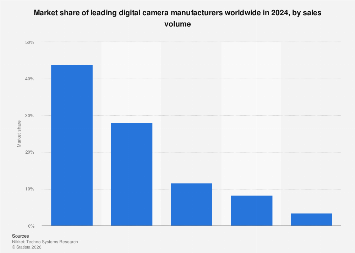
Canon has once again asserted its leadership in the global digital camera market, capturing a commanding presence in 2024. The Japanese imaging giant secured a substantial share, underscoring its enduring appeal and strategic positioning in an industry undergoing significant transformation. Following closely behind Canon were its perennial rivals, Sony and Nikon, who continue to vie for market influence with their distinct technological strengths and product portfolios. Panasonic, while a notable player, operates with a more specialized focus, commanding a market share below five percent, indicating a segment of the market that prioritizes niche applications or specific imaging philosophies.
The sustained market leadership of Canon is a testament to its long-standing commitment to innovation and quality in the imaging sector. Founded in 1937 as Precision Optical Instruments Laboratory, the company has evolved into a multifaceted enterprise specializing in optical, imaging, and industrial products. This deep historical foundation has allowed Canon to weather technological shifts and consumer preference changes with remarkable resilience. While the company’s financial performance has experienced fluctuations over its extensive history, its sales trajectory reached a significant zenith in 2007, when revenues approached an impressive 4.2 trillion Japanese yen. More recently, in 2023, Canon’s sales remained robust, registering approximately 3.9 trillion Japanese yen, a figure that speaks to its consistent revenue generation and substantial operational scale in the current economic climate. This financial strength provides a solid bedrock for continued investment in research and development, a critical factor for maintaining competitive advantage in the fast-paced technology sector.
The broader digital camera market, however, paints a more complex picture. The industry experienced its peak in terms of unit shipments in 2010, when global vendors dispatched over 121 million digital still cameras. Since that high point, the market has witnessed a persistent decline. This downward trend is largely attributable to the meteoric rise of smartphones and the rapid advancements in their integrated camera capabilities. Consumers, increasingly reliant on their mobile devices for everyday photography, have found the convenience and ubiquity of smartphone cameras sufficient for a vast array of photographic needs. Despite this pervasive trend, the market for dedicated digital cameras remains significant. In 2023, global shipments of digital still cameras still amounted to a considerable 6.9 million units, demonstrating that a substantial segment of consumers and professionals continue to seek out the superior image quality, optical versatility, and specialized features offered by dedicated camera systems.
Looking ahead, projections for the digital camera market suggest a period of relative price stability. The average cost of a digital camera is anticipated to remain above $700 U.S. dollars through 2030. This forecast implies a market that is less about mass-market accessibility and more about catering to a discerning clientele seeking advanced performance and specialized tools. The continued presence of established players like Canon, Sony, and Nikon, alongside the resilience of the professional and enthusiast segments, indicates a market that, while smaller than its peak, is focused on value and specialized capabilities rather than sheer volume. The development of mirrorless camera technology, offering a compelling blend of portability and professional-grade image quality, has been a key driver in sustaining interest and innovation within this segment. Furthermore, the growing popularity of content creation, vlogging, and professional photography, where image fidelity and control are paramount, ensures a sustained demand for high-performance camera solutions.
The competitive dynamics within the digital camera market are characterized by intense innovation, particularly in sensor technology, autofocus systems, and video recording capabilities. Sony, for instance, has made significant inroads by leveraging its expertise in image sensor manufacturing, often supplying its advanced sensors to other camera brands, including its direct competitors. This strategic positioning allows Sony to benefit from broader market trends while simultaneously pushing the boundaries of imaging technology. Nikon, another titan with a rich heritage in optics and photography, continues to invest heavily in its Z-mount mirrorless system, aiming to capture a larger share of the professional and advanced amateur markets. The company’s focus on robust build quality and exceptional optical performance remains a core tenet of its brand identity.
The economic impact of the camera manufacturing industry extends beyond the direct sales of photographic equipment. It supports a vast ecosystem of component suppliers, lens manufacturers, software developers, and accessory producers. The demand for high-resolution sensors, advanced processors, and sophisticated optical elements drives innovation in related industries. Moreover, the thriving photography and videography sector, fueled by accessible yet powerful camera technology, contributes to the creative economy, supporting freelance professionals, content creators, and media organizations worldwide. As the digital camera market matures, it is likely to see further consolidation and a greater emphasis on specialized product lines catering to distinct user needs, from wildlife photographers and sports journalists to filmmakers and serious hobbyists. The enduring appeal of capturing moments with unparalleled quality and creative control ensures that the dedicated digital camera will remain a relevant and vital tool in the global marketplace for the foreseeable future.