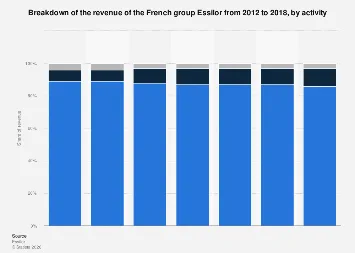
The global optical industry, a sector characterized by its consistent demand and technological evolution, has witnessed significant shifts in revenue generation for its leading players. Essilor International, a dominant force in the ophthalmic optics market, provides a compelling case study for understanding these evolving market dynamics. Between 2012 and 2018, the company experienced a notable recalibration of its revenue streams across various operational segments, reflecting broader trends in consumer behavior, technological adoption, and market consolidation. This period was crucial for Essilor as it navigated a complex global marketplace, balancing growth in established markets with expansion into emerging economies, all while adapting to an increasingly digital and health-conscious consumer base.
During the 2012-2018 timeframe, Essilor’s revenue distribution across its key business sectors underwent a subtle yet significant transformation. While specific year-on-year percentage breakdowns for every segment are proprietary, a review of the company’s operational focus and reported financial performance during this era indicates a strategic emphasis on certain areas. The core business of spectacle lenses, encompassing both prescription lenses and lens technologies, consistently formed the bedrock of Essilor’s revenue. This segment, encompassing brands like Varilux, Crizal, and Eyezen, continued to be the primary engine of growth, driven by an aging global population requiring vision correction, increasing awareness of eye health, and the ongoing innovation in lens materials, coatings, and digital designs that offer enhanced visual performance and comfort. The demand for premium, high-index, anti-reflective, and blue-light filtering lenses saw a steady rise, contributing to an increase in average selling prices within this segment.
Beyond its foundational lens business, Essilor’s strategic acquisitions and organic growth initiatives significantly influenced its revenue mix. The company’s expanding presence in the eyewear frame and sunglasses market, particularly through acquisitions of established brands and distribution networks, represented a growing, albeit secondary, revenue contributor. This diversification strategy allowed Essilor to capture a larger share of the consumer’s optical spending, moving beyond just the lens component. The integration of these frame businesses provided synergies, enabling cross-selling opportunities and a more comprehensive offering to optical retailers and consumers alike. While the margins in the frame segment might differ from the high-margin lens business, the increased volume and market penetration offered a substantial boost to overall revenue.
The digital revolution also played a pivotal role in reshaping Essilor’s revenue streams. The company invested heavily in its e-commerce capabilities and its direct-to-consumer (DTC) channels, albeit cautiously, to complement its traditional B2B relationships with opticians and eye care professionals. This digital push aimed to reach a wider demographic, particularly younger consumers who are more accustomed to online purchasing. Furthermore, the development and adoption of diagnostic equipment and services for eye care professionals represented another facet of Essilor’s evolving business model. By providing advanced tools for vision testing and eye health assessment, Essilor not only strengthened its relationships with its core customer base but also created an additional revenue stream through the sale and maintenance of this specialized equipment.
Examining the broader economic context of 2012-2018 reveals several macro-economic factors that likely influenced Essilor’s sectoral revenue. The period saw a gradual recovery from the 2008 global financial crisis, leading to increased disposable income in many developed markets, which often translates to higher spending on discretionary items like premium eyewear. Concurrently, emerging markets, particularly in Asia and Latin America, experienced robust economic growth, creating new consumer bases with a growing demand for vision correction solutions. Essilor’s strategic investments in these regions, including manufacturing facilities and distribution networks, were instrumental in capitalizing on this demographic dividend.
The global ophthalmic lens market itself is substantial and has been on an upward trajectory. Industry reports from entities like Grand View Research and Mordor Intelligence projected consistent growth, driven by factors such as an increasing prevalence of myopia and other refractive errors, particularly among children and young adults, and a growing aging population susceptible to presbyopia and age-related eye conditions like cataracts. Essilor, as the market leader, was well-positioned to benefit from these demographic tailwinds. The company’s consistent investment in research and development, leading to innovations in progressive lenses, photochromic technologies, and specialized coatings, allowed it to command premium pricing and maintain its competitive edge, thereby bolstering revenue from its core lens segment.
Global comparisons further illuminate Essilor’s strategic positioning. While Essilor dominated the lens segment, other global players like Carl Zeiss Vision and Hoya Corporation were also significant competitors, vying for market share through technological innovation and strategic partnerships. The competitive landscape encouraged continuous product development and aggressive marketing strategies. Essilor’s consistent focus on both innovation and strategic acquisitions, such as its landmark merger with Luxottica in 2018 to form EssilorLuxottica, underscored its ambition to consolidate its leadership and create a vertically integrated powerhouse spanning lenses, frames, retail, and distribution. This merger, while finalized at the end of the period, represented a culmination of Essilor’s strategy to diversify and strengthen its market position across the entire eyewear value chain.
The economic impact of Essilor’s operations extends beyond its direct financial performance. As a major global employer, the company’s growth and revenue generation contributed to job creation in manufacturing, research and development, sales, and distribution across numerous countries. Its investments in local markets often supported the development of the optical retail infrastructure, providing independent opticians with advanced products and business support, thereby fostering local economies. Furthermore, Essilor’s commitment to vision care initiatives, such as providing free eye exams and corrective lenses to underserved populations, demonstrated a social impact that complemented its economic footprint.
Looking closer at the revenue segmentation, it’s crucial to consider the impact of different product categories within lenses. For instance, the growth in digitally surfaced lenses and personalized prescription lenses, enabled by advanced manufacturing technologies, likely contributed to higher revenue per unit. Similarly, the increasing penetration of ophthalmic instruments and lens processing equipment in optical labs, often supplied by Essilor, added another layer to its diversified revenue. The company’s ability to offer a comprehensive solution, from lens manufacturing equipment to the final product delivered to the consumer, solidified its market dominance and contributed to its robust financial performance throughout the 2012-2018 period.
The period also saw a growing emphasis on preventative eye care and the role of eyewear in overall health and well-being. Essilor’s marketing and product development efforts increasingly reflected this trend, promoting lenses that offered protection against digital eye strain and harmful UV radiation. This consumer education and product innovation helped to elevate the perceived value of ophthalmic products, moving them beyond mere corrective devices to essential tools for modern living. This subtle shift in consumer perception undoubtedly supported higher revenue generation across Essilor’s product portfolio.
In conclusion, the period between 2012 and 2018 marked a dynamic phase for Essilor, characterized by the sustained strength of its core lens business, strategic diversification through acquisitions in eyewear, and adaptation to the digital age. The company’s ability to leverage global demographic trends, technological advancements, and a robust M&A strategy allowed it to not only maintain its leadership position but also to lay the groundwork for future growth and integration within the increasingly consolidated global eyewear market. The intricate interplay of these factors shaped Essilor’s sectoral revenue landscape, underscoring its resilience and strategic foresight in a competitive and ever-evolving industry.