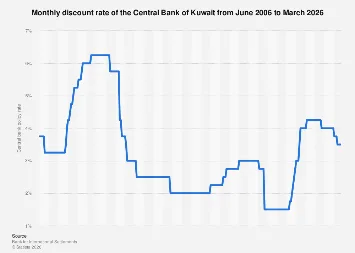
Kuwait’s central bank policy rate underwent a significant period of adjustment, mirroring the dynamic global economic landscape and domestic inflationary pressures. Between February 2022 and July 2023, the benchmark policy rate experienced a notable upward trajectory, escalating from a modest percentage to a substantially higher figure. This tightening cycle, characterized by four successive rate hikes, was a direct response to the pervasive surge in global inflation, a phenomenon that affected economies worldwide. By aligning its monetary policy with broader international trends, the Central Bank of Kuwait (CBK) aimed to anchor inflation expectations and preserve the stability of the Kuwaiti Dinar.
The period of monetary tightening, while necessary to combat inflation, inevitably impacted domestic borrowing costs and investment decisions. However, as global inflationary pressures began to abate and domestic economic conditions evolved, the CBK initiated a cautious pivot towards monetary accommodation. This shift became evident in early 2024. In January of that year, the policy rate was reduced, marking the first instance of easing since the tightening phase. This initial cut was followed by a further reduction in September 2024, signaling a more pronounced and deliberate move towards lowering borrowing costs and stimulating economic activity. As of March 2026, the policy rate has settled at a specific percentage, reflecting the culmination of these strategic adjustments and the central bank’s assessment of the prevailing economic environment.
This trajectory highlights Kuwait’s strategic approach to monetary policy, balancing the imperative of price stability with the need to foster sustainable economic growth. The CBK’s actions are deeply intertwined with global monetary policy shifts, particularly those undertaken by major central banks like the U.S. Federal Reserve. When the Federal Reserve raised interest rates aggressively to combat inflation, many central banks, especially those with currency pegs or strong trade ties to the U.S. dollar, found themselves compelled to follow suit. Kuwait, which pegs its Dinar to a basket of currencies heavily influenced by the U.S. dollar, is particularly sensitive to these global monetary policy movements. The significant increase in the CBK’s policy rate during 2022-2023 was, therefore, a necessary measure to maintain the attractiveness of the Dinar and prevent capital outflows, especially as global interest rates rose.
The subsequent easing cycle, commencing in 2024, reflects a recalibration of these priorities. As inflation moderated both globally and domestically, the CBK could afford to loosen its monetary stance. Lower interest rates can stimulate domestic demand by making borrowing cheaper for businesses and consumers. This can encourage investment in new projects, expansion of existing businesses, and increased consumer spending on durable goods and services. For Kuwait, a nation heavily reliant on oil revenues, diversifying its economy and fostering non-oil sector growth is a long-term objective. Lower borrowing costs can play a crucial role in supporting this diversification agenda by making it more attractive for local and foreign investors to deploy capital in sectors beyond oil and gas.
The specific percentages of these rate changes, while not disclosed in their entirety, represent significant policy decisions with tangible economic consequences. For instance, a rise of several percentage points in the policy rate can translate into a substantial increase in the cost of capital for businesses, potentially slowing down expansion plans and hiring. Conversely, a series of cuts can provide a much-needed stimulus, lowering debt servicing costs for corporations and households alike. The gradual nature of the easing phase, characterized by multiple smaller adjustments rather than a single large cut, suggests a cautious approach by the CBK. This prudence likely stems from a desire to avoid reigniting inflationary pressures while ensuring that the easing cycle is sustainable and supports genuine economic recovery.
Looking ahead, the future path of Kuwait’s policy rate will be contingent on a confluence of factors. Global inflation trends will remain a primary determinant. Should inflation re-accelerate internationally, the CBK might be compelled to pause or even reverse its easing cycle. Domestically, the pace of economic growth, the performance of the non-oil sector, and fiscal policy decisions will also play a significant role. Government spending, particularly on infrastructure projects and economic diversification initiatives, can influence aggregate demand and, consequently, inflationary pressures. Furthermore, the CBK will likely monitor exchange rate dynamics closely, ensuring that its policy rate remains consistent with the objective of maintaining the stability of the Kuwaiti Dinar.
The effectiveness of monetary policy in Kuwait, as in many other economies, is also influenced by the transmission mechanisms through which it operates. These include the banking sector’s lending rates, the responsiveness of businesses and consumers to changes in borrowing costs, and the overall health of the financial system. The banking sector in Kuwait is generally well-capitalized and liquid, which can facilitate the smooth transmission of monetary policy signals. However, the degree to which lower interest rates translate into increased lending and investment depends on factors such as credit demand, risk appetite of banks, and the regulatory environment.
The long-term outlook for Kuwait’s monetary policy will also be shaped by broader global economic trends, including geopolitical stability, commodity price fluctuations, and technological advancements. The ongoing global transition towards cleaner energy sources, for instance, could have long-term implications for Kuwait’s oil-dependent economy, necessitating adaptive monetary and fiscal policies. Moreover, the increasing integration of global financial markets means that external shocks can have a more pronounced impact on domestic economies, requiring central banks to remain agile and responsive.
The CBK’s policy rate adjustments, therefore, are not isolated events but rather integral components of a complex and dynamic economic management strategy. The journey from a tightening phase to an easing cycle underscores the central bank’s commitment to navigating evolving economic conditions, balancing the crucial objectives of price stability and economic growth. The measured approach to easing, with specific rate cuts implemented at distinct intervals, indicates a data-driven decision-making process, where policy actions are carefully calibrated based on incoming economic indicators and forward-looking assessments. This strategic foresight is essential for fostering a stable and prosperous economic environment in Kuwait amidst an increasingly interconnected and unpredictable global economic landscape. The evolution of the policy rate through 2026 will offer a clear barometer of the CBK’s confidence in the domestic economy’s resilience and its ability to adapt to both domestic and international economic forces.