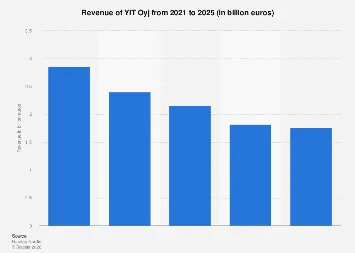
Finnish construction and urban development giant YIT Oyj is charting a course through a complex economic landscape, with its revenue performance in the coming years anticipated to be shaped by a confluence of global and regional factors. While precise, up-to-the-minute financial figures for future periods are typically proprietary and subject to revision, analysis of industry trends, company strategies, and macroeconomic indicators provides a framework for understanding YIT’s expected revenue trajectory leading up to and beyond 2025. The company’s business model, heavily reliant on residential and commercial property development, infrastructure projects, and building services, places it at the forefront of significant economic shifts.
The European construction sector, YIT’s primary operational theater, has experienced considerable volatility in recent years. Post-pandemic recovery efforts, coupled with inflationary pressures and rising interest rates, have created a bifurcated market. On one hand, demand for new housing, particularly in urban centers experiencing population growth and a shortage of affordable housing, remains robust. On the other hand, the cost of raw materials, labor shortages, and the tightening of credit conditions for developers and buyers pose significant headwinds. YIT’s strategic focus on sustainable construction and energy-efficient buildings, while potentially commanding premium pricing and aligning with evolving regulatory requirements and consumer preferences, also necessitates investment in new technologies and materials, impacting short-term cost structures.
YIT’s strategic repositioning in recent years, including divestments and a sharpened focus on core markets and business segments, aims to streamline operations and enhance profitability. The company has been actively managing its project portfolio, prioritizing those with stronger margins and reduced risk profiles. This strategic pruning is expected to contribute to a more resilient revenue base. Furthermore, YIT’s increasing emphasis on urban renewal and the development of integrated living spaces, often involving public-private partnerships, can provide a more stable and predictable revenue stream, less susceptible to the cyclicality of purely speculative development. The company’s commitment to digital transformation within its operations, from project planning to execution and maintenance, is also a key element in its long-term growth strategy, aiming to improve efficiency and reduce costs, thereby indirectly bolstering revenue potential through enhanced competitiveness.
Forecasting revenue for a company like YIT involves considering a multitude of variables. Macroeconomic forecasts for key markets such as Finland, Sweden, Norway, Denmark, the Baltic States, and Poland are crucial. Factors like Gross Domestic Product (GDP) growth, inflation rates, unemployment levels, and consumer confidence directly influence demand for housing and commercial properties. For instance, a slowdown in GDP growth in any of YIT’s core markets could translate into reduced investment in new construction projects. Conversely, economic expansion, particularly in sectors that drive demand for office spaces or retail outlets, would likely have a positive impact. The European Central Bank’s (ECB) monetary policy, including interest rate decisions, is a critical determinant of the cost of capital for developers and mortgage rates for homebuyers, directly impacting affordability and, consequently, sales volumes.
Market data from industry associations and research firms often provide benchmarks and forecasts for the construction sector. For example, reports from organizations like Euroconstruct or national construction federations can offer insights into projected growth rates for new housing starts, renovation activities, and non-residential construction. These aggregate figures, when contextualized with YIT’s specific market share and strategic initiatives, can inform revenue expectations. The company’s order backlog also serves as a vital leading indicator of future revenue. A strong and growing order backlog suggests sustained activity and revenue generation in the medium term. Fluctuations in the backlog, whether due to the successful acquisition of new large-scale projects or the completion of existing ones, directly translate into revenue performance.
Global economic trends also play a role, particularly concerning the supply chain for construction materials. Disruptions in global trade, geopolitical tensions, or shifts in commodity prices can impact the cost and availability of essential materials like steel, timber, and concrete, affecting project profitability and the ability to deliver on time and within budget. YIT’s diversification into building services, which include maintenance and technical solutions for existing buildings, offers a more recurring revenue stream, less exposed to the upfront investment cycles of new construction. This segment is increasingly benefiting from the global focus on energy efficiency and the retrofitting of older buildings, presenting a stable and growing revenue opportunity.
The competitive landscape is another critical factor. YIT operates in a highly competitive environment, with both large international players and smaller local firms vying for market share. The company’s ability to differentiate itself through quality, innovation, sustainability, and efficient project management is paramount to securing new contracts and maintaining client relationships. Pricing strategies, influenced by market demand, competitor pricing, and cost structures, will directly impact revenue realization. Furthermore, regulatory changes related to building standards, environmental regulations, and urban planning policies can create both opportunities and challenges, influencing project feasibility and demand. For example, stricter energy efficiency mandates could drive demand for new construction and renovations that meet these standards, but also increase upfront costs for developers.
In terms of global comparisons, the construction industry’s performance varies significantly across different regions. Developed markets in North America and parts of Asia, for instance, may exhibit different growth dynamics and consumer preferences compared to Europe. YIT’s international footprint, while primarily focused on Europe, means it is indirectly exposed to global economic sentiment and trade flows. The company’s strategic decisions, such as potential expansion into new geographic markets or strategic partnerships, would further shape its revenue outlook. Analyzing revenue growth against industry peers, both within Europe and globally, provides context for YIT’s performance and potential.
Looking towards 2025, YIT’s revenue is expected to be influenced by its success in navigating these diverse economic currents. The ongoing investment in sustainable solutions, its focus on urban development projects with long-term demand, and its efforts to optimize operational efficiency are all strategic pillars designed to ensure sustained revenue growth and market leadership. The company’s ability to secure large infrastructure projects, coupled with consistent demand in its residential segments, will be key indicators of its financial health and its capacity to meet projected revenue targets. The interplay between macroeconomic stability, favorable interest rate environments, and a robust construction market in its key operating regions will ultimately determine the extent to which YIT achieves its revenue aspirations in the years leading up to and beyond 2025.