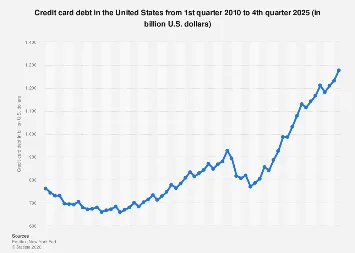
The landscape of consumer finance in the United States is currently characterized by a significant and accelerating buildup of credit card debt, with projections indicating a peak in aggregate balances by the fourth quarter of 2025, reaching unprecedented levels. This burgeoning indebtedness is not a sudden phenomenon but rather a complex interplay of economic conditions, evolving consumer behaviors, and the strategic maneuvering of major financial institutions. While the COVID-19 pandemic initially spurred a temporary dip in credit card balances, the subsequent recovery and economic shifts have propelled the debt total to new heights, raising questions about household financial resilience and the broader economic implications.
The pandemic’s initial shockwaves, beginning in late 2019, saw a notable contraction in outstanding credit card debt. From an aggregate of an undisclosed figure in the final quarter of 2019, balances retreated to a lower undisclosed sum by the first quarter of 2021. This period of deleveraging was attributed to a confluence of factors, including government stimulus measures that bolstered savings, reduced consumer spending opportunities due to lockdowns, and a heightened sense of economic uncertainty that prompted a more cautious approach to borrowing. However, this contraction proved to be a temporary recalibration rather than a structural shift. As the economy reopened and inflation began to take hold, consumer spending rebounded, often facilitated by the very credit lines that had been previously reduced. This resurgence in spending, coupled with rising prices for goods and services, has fueled the current expansion of credit card balances.
The pervasive use of credit cards in American society underscores their integral role in daily commerce and financial management. By 2025, it is estimated that the penetration rate of credit cards among the U.S. population will exceed a substantial percentage, representing a significant increase of approximately seven percentage points since 2014. This widespread adoption is not accidental; it is driven by a deeply ingrained culture of convenience that prioritizes frictionless transactions, a sophisticated array of reward programs designed to incentivize spending, and a fundamental consumer preference for the flexibility of deferred payments. For many Americans, credit cards have become more than just a payment method; they are a tool for managing cash flow, accessing immediate purchasing power, and accumulating benefits, from travel miles to cashback rewards. This reliance on credit for everyday purchases and larger expenditures creates a continuous demand for credit card services and contributes to the sustained growth of outstanding balances.
The credit card issuing market in the United States is a highly concentrated arena dominated by a handful of financial behemoths. In 2024, the transaction volumes processed by JPMorgan Chase & Co. and American Express underscored their preeminent positions, with each recording over one trillion U.S. dollars in credit card-related activity. Following closely behind, Citi and Capital One also demonstrated substantial market influence, with their respective credit card operations generating over half a trillion U.S. dollars in transactions. This oligopolistic structure is further reinforced by the presence of other major players such as Bank of America, Synchrony Financial, and Wells Fargo. These industry titans have cultivated dominant market shares through a combination of extensive customer bases, meticulously crafted and appealing reward structures, and a continuous stream of competitive product offerings. Their ability to leverage economies of scale, invest heavily in technology and marketing, and manage vast portfolios of risk allows them to maintain a commanding presence, making them the default choices for a significant portion of American credit card consumers. The ongoing competition among these issuers often centers on attracting and retaining cardholders through enhanced rewards, lower introductory interest rates, and specialized card features catering to diverse consumer needs, further solidifying their market dominance.
The economic implications of this expanding credit card debt are multifaceted. On one hand, robust credit card usage can signal consumer confidence and contribute to economic growth by facilitating spending. However, the increasing burden of debt also raises concerns about household financial stability, particularly for lower-income demographics who may be more susceptible to interest rate fluctuations and economic downturns. The average credit card interest rate, hovering around 20% and often higher for those with less-than-perfect credit, means that carrying a balance can become prohibitively expensive, leading to a cycle of debt accumulation. This can strain household budgets, reduce discretionary spending, and potentially lead to increased delinquencies and defaults, which can have ripple effects throughout the financial system.
Moreover, the growth in credit card debt occurs within a broader context of rising interest rates globally, as central banks endeavor to combat persistent inflation. While the U.S. Federal Reserve has implemented several rate hikes, the full impact on consumer borrowing costs is still unfolding. For individuals carrying substantial credit card balances, these rising rates translate directly into higher monthly payments, potentially exacerbating financial pressures. The long-term sustainability of current spending patterns fueled by credit remains a key question for economists and policymakers alike.
Globally, the U.S. consumer credit card market is one of the largest and most sophisticated. While many developed nations also see significant credit card usage, the scale and the reliance on revolving credit for everyday purchases are particularly pronounced in the United States. European markets, for instance, often exhibit a greater reliance on debit cards and bank transfers, with credit card penetration and balances typically lower in proportion to GDP. This difference can be attributed to varying cultural attitudes towards debt, differing regulatory environments, and the availability of alternative payment methods.
The sustained growth in credit card debt highlights the ongoing evolution of consumer financial behavior and the strategic imperatives of major financial institutions. As the United States navigates this period of elevated indebtedness, close monitoring of household financial health, interest rate trends, and the potential for increased financial distress will be crucial for understanding the broader economic outlook. The ability of consumers to manage their growing credit card obligations, coupled with the strategies employed by issuers to manage risk and attract new customers, will shape the trajectory of this vital segment of the U.S. economy in the years to come.