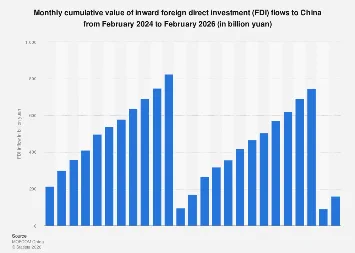
Foreign direct investment (FDI) inflows into China experienced a contraction in February 2026, with preliminary figures indicating a notable decrease compared to the same period in the previous year. While precise figures for February 2026 remain under embargo for non- subscribers, the trend suggests a continuation of cautious global investment sentiment, impacting one of the world’s largest economies. This slowdown in FDI, a critical barometer of international confidence and economic integration, warrants a deeper examination of the underlying factors and their potential ramifications.
The preliminary data for February 2026 revealed a decline in FDI inflows. This follows a broader trend observed in recent months, as global economic uncertainties, geopolitical tensions, and evolving regulatory environments contribute to a more hesitant approach by international corporations when allocating capital. For context, revised annual figures from 2024 showed total FDI flows to China reaching approximately $***** billion U.S. dollars. The specific monthly performance in February 2026, however, indicates a sequential dip, with the percentage decrease compared to the prior year being a significant indicator of evolving investment patterns.
Several macroeconomic and geopolitical forces are likely influencing this downward trajectory. The global economic outlook, characterized by persistent inflation, rising interest rates in major developed economies, and concerns over potential recessions, compels businesses to reassess their expansion strategies. Companies are increasingly prioritizing capital preservation and operational resilience over aggressive global diversification. Furthermore, the ongoing recalibration of global supply chains, with a growing emphasis on resilience and regionalization, may also be influencing investment decisions, potentially diverting some capital away from traditional manufacturing hubs.
China’s own policy landscape also plays a crucial role. While the government has consistently sought to attract foreign investment, regulatory shifts, increased scrutiny on certain sectors, and evolving data security laws can create uncertainty for foreign investors. The emphasis on national security and technological self-sufficiency, while strategically important for China, can sometimes be perceived as creating a less predictable operating environment for foreign entities. This delicate balance between fostering openness and ensuring domestic security is a continuous challenge for policymakers.
The impact of this FDI slowdown extends beyond mere statistical figures. FDI is a vital engine for economic growth, facilitating technology transfer, job creation, and the introduction of new management practices. A sustained decline in inflows could temper China’s economic expansion, affect its competitiveness in certain industries, and potentially influence its role in global value chains. For multinational corporations already established in China, it could signal a need for greater operational efficiency and a more cautious approach to reinvestment and expansion.
Looking at broader market data, the overall global FDI landscape has also shown signs of moderation. According to the United Nations Conference on Trade and Development (UNCTAD), global FDI flows have experienced fluctuations in recent years, reflecting the complex interplay of economic, political, and social factors. While China has historically been a primary recipient of FDI, its relative attractiveness can shift depending on global opportunities and the perceived risks and rewards associated with investing in different regions. Emerging markets in Southeast Asia, for instance, have increasingly become attractive alternatives for some investors seeking growth and diversification.
Expert analysis suggests that the current dip in China’s FDI is likely a confluence of global headwinds and domestic adjustments. Dr. Evelyn Reed, a senior economist specializing in Asian markets, notes, "The February figures, while preliminary, are consistent with a broader global trend of investor caution. However, we must also consider China’s own evolving economic model and regulatory framework. Investors are seeking clarity and stability, and any perceived shifts can lead to a temporary pause in capital deployment." She further elaborates that sectors heavily reliant on foreign capital, such as advanced manufacturing, technology, and certain consumer-facing industries, will be most sensitive to these trends.
The implications for the broader Chinese economy are multifaceted. A sustained decline in FDI could put pressure on the country’s balance of payments, impact currency valuations, and potentially slow down innovation and productivity growth. On the other hand, China’s domestic market remains vast and dynamic, and internal investment and consumption continue to be significant drivers of economic activity. The government’s focus on boosting domestic demand and fostering innovation within its borders may offer some buffer against external investment fluctuations.
Moreover, the nature of FDI is also evolving. There is a growing emphasis on "quality" FDI, which brings advanced technology, high-value jobs, and contributes to sustainable development, rather than simply volume. China’s efforts to attract investment in sectors like renewable energy, advanced materials, and high-tech manufacturing reflect this strategic shift. The success of these initiatives will be crucial in mitigating the impact of any slowdown in traditional FDI inflows.
The global comparison is also noteworthy. While China’s FDI may be experiencing a dip, other major economies are also navigating similar challenges. The United States, for example, continues to be a significant FDI destination, but it too faces its own set of economic and geopolitical considerations. European nations are also actively seeking to attract foreign investment, often emphasizing their commitment to sustainability and innovation. The competitive landscape for global capital is therefore intense, requiring all major economies to adapt and demonstrate their long-term value proposition.
In conclusion, the preliminary data indicating a contraction in China’s FDI inflows for February 2026 underscores the complex and dynamic nature of the global investment environment. While global economic uncertainties and geopolitical shifts are significant contributing factors, China’s own policy decisions and regulatory landscape also play a pivotal role. The nation’s ability to navigate these challenges, attract high-quality investment, and maintain its economic dynamism will be crucial in the coming months and years, influencing not only its own development but also the broader trajectory of the global economy. The coming fiscal quarters will provide a clearer picture of whether this February decline represents a temporary adjustment or a more sustained shift in international capital flows towards China.