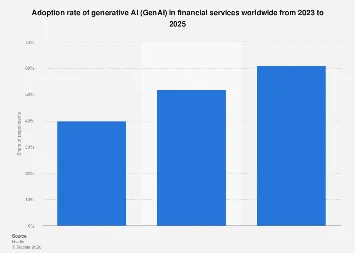
The financial services sector has experienced a dramatic surge in the adoption of generative artificial intelligence (GenAI) throughout 2025. A significant percentage of industry players are now actively integrating this transformative technology, marking a substantial increase from the previous year. This widespread embrace signals a fundamental shift in how financial institutions operate, interact with customers, and develop new products and services.
The primary driver behind this rapid GenAI integration is the pursuit of enhanced customer experience and engagement. Financial firms are leveraging the capabilities of GenAI to create more sophisticated and responsive customer-facing applications. This includes the deployment of advanced chatbots capable of handling complex queries, the development of intelligent virtual assistants that offer personalized guidance, and the implementation of AI-powered tools to support customer service agents, enabling them to provide faster and more accurate assistance. These applications are not merely automating existing processes but are fundamentally reshaping the customer journey, making it more seamless, intuitive, and tailored to individual needs.
This trend is part of a broader digital transformation within the financial industry, where AI has been a growing area of investment for years. However, GenAI’s ability to generate human-like text, code, and even creative content has unlocked new possibilities that were previously beyond reach. The insights from a comprehensive survey of 839 respondents across various financial services segments—including asset managers, banks, insurers, fintechs, and regulators—reveal a clear trajectory of increasing GenAI adoption from 2023 through 2025. The survey, which included an even split between management and AI practitioners, also noted a diverse representation of company sizes, with a third of respondents from firms generating over $250 million in annual revenue and 40 percent from organizations exceeding 500 employees. This broad participation underscores the pervasive nature of GenAI’s impact across the financial landscape.
The strategic imperative to innovate and maintain a competitive edge in a rapidly evolving market is compelling financial institutions to explore and implement GenAI solutions. Beyond customer-facing applications, the technology is being explored for a multitude of internal use cases, ranging from risk management and fraud detection to algorithmic trading and personalized financial advice. The ability of GenAI to process vast amounts of data, identify patterns, and generate insights at an unprecedented speed offers significant potential for optimizing operational efficiency and mitigating financial risks.
Global Market Dynamics and Investment Trends
The global market for AI in financial services is experiencing robust growth, with GenAI emerging as a key catalyst. Venture capital funding has flowed into AI startups targeting the financial sector, and established technology providers are rapidly expanding their GenAI offerings to meet the demand. This investment surge is not limited to North America and Europe; Asia, particularly China, is also a significant player in AI adoption, driven by government initiatives and a large tech-savvy population.
According to market analysis, the global AI in financial services market size was valued at tens of billions of dollars in recent years and is projected to grow at a compound annual growth rate (CAGR) well into the double digits over the next decade. GenAI is expected to capture a substantial portion of this growth, as its unique capabilities address some of the most pressing challenges and opportunities in the industry. The ability to automate complex tasks, personalize customer interactions at scale, and generate novel solutions positions GenAI as a critical component of future financial infrastructure.
The strategic implementation of GenAI is also influenced by regulatory landscapes. While regulators are keen to foster innovation, they are also focused on ensuring the ethical and responsible use of AI, particularly concerning data privacy, bias, and financial stability. Financial institutions are therefore investing not only in the technology itself but also in robust governance frameworks and compliance measures to navigate this complex environment.
Economic Impact and Future Outlook
The widespread adoption of GenAI in financial services is poised to have a profound economic impact. Increased efficiency and productivity can lead to cost savings for institutions, which can then be passed on to consumers in the form of lower fees or improved services. Furthermore, GenAI’s ability to facilitate new product development and personalized financial solutions could drive economic growth by enabling greater access to capital and investment opportunities.
However, the rapid integration of AI also raises questions about the future of work in the financial sector. While AI is expected to automate certain roles, it is also projected to create new jobs requiring specialized skills in AI development, data science, and AI ethics. Financial institutions will need to invest in reskilling and upskilling their workforce to adapt to these changes.
The survey data indicates a clear upward trend, suggesting that by 2025, a substantial majority of financial services firms will have some form of GenAI integration. This includes not only large, established players but also nimble fintech companies that are leveraging AI to disrupt traditional business models. The competitive landscape is likely to become increasingly bifurcated, with firms that effectively harness GenAI gaining a significant advantage over those that lag behind.
Looking ahead, the evolution of GenAI in financial services will likely be characterized by continuous innovation. As the technology matures, we can expect to see more sophisticated applications, such as AI-powered financial planning advisors that can manage complex portfolios, automated compliance systems that can adapt to changing regulations in real-time, and hyper-personalized insurance products that dynamically adjust to individual risk profiles. The journey of GenAI adoption in finance is still in its early stages, but its transformative potential is undeniable, promising to reshape the industry for decades to come. The strategic imperative is clear: embrace the change, invest wisely, and prepare for a future where artificial intelligence is an indispensable partner in financial innovation and service delivery.