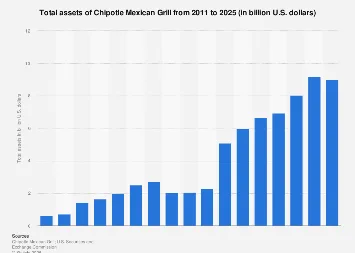
Chipotle Mexican Grill, a titan in the fast-casual dining sector, is poised for continued asset growth in the coming years, with projections indicating a significant upward trajectory for its total assets through 2025. This anticipated expansion is not an isolated phenomenon but rather a reflection of broader trends within the quick-service restaurant (QSR) and fast-casual markets, coupled with Chipotle’s distinct strategic initiatives aimed at enhancing its operational footprint and financial robustness. While precise, up-to-the-minute asset figures often reside within proprietary financial databases requiring specific access, industry analysis and historical performance data provide a clear indication of Chipotle’s financial trajectory.
The company’s asset base, encompassing everything from its physical restaurant locations and kitchen equipment to its intellectual property, inventory, and cash reserves, is intrinsically linked to its growth strategy. Chipotle’s commitment to opening new restaurants, particularly in underserved markets and through various store formats like its Chipotlanes for enhanced drive-thru efficiency, directly translates into increased investment in property, plant, and equipment. This physical expansion is a primary driver of asset accumulation. Moreover, ongoing investments in technology, including digital ordering platforms, data analytics capabilities, and supply chain optimization tools, also contribute substantially to the company’s intangible and current asset valuations.
Globally, the fast-casual dining segment has demonstrated remarkable resilience and growth, outpacing many other retail sectors. According to market research firms, the global QSR market, of which fast-casual is a significant component, is projected to witness a compound annual growth rate (CAGR) of approximately 4-5% over the next five years. This robust market environment provides fertile ground for established players like Chipotle to expand their asset base. Countries across North America, Europe, and parts of Asia are witnessing increased consumer demand for convenient, higher-quality food options, aligning perfectly with Chipotle’s brand proposition. As Chipotle continues its international expansion, this will necessitate further investment in real estate, infrastructure, and local market penetration, thereby boosting its total assets.
Looking at the broader economic context, the projected growth in Chipotle’s assets can also be viewed through the lens of capital expenditure cycles and investor confidence. Companies with strong brand recognition, consistent revenue streams, and a clear vision for future growth typically attract significant investment, which in turn fuels asset acquisition. Chipotle’s consistent performance, including its ability to navigate economic headwinds and adapt to evolving consumer preferences, has bolstered investor confidence. This confidence is often reflected in the company’s stock performance and its capacity to secure financing for its expansion plans, thereby enabling the acquisition of new assets.
Statistics from financial reporting agencies, while often requiring subscription access for granular detail, consistently show a pattern of asset growth for leading QSR companies. For Chipotle, this growth is not merely about accumulating physical stores. It also involves significant investments in human capital through training and development programs, which, while not always directly reflected as tangible assets on a balance sheet, are crucial for operational excellence and long-term value creation. Furthermore, the company’s focus on sustainability and ethical sourcing, while incurring operational costs, also builds brand equity and can be considered an intangible asset, influencing its overall valuation and investor perception.
The competitive landscape also plays a role. As Chipotle strengthens its position, competitors are also vying for market share, often through aggressive expansion and technological innovation. To maintain and enhance its competitive edge, Chipotle must continually invest in its infrastructure, brand presence, and customer experience. This competitive pressure necessitates a proactive approach to asset management and acquisition, ensuring that the company remains at the forefront of the industry. For instance, investments in advanced kitchen technology to improve order accuracy and speed, or the deployment of sophisticated inventory management systems to reduce waste and optimize costs, are critical asset-building activities.
Analyzing specific asset categories, property, plant, and equipment (PP&E) will likely constitute the largest portion of Chipotle’s asset growth. Each new restaurant opening represents a significant capital outlay for land, building construction or leasehold improvements, and kitchen equipment. The company’s strategic decision to prioritize drive-thru and pickup channels, often incorporated into newer store designs and existing remodels, requires specific infrastructure investments that enhance efficiency and cater to evolving consumer behavior. This focus on optimizing the physical store footprint for digital orders is a key aspect of their asset strategy.
Beyond physical assets, Chipotle’s investment in technology and digital infrastructure is a rapidly growing component of its asset base. This includes investments in its mobile app, online ordering systems, data analytics platforms for customer insights, and back-end operational software. These technological assets are crucial for enhancing customer convenience, personalizing marketing efforts, and improving operational efficiency. The ongoing digital transformation across the retail and food service sectors means that companies like Chipotle must continuously allocate capital to maintain and upgrade these digital capabilities.
Inventory and cash reserves also contribute to total assets. As the company expands its store count and sales volume, its inventory levels, consisting of food and beverage supplies, will naturally increase. Similarly, healthy cash reserves are essential for managing operational expenses, investing in new ventures, and providing a buffer against economic uncertainties. Chipotle’s financial management and profitability will directly influence its ability to maintain and grow these liquid assets.
Economically, the growth in Chipotle’s assets signals a positive outlook for job creation, both directly within its stores and indirectly through its supply chain and construction partners. Each new restaurant opening typically creates dozens of local jobs, contributing to community economic development. Furthermore, the company’s investments in technology and infrastructure can spur innovation and demand within related industries, such as software development, equipment manufacturing, and construction services.
In conclusion, while specific figures for Chipotle Mexican Grill’s total assets in 2025 are proprietary, the trajectory of its growth is evident. Driven by a combination of robust market demand for fast-casual dining, strategic investments in physical expansion and digital innovation, and a commitment to operational excellence, the company is expected to continue its pattern of asset accumulation. This growth is not only a testament to Chipotle’s business acumen but also a significant contributor to broader economic activity, job creation, and technological advancement within the global food service industry. The company’s ability to adapt to changing consumer habits and leverage technology will be paramount in sustaining this asset growth and solidifying its position as an industry leader.