Germany, Europe’s economic powerhouse, has been on a protracted journey through fluctuating inflationary pressures and corresponding monetary policy recalibrations, with the period between early 2018 and the beginning of 2026 offering a stark illustration of these macroeconomic dynamics. Over this span, the nation’s inflation rate, a crucial barometer of economic health, exhibited significant swings, moving from a period of relative quiescence to a sharp ascent and subsequent, albeit uneven, deceleration. This complex interplay between price stability and central bank action has had profound implications for businesses, consumers, and the broader Eurozone economy.
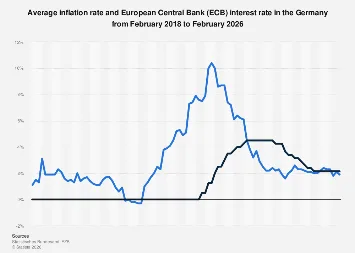
In the initial phase of this observation period, from February 2018, Germany’s inflation rate largely maintained a moderate trajectory, oscillating between a low of 0.3 percent and a high of 3.1 percent. This environment was characterized by relatively stable demand and controlled cost pressures, a familiar landscape for policymakers. However, this equilibrium began to erode, setting the stage for a dramatic upswing. By October 2022, the Consumer Price Index (CPI) reached an alarming zenith of 10.4 percent. This surge, mirroring broader global trends fueled by supply chain disruptions exacerbated by geopolitical events, soaring energy prices, and a rebound in post-pandemic demand, presented a formidable challenge to the European Central Bank (ECB) and its mandate for price stability. The sheer magnitude of this spike underscored the fragility of economic recovery and the potent impact of external shocks.
The subsequent period witnessed a concerted effort to rein in this inflationary spiral. By September 2024, a noticeable moderation had taken hold, with the inflation rate falling to a more manageable 1.6 percent. This deceleration was a testament to the effectiveness of earlier monetary tightening measures and a gradual easing of some of the most acute supply-side pressures. However, the respite proved to be temporary. As the calendar turned towards the end of 2024, inflationary forces began to reassert themselves. By December of that year, the inflation rate had climbed back to 2.6 percent, signaling that the battle against rising prices was far from over. This resurgence highlighted the persistence of underlying inflationary dynamics, potentially including wage pressures and the pass-through of earlier cost increases into final goods and services.
The first half of 2025 offered a period of relative stability, with inflation hovering around the 2.1 percent mark in May. This stabilization, while a welcome development, still indicated inflation remaining above the ECB’s medium-term target of 2 percent, a threshold considered optimal for fostering sustainable economic growth without distorting price signals. The continued presence of inflation above target necessitated a cautious approach from monetary authorities.
In response to the escalating inflationary pressures that began to manifest in earnest in 2022, the European Central Bank embarked on a significant policy pivot. For an extended period, the ECB had maintained historically low, even negative, interest rates, a strategy designed to stimulate economic activity and combat deflationary risks. However, the inflationary surge necessitated a reversal of this accommodative stance. In July 2022, the ECB executed its first interest rate hike since March 2016, raising its benchmark rate to 0.5 percent. This marked a watershed moment, signaling a clear shift in the central bank’s priorities.
The rate hikes continued in a determined fashion, reflecting the ECB’s commitment to anchoring inflation expectations. By September 2023, the interest rate had ascended to 4.5 percent, a level that remained in place through June 2024. This sustained period of elevated borrowing costs was designed to cool demand, curb excessive spending, and thereby reduce inflationary pressures across the Eurozone, with Germany as its largest constituent economy bearing significant impact. The higher interest rates made borrowing more expensive for businesses and consumers, impacting investment decisions and consumption patterns. For Germany’s export-oriented economy, this translated into higher financing costs for its trading partners and a potential dampening of global demand for its goods.
A significant policy shift occurred in June 2024, when the ECB, in response to further signs of moderating inflation and a growing concern about the potential for an economic slowdown, implemented its first rate cut of this tightening cycle. This move signaled a recalibration of the central bank’s strategy, acknowledging that the balance of risks might be shifting. The subsequent months of 2024 saw a series of further rate reductions, culminating in a benchmark rate of 3.15 percent by the end of the year. This series of cuts indicated a growing confidence within the ECB that inflationary pressures were sufficiently subdued to allow for a gradual easing of monetary policy, aiming to support economic growth without reigniting inflation.
The trend of monetary easing continued into the first half of 2025. The ECB continued its program of rate cuts, further reducing borrowing costs for businesses and consumers. By June 2025, the key interest rate had been lowered to 2.15 percent. This continued descent suggested a proactive approach to preemptively address any emerging signs of economic weakness and to ensure that monetary policy remained supportive of a healthy growth trajectory.
As of February 2026, the economic landscape presented a picture of relative equilibrium. The inflation rate stood at 1.9 percent, a figure that had moved closer to the ECB’s target, suggesting that the period of intense inflationary pressure had largely subsided. Concurrently, the ECB’s benchmark interest rate was maintained at 2.15 percent. This alignment of inflation and interest rates indicated a central bank operating within its comfort zone, balancing the need to maintain price stability with the objective of fostering sustainable economic expansion. The journey from the double-digit inflation rates of 2022 to this more stable environment reflects a complex interplay of global economic forces, the resilience of the German economy, and the decisive, albeit evolving, policy responses of the European Central Bank. The experience underscores the challenges of managing a large, integrated economy within a currency union, where domestic policies must navigate both national specificities and the broader Eurozone context. Looking ahead, vigilance will remain paramount as policymakers continue to monitor economic indicators for any signs of renewed inflationary pressures or unexpected slowdowns, ensuring that Germany and the wider Eurozone can sustain their path towards stable and robust economic growth.