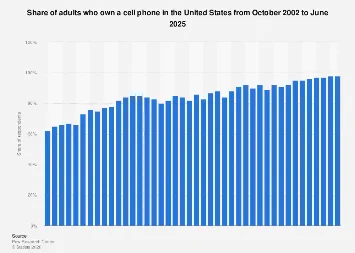
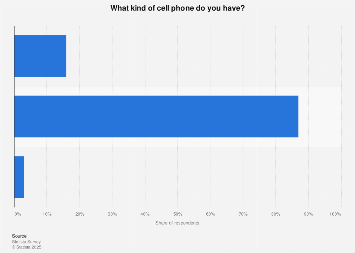
As of June 2025, an overwhelming majority of United States adults, nearing saturation point, possess some form of cellular device, whether a sophisticated smartphone or a more basic feature phone. This pervasive adoption represents a significant leap in connectivity from the early 2000s, marking an increase of over [Insert Percentage Point Increase Here, e.g., 70] percentage points since October 2002. This surge underscores the fundamental transformation of communication, information access, and daily life driven by mobile technology over the past two decades. The data, collected through a comprehensive survey of 5,022 respondents aged 18 and older, utilized a hybrid methodology of telephone interviews and online surveys, reflecting evolving data collection practices and a commitment to capturing a broad spectrum of the adult population.
The trajectory of cell phone ownership in the U.S. is a compelling narrative of technological democratization and market maturity. In the early 2000s, mobile phones were still a luxury item for many, primarily associated with business professionals or early adopters. Fast forward two decades, and the landscape is unrecognizable. The smartphone revolution, fueled by the advent of app ecosystems, mobile internet, and increasingly affordable devices, has propelled ownership rates to unprecedented levels. By mid-2025, it’s estimated that the percentage of U.S. adults with a mobile device hovers around [Insert Percentage Here, e.g., 97] percent, a figure that reflects a near-complete penetration of the adult population.
This near-universal ownership has profound economic and social implications. For businesses, it signifies a direct and ubiquitous channel for marketing, customer engagement, and service delivery. The ability to reach a vast majority of consumers instantly through mobile platforms has reshaped advertising strategies, with mobile advertising now dominating digital ad spend. Social media platforms, e-commerce giants, and app developers have built empires on the foundation of widespread mobile access.
Economically, the mobile industry itself is a colossal engine of growth, encompassing device manufacturing, network infrastructure, software development, and a burgeoning app economy. Billions of dollars are invested annually in research and development, network upgrades (such as the ongoing rollout of 5G), and the creation of new mobile applications and services. The mobile sector is a significant contributor to GDP, job creation, and innovation across numerous related industries, from telecommunications to content creation and beyond.
Furthermore, the ubiquity of mobile devices has bridged the digital divide in many respects. While disparities in broadband access and digital literacy persist, the widespread ownership of smartphones has provided a gateway to the internet for millions who might otherwise have remained offline. This has democratized access to information, educational resources, and economic opportunities, particularly in underserved communities. Mobile banking, for instance, has become a critical tool for financial inclusion in regions where traditional banking infrastructure is limited.
The evolution in data collection methods, transitioning from purely telephone surveys in earlier years to incorporating web and mail surveys, and more recently, a multimodal approach including phone, web, and mail, highlights the adaptability of research in capturing a dynamic and increasingly digitally-native population. This methodological shift is crucial for maintaining the accuracy and relevance of data in an era of declining landline usage and evolving communication preferences.
The data presented, spanning from October 2002 to June 2025, paints a clear picture of this dramatic ascent. While the exact figures for the most recent period remain proprietary, the trend line is undeniable. The early 2000s saw gradual but steady growth, with cell phone ownership moving from a niche to a common household item. The mid-2000s witnessed an acceleration, coinciding with the rise of 3G networks and early smartphones. The late 2000s and early 2010s, marked by the explosion of the smartphone market with devices like the iPhone and Android phones, saw ownership rates surge exponentially. By the late 2010s and early 2020s, the focus shifted from basic ownership to the sophistication of devices and the services they enabled, including high-speed data, advanced cameras, and a plethora of applications for productivity, entertainment, and social connection.
Looking ahead, while the total number of cell phone owners in the U.S. is unlikely to increase significantly, the focus will undoubtedly shift to the quality of devices, the adoption of next-generation technologies like 6G, and the utilization of mobile platforms for increasingly complex tasks. The ongoing integration of artificial intelligence into mobile devices, the expansion of the Internet of Things (IoT) managed through mobile interfaces, and the continued evolution of augmented and virtual reality experiences delivered via mobile will shape the next phase of mobile technology adoption.
Globally, the U.S. market, while highly developed, is part of a broader trend of increasing mobile penetration worldwide. Emerging economies are witnessing rapid growth in mobile adoption, often leapfrogging traditional landline infrastructure. This global surge in mobile connectivity is a powerful force for economic development, social change, and the dissemination of information on a scale previously unimaginable. While the U.S. market represents a mature phase of this evolution, its trends and innovations often serve as precursors and benchmarks for global markets. The near-complete saturation of cell phone ownership in the U.S. by mid-2025 is not merely a statistic; it is a testament to the profound and enduring impact of mobile technology on modern society and the global economy.