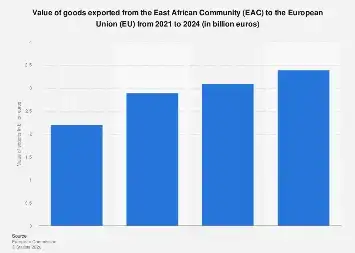
The East African Community (EAC) has witnessed a significant upswing in its merchandise exports to the European Union (EU) in 2024, with the total value reaching an estimated €XX billion. This represents a substantial increase of approximately seven percent compared to the preceding year, underscoring the growing economic ties and the increasing demand for East African products within the lucrative European market. This upward trajectory builds upon a solid foundation, as EAC exports to the EU stood at €XX billion in 2021, a figure that has steadily climbed over the subsequent years.
The composition of these exports highlights the region’s agricultural and natural resource strengths. Key commodities driving this trade relationship include a diverse range of agricultural products such as coffee, tea, and fresh vegetables, alongside high-value horticultural items like cut flowers. Additionally, the EAC is a notable supplier of fish and tobacco to the EU market, indicating a diversified export portfolio that caters to various consumer preferences and industrial demands.
This burgeoning trade flow is not merely a statistical blip; it reflects deeper economic dynamics at play. The EAC, comprising Burundi, Kenya, Rwanda, Tanzania, and Uganda, is increasingly positioning itself as a vital trading bloc within the African continent and on the global stage. The preferential trade agreements and ongoing efforts to harmonize trade policies within the EAC are likely contributing to this enhanced export performance. By streamlining customs procedures, reducing non-tariff barriers, and fostering a more predictable business environment, member states are better equipped to compete in international markets.
The European Union, as one of the world’s largest economic blocs, offers a substantial and sophisticated market for goods. For the EAC, access to this market is crucial for economic development, foreign exchange earnings, and job creation. The consistent growth in exports suggests that EAC producers are effectively meeting the quality standards, regulatory requirements, and consumer expectations of the EU. This is particularly important for agricultural products, which often face stringent import regulations related to food safety, phytosanitary measures, and sustainability.
Analyzing the specific product categories further, coffee and tea remain perennial strong performers, capitalizing on the EU’s strong demand for these beverages. The cut flower industry, heavily concentrated in countries like Kenya, has also demonstrated remarkable resilience and growth, driven by the EU’s appetite for floral decorations and gifting. The inclusion of fish and vegetables in the export basket points to the diversification of the EAC’s primary sector exports, moving beyond traditional commodities to include more perishable and higher-value items. This diversification requires sophisticated logistics, cold chain infrastructure, and adherence to strict quality control measures, all of which indicate an evolving capacity within the EAC.
The economic impact of these exports extends beyond the immediate financial gains. Increased export revenues can be reinvested into domestic economies, supporting infrastructure development, technological upgrades in production, and social programs. For instance, the horticultural sector often employs a significant number of women, making export growth a critical factor in gender empowerment and rural development. Furthermore, a robust export sector attracts foreign direct investment (FDI) as international buyers and investors seek to secure supply chains and capitalize on the region’s production capabilities.
Looking at global trade patterns, the EAC’s performance in exporting to the EU can be contextualized within broader trends of South-South and South-North trade. As developing economies become increasingly interconnected, regions like East Africa are leveraging their comparative advantages to carve out significant market shares. The EU’s trade policy towards African nations, often characterized by agreements like the Economic Partnership Agreements (EPAs), aims to foster sustainable development and create reciprocal trade relationships. The current export figures suggest that these policies, combined with the EAC’s own initiatives, are yielding positive results.
However, challenges remain. Global economic uncertainties, fluctuations in commodity prices, and geopolitical events can all impact export volumes and values. Climate change also poses a significant threat to agricultural output, which forms the backbone of many EAC exports. Producers and governments must continue to invest in climate-resilient agriculture, sustainable farming practices, and robust risk management strategies to ensure the long-term sustainability of these trade flows.
Moreover, the EAC faces the ongoing challenge of value addition. While exporting raw or semi-processed goods is beneficial, further processing and manufacturing within the EAC could significantly boost export revenues and create more skilled employment opportunities. Developing processing facilities for coffee, tea, fish, and fruits, for instance, would allow the region to capture a larger share of the final product’s value. This requires not only investment in machinery and technology but also in human capital and research and development.
The EU’s commitment to sustainable trade and environmental standards is also a key factor. EAC exporters are increasingly being required to demonstrate compliance with a range of environmental, social, and governance (ESG) criteria. While this presents a compliance hurdle, it also offers an opportunity for EAC producers to differentiate themselves in the market and attract ethically conscious consumers and businesses in the EU. Investments in sustainable practices, organic farming, and fair labor conditions can thus translate into a competitive advantage.
The data from 2021 to 2024 paints a picture of a dynamic and growing economic partnership. The consistent year-on-year increase in export value from the EAC to the EU, culminating in the significant figures for 2024, is a testament to the region’s economic potential and its increasing integration into global value chains. As the EAC continues to pursue economic diversification, infrastructure development, and policy reforms, its role as a key supplier of agricultural and other goods to the European market is likely to strengthen further, offering mutual benefits for both regions. The ongoing evolution of this trade relationship will be closely watched as an indicator of broader economic trends and development outcomes across East Africa.