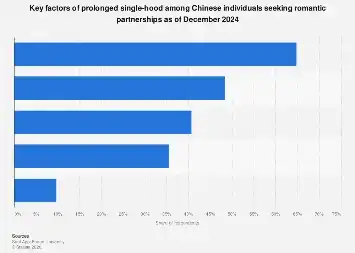
The burgeoning demographic of single individuals in China, a significant portion of whom express a desire for partnership, points to a complex interplay of evolving social norms, economic pressures, and demographic shifts that are reshaping the nation’s relational fabric. Recent survey data, encompassing approximately 8,000 single respondents, reveals that a substantial 76.8 percent are actively seeking romantic relationships, a figure that underscores a persistent societal aspiration for companionship amidst changing life circumstances. This underlying desire, however, is juxtaposed against the realities that contribute to the increasing prevalence of singlehood, presenting a multifaceted challenge with far-reaching economic and social implications.
The survey’s gender distribution, with 61 percent male respondents and 39 percent female, offers a crucial lens through which to understand potential disparities in relationship formation. This imbalance, while not unique to China, can exacerbate existing pressures. In many traditional societies, including aspects of Chinese culture, there’s an expectation for men to initiate relationships and often to possess greater financial stability before marriage. A higher proportion of single men could indicate greater difficulty in meeting these expectations, potentially leading to increased social and economic strain. This gender gap in the single population is a demographic anomaly that has been discussed for decades, stemming partly from historical population control policies and a cultural preference for male offspring, which has led to a surplus of men in certain age cohorts.
Geographically, the survey highlights a significant concentration of single individuals residing in ordinary prefecture-level cities (36 percent), followed by new tier-1 cities (23 percent), tier-2 capitals (18 percent), and tier-1 megacities (14 percent). A smaller segment (9 percent) originates from rural or overseas areas. This distribution suggests that while urban centers are experiencing a notable number of singles, the phenomenon is not confined to the most developed metropolises. The prevalence in prefecture-level cities might reflect a growing desire for partnership as these areas develop economically and socially, offering more opportunities but also introducing the pressures associated with modern dating. Conversely, the presence of singles in tier-1 megacities, despite their economic dynamism, could be attributed to intense career pressures, high living costs, and a more individualistic lifestyle that may prioritize personal advancement over immediate relationship commitments. The dispersion across various urban tiers indicates that the factors contributing to singlehood are embedded within China’s diverse economic and social landscapes.
The age demographics provide further insight. The largest cohort of singles falls within the 25-29 year age bracket (30 percent), closely followed by the 30-34 year group (24 percent), and then the 18-24 year olds (23 percent). The 35+ age group accounts for the remaining 23 percent. This clustering in the late twenties and early thirties is particularly significant. This is a demographic typically at the peak of their career development and earning potential, yet also facing increasing societal and familial pressure to marry and start a family. The fact that a considerable portion of these individuals remain single, despite expressing a desire for relationships, points towards obstacles that transcend personal choice, likely encompassing economic realities and evolving societal expectations. The 18-24 age group, while also a significant segment, represents a younger demographic who may still be exploring life choices or are in earlier stages of their educational and professional journeys, where relationship formation might not be the immediate priority.
Several economic factors are likely at play in this evolving landscape. The soaring cost of living, particularly in major urban centers, presents a formidable barrier to marriage and family formation. High housing prices, coupled with the expense of raising children and providing education, can create a significant financial burden that deters individuals from entering into long-term commitments. This is further amplified by increasing expectations around financial stability for men, who are often still perceived as the primary providers. The competitive job market, characterized by demanding work cultures like the "996" (9 am to 9 pm, six days a week) in some sectors, leaves individuals with limited time and energy for dating and relationship building. The pursuit of career advancement, driven by both personal ambition and economic necessity, can thus inadvertently sideline romantic pursuits.
Socially, China has witnessed a rapid transformation in its cultural norms. The one-child policy, while now relaxed, has left a lasting demographic imprint, contributing to the gender imbalance and altering traditional family structures. Furthermore, increased access to education, particularly for women, has led to greater economic independence and a broader range of life aspirations. Many educated women are now prioritizing personal and professional growth, delaying marriage or choosing not to marry at all. This shift in female agency, while a positive development for gender equality, can also contribute to the pool of single individuals, as traditional courtship patterns may no longer align with contemporary expectations. The rise of individualism and the influence of globalized culture also play a role, encouraging more diverse definitions of success and personal fulfillment that may not always include traditional marriage.
The economic implications of a growing single population are substantial and varied. On one hand, single individuals often have higher disposable incomes, as they have fewer dependents and shared financial responsibilities. This can stimulate consumption in sectors such as dining, entertainment, travel, and personal goods. The "single economy," or "singles economy," is a recognized market segment, with businesses tailoring products and services to cater to the needs and desires of this demographic. However, a prolonged trend of delayed marriage and declining birth rates could pose significant challenges to long-term economic growth. A shrinking workforce, an aging population, and reduced domestic demand in the future are potential consequences that policymakers are increasingly scrutinizing. The declining fertility rate, a global concern, is particularly pronounced in China, with implications for social security systems, healthcare, and the overall demographic dividend that has fueled China’s economic ascent.
Expert analysis suggests that these trends are not isolated but are part of broader global shifts towards later marriages and smaller family sizes, influenced by urbanization, education, and economic development. However, the scale and pace of change in China, coupled with its unique demographic history, make its situation particularly noteworthy. Economists are closely monitoring how this demographic shift will impact consumption patterns, labor markets, and the future trajectory of China’s economic development. Policy responses, such as incentives for childbirth and efforts to ease the financial burdens of raising children, are being debated and implemented, but their effectiveness in reversing these deep-seated trends remains to be seen. The desire for relationships expressed by a majority of single respondents suggests that while the path to partnership may be fraught with challenges, the fundamental human need for connection and companionship remains strong, underscoring the ongoing societal evolution within the world’s most populous nation.