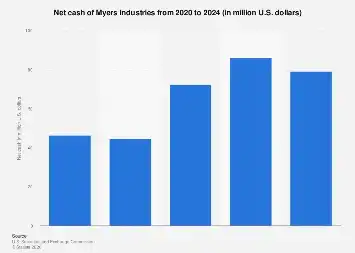
Myers Industries, a prominent player in the manufacturing of polymer products, is currently navigating a complex financial environment as businesses worldwide assess their liquidity and cash reserves in anticipation of and response to evolving economic conditions. While specific, up-to-the-minute net cash figures for 2024 remain proprietary data typically accessible through premium subscriptions on financial data platforms, an examination of the company’s financial health and the broader economic context provides crucial insights into its likely strategic positioning. Understanding a company’s net cash position is paramount for investors, creditors, and analysts seeking to gauge its short-term solvency, operational flexibility, and capacity for future investment or strategic maneuvers.
The concept of "net cash" generally refers to a company’s total cash and cash equivalents minus its short-term debt. This metric offers a snapshot of readily available funds to meet immediate obligations. For a manufacturing entity like Myers Industries, a robust net cash position is particularly vital. It underpins the ability to manage fluctuating raw material costs, sustain payrolls during periods of market volatility, and capitalize on unforeseen opportunities, such as acquiring distressed assets or investing in new production technologies. In the current global economic climate, characterized by persistent inflation, interest rate hikes, and geopolitical uncertainties, maintaining a healthy cash buffer has become a strategic imperative rather than a mere accounting entry.
Myers Industries operates within a sector that is inherently sensitive to economic cycles. Demand for its products, which range from material handling containers and reusable packaging to agricultural products and recreational vehicle components, is closely tied to the health of consumer spending, industrial production, and infrastructure development. Consequently, the company’s financial performance, including its cash generation capabilities, is influenced by a confluence of macro-economic factors. For instance, a slowdown in construction or automotive manufacturing could directly impact sales volumes and, by extension, the cash inflows from operations. Conversely, a surge in e-commerce, a sector that heavily relies on efficient logistics and packaging solutions, could provide a significant tailwind.
To gain a more comprehensive understanding of Myers Industries’ financial standing, it is beneficial to consider its historical financial statements and the typical KPIs associated with balance sheets and cash flow statements. These typically include metrics such as operating cash flow, free cash flow, current ratio, and quick ratio, all of which shed light on different facets of liquidity and financial stability. Operating cash flow, for example, measures the cash generated from a company’s core business activities, while free cash flow represents the cash remaining after capital expenditures, indicating the funds available for debt repayment, dividends, or share buybacks. A consistently positive and growing trend in these figures would suggest strong underlying operational performance and effective cash management.
Furthermore, comparing Myers Industries’ financial metrics against industry benchmarks and its direct competitors is crucial for a nuanced assessment. The plastics and rubber products manufacturing industry, according to various industry reports, has experienced periods of margin pressure due to input cost volatility, particularly for petrochemical-based resins. Companies that have successfully managed these pressures, often through strategic sourcing, price adjustments, or operational efficiencies, are likely to exhibit stronger cash flow generation. Analysts would typically look at how Myers Industries’ profitability, leverage ratios, and cash conversion cycles stack up against peers in North America and globally. For example, examining the net cash trends of publicly traded competitors in similar product segments can reveal broader industry dynamics and highlight best practices in financial stewardship.
The current economic outlook presents both challenges and opportunities for companies like Myers Industries. The global supply chain disruptions that have plagued recent years, while showing signs of easing in some areas, continue to pose risks to inventory management and production schedules, impacting working capital requirements. Simultaneously, the push towards sustainability and circular economy principles is creating demand for more innovative and environmentally friendly polymer solutions, potentially opening new revenue streams and requiring strategic investments in research and development and new manufacturing capabilities. The ability to fund these investments will, in large part, depend on the company’s net cash position and its access to capital markets.
From an investor’s perspective, a healthy net cash position signals financial resilience and a reduced reliance on external financing, which can be particularly advantageous in a rising interest rate environment. It suggests that the company is less vulnerable to credit rating downgrades and has the capacity to weather economic downturns without resorting to drastic cost-cutting measures that could impair long-term growth. For creditors, a strong net cash balance provides assurance of the company’s ability to service its debt obligations.
The broader economic impact of manufacturing companies like Myers Industries extends beyond their immediate financial statements. They are significant employers, contribute to local and national economies through taxes and procurement, and play a critical role in the supply chains of numerous other industries. Therefore, the financial health and strategic decisions of such companies have ripple effects throughout the economy.
While the precise 2024 net cash figure for Myers Industries requires access to specialized financial data, the analytical framework for evaluating its financial strength remains consistent. It involves a deep dive into its operational performance, its balance sheet health, its cash flow generation capabilities, and its positioning within the broader industry and economic landscape. Companies that prioritize robust cash management, maintain efficient operations, and strategically adapt to market shifts are best positioned to not only survive but thrive in the dynamic global economic environment of 2024 and beyond. The ability to generate and effectively manage cash reserves is, and will continue to be, a defining characteristic of resilient and successful enterprises.