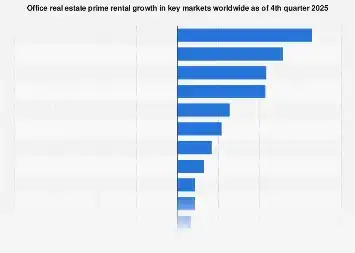
The landscape of global prime office real estate in late 2025 presents a complex picture of diverging rental growth patterns, with some major metropolitan hubs experiencing robust increases while others grapple with declining values. As of the fourth quarter of 2025, Tokyo, London, and Sydney emerged as frontrunners in prime rental appreciation, signaling a resilient demand for high-quality office spaces in these key economic centers. Conversely, a significant portion of the surveyed markets, including Beijing, witnessed a contraction in prime rental rates, underscoring the nuanced and varied recovery trajectory of the commercial property sector.
In Tokyo, prime office rents saw a notable surge, exceeding a substantial percentage. This performance reflects a confluence of factors, including a robust corporate demand, limited supply of Grade A office space, and a generally stable economic environment. The Japanese capital has consistently demonstrated its appeal as a global business hub, attracting multinational corporations and fostering a dynamic local economy. The influx of technology firms and financial services, coupled with a strategic focus on urban development, has underpinned the sustained growth in its prime office rental market. Experts point to the increasing emphasis on ESG (Environmental, Social, and Governance) compliant buildings, which are commanding premium rents, as a significant driver in Tokyo’s market.
London, another perennial global financial powerhouse, also registered strong growth in its prime office rental segment. Despite ongoing economic uncertainties and the lingering effects of post-Brexit adjustments, the city’s status as a major international business and financial center continues to attract significant investment and corporate occupancy. The demand for flexible, well-located, and amenity-rich office spaces has driven up rental values in prime districts. The market is characterized by a flight to quality, where modern, sustainable, and technologically advanced buildings are outperforming older stock. This trend is further amplified by a tight supply pipeline in the most sought-after submarkets, creating upward pressure on rents.
Sydney’s property market, particularly its prime office segment, mirrored the positive trends observed in Tokyo and London. Australia’s largest city benefits from a strong domestic economy, a growing technology sector, and a healthy influx of foreign investment. The demand for premium office space is robust, driven by companies seeking to attract and retain talent in a competitive labor market. The emphasis on collaborative workspaces, employee well-being, and sustainability features in modern office buildings is a key differentiator, allowing landlords of prime assets to command higher rents.
In stark contrast, the picture is less optimistic for several other major markets. Beijing, for instance, experienced a significant decline in prime office rents, dropping by over a considerable percentage. This downturn can be attributed to a combination of domestic economic headwinds, evolving regulatory landscapes, and a shifting corporate real estate strategy within China. The country’s broader economic adjustments, including a focus on domestic consumption and a moderation in the pace of expansion for some industries, have directly impacted demand for office space in its capital. Furthermore, the increasing adoption of hybrid work models and the development of new business districts in other cities may have also contributed to a reduced demand for prime space in Beijing.
The divergence in rental growth across these key markets highlights the complex interplay of global economic forces, localized market dynamics, and evolving workplace trends. While the broad strokes of a global economic recovery are in play, the nuances of regional growth, industry-specific demand, and the persistent impact of the pandemic on work patterns are creating distinct outcomes for commercial real estate.
Analysis of the broader dataset reveals that a significant proportion of the 16 markets under observation experienced a decline in prime office rents by the fourth quarter of 2025. This suggests that the anticipated universal rebound in office real estate demand has not materialized uniformly. Factors such as oversupply in certain markets, a slower-than-expected return to office mandates, and the continued expansion of remote and hybrid work arrangements are likely contributing to this widespread pressure on rental values.
The five-year rental growth figures, which provide a longer-term perspective, would offer further insights into the resilience and adaptability of these markets. However, preliminary indications point towards a market segmenting between those locations that can effectively leverage their economic strengths and offer superior office environments, and those facing structural challenges or slower economic momentum. The sustained growth in Tokyo, London, and Sydney underscores the enduring appeal of well-established global cities that can adapt to changing occupier needs and maintain a high standard of office provision.
The economic impact of these rental trends extends beyond the real estate sector itself. For cities experiencing robust rental growth, it signifies a healthy demand for commercial space, which in turn supports ancillary businesses, employment, and tax revenues. A thriving office market can stimulate investment in urban infrastructure, hospitality, and retail sectors. Conversely, markets experiencing declining rents may signal broader economic challenges, potentially leading to reduced investment, job losses in related sectors, and a decline in local government revenues.
The global office real estate market is thus at a critical juncture. The long-term implications of hybrid work models, the increasing emphasis on sustainability and employee well-being, and the ongoing shifts in global economic power will continue to shape demand and rental values. Investors and developers are closely monitoring these trends, seeking to identify markets and asset classes that are best positioned to navigate this evolving landscape. The ability of landlords to offer flexible lease terms, invest in modern amenities, and prioritize environmental credentials will be paramount in capturing a larger share of the market and achieving sustainable rental growth in the years to come. The future of prime office space likely lies in its capacity to be more than just a place to work, but a destination that fosters collaboration, innovation, and employee satisfaction in an increasingly dynamic world.