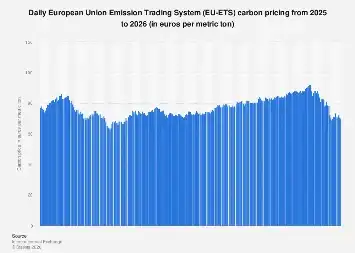
The European Union Emissions Trading Scheme (EU-ETS) has witnessed a landmark moment as the price of carbon allowances (EUAs) for the 2025-2026 trading period surpassed the significant psychological and economic threshold of €100 per metric ton of CO2 equivalent in early January 2026. This milestone underscores the evolving dynamics of the world’s largest carbon market, reflecting a complex interplay of regulatory tightening, economic recovery, and the escalating urgency to meet ambitious climate targets. While the EU-ETS has experienced considerable price volatility since its inception, the sustained upward trajectory in recent years, punctuated by this new record, signals a maturing and increasingly impactful mechanism for decarbonization.
Established in 2005, the EU-ETS stands as the pioneering global carbon market, designed to be the cornerstone of the European Union’s strategy to combat climate change. The fundamental principle is to cap and reduce greenhouse gas (GHG) emissions from some of the EU’s most polluting industrial sectors and aviation. This is achieved by setting a limit on the total amount of GHGs that can be emitted by installations covered by the scheme. Companies receive or buy emission allowances, which represent one ton of CO2 equivalent. They must surrender enough allowances to cover their emissions each year. If they emit more than they have allowances for, they face penalties. Conversely, companies that reduce their emissions can sell their surplus allowances, creating a financial incentive for cleaner operations.
The scheme operates in multi-year phases, with the current, fourth phase running from 2021 to 2030. This phase is characterized by more stringent emission reduction targets and a faster reduction in the overall number of allowances available. The EU’s commitment to achieving at least a 55% reduction in net GHG emissions by 2030 compared to 1990 levels (the "Fit for 55" package) has directly translated into a more restrictive cap within the EU-ETS. This scarcity of allowances is a primary driver of the rising prices, as demand from industries seeking to comply with their emission obligations intensifies against a shrinking supply.
Despite the overall upward trend, the market has not been immune to fluctuations. Following a period of relatively low prices, the 2018 reform of the EU-ETS marked a turning point, initiating a more sustained price recovery. However, even within this broader trend, interim market corrections can occur. For instance, the year 2024 saw a notable year-on-year decrease in average annual EUA prices, falling by a significant percentage to approximately €65 per ton. This dip can be attributed to a confluence of factors, potentially including temporary economic slowdowns in energy-intensive sectors, shifts in energy generation mixes, or anticipation of specific regulatory adjustments. Nevertheless, the market demonstrated resilience, with prices rebounding strongly in 2025. By January of that year, EU-ETS prices had recovered to a maximum of €95 per allowance, laying the groundwork for the subsequent breach of the €100 mark in early 2026.
The impact of the EU-ETS price surge extends beyond the immediate compliance costs for covered entities. It has profound implications for investment decisions, technological innovation, and broader economic competitiveness. A higher carbon price acts as a powerful signal to businesses, making investments in low-carbon technologies and processes more economically attractive. This can accelerate the adoption of renewable energy sources, energy efficiency measures, and carbon capture technologies. For industries that are heavily reliant on fossil fuels, the rising cost of emissions incentivizes a strategic pivot towards cleaner alternatives, even if it requires significant upfront capital expenditure.
The economic implications are multifaceted. While some industries may face increased operational costs, leading to concerns about carbon leakage (where companies relocate to regions with less stringent climate policies), the EU is actively implementing measures to mitigate this risk. The proposed Carbon Border Adjustment Mechanism (CBAM), for example, aims to level the playing field by imposing a carbon price on imported goods from countries with weaker climate regulations. This mechanism is designed to prevent industries within the EU from being disadvantaged and to encourage other nations to adopt similar carbon pricing policies.
Furthermore, the revenue generated from the auctioning of EU-ETS allowances is substantial. Member states are obligated to use at least 50% of this revenue to fund climate and energy-related projects, including investments in renewable energy, energy efficiency, and research and development of low-carbon technologies. This recycling of carbon revenues can foster green growth, create new jobs in the clean economy, and contribute to energy security by reducing reliance on imported fossil fuels.
When viewed in a global context, the EU-ETS stands out for its relatively high carbon price. As of April 2025, the average annual carbon price within the EU-ETS was approximately $85 USD per metric ton. This figure positions the EU market as a leader in putting a significant price on pollution. In comparison, the UK Emissions Trading Scheme, which diverged from the EU-ETS after Brexit, averaged around $70 USD per ton during the same period. Further afield, the Regional Greenhouse Gas Initiative (RGGI) in the United States, which covers power sector emissions in several northeastern states, had a significantly lower average price of approximately $15 USD per ton. These disparities highlight the varying levels of ambition and the different policy approaches being adopted by jurisdictions worldwide in their efforts to address climate change.
The ongoing expansion of the EU-ETS to include new sectors, such as maritime transport from 2024 and buildings and road transport from 2027 (under the new ETS2), will further increase the scope and impact of carbon pricing. This expansion, while potentially introducing new challenges and compliance burdens, signifies the EU’s unwavering commitment to integrating climate considerations across its entire economy. The successful implementation and continued evolution of the EU-ETS, exemplified by the recent surge in allowance prices, are crucial not only for achieving the EU’s own climate objectives but also for influencing global climate policy and driving the transition to a low-carbon future. The €100 per ton benchmark is not merely a number; it represents a tangible signal of the market’s response to robust climate policy and a growing recognition of the economic imperative to decarbonize.