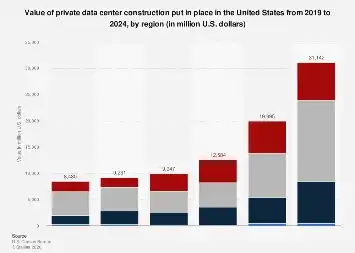
The United States is witnessing a dramatic surge in private data center construction, with the Southern region emerging as the undisputed leader in capital investment. In 2024, the South is projected to account for nearly $15.5 billion in private data center construction spending, a stark contrast to the $491 million anticipated for the Northeast. This significant regional disparity underscores a broader trend of evolving digital infrastructure development across the nation, driven by factors such as hyperscale cloud provider expansion, artificial intelligence (AI) demand, and favorable business climates.
From 2019 to 2024, the data illustrates a dynamic transformation in the value of private data center construction across U.S. regions. While the South has consistently been a major player, its dominance has amplified significantly in recent years. In 2019, the South commanded $4.58 billion in construction value, a substantial figure but one that was more closely matched by the Midwest ($1.71 billion) and the West ($1.91 billion). The Northeast, even then, represented a smaller segment with $291 million.
The years that followed saw a gradual but persistent rise in construction activity. By 2020, the South maintained its lead with $4.55 billion, while the Midwest saw a notable increase to $2.58 billion, and the West reached $1.86 billion. The Northeast, however, experienced a slight dip to $254 million.
A more pronounced shift began to materialize in 2021, with the West experiencing a significant leap to $3.29 billion, indicating growing interest in that region. The South remained strong at $4.08 billion, while the Midwest saw a slight decrease to $2.46 billion, and the Northeast continued its downward trend to $116 million. This period hinted at a diversifying demand across different geographic areas.
The upward trajectory accelerated in 2022. The West continued its impressive growth, reaching $4.32 billion, closely followed by the South at $4.72 billion. The Midwest also demonstrated robust expansion, climbing to $3.47 billion. The Northeast, however, saw a further decline in investment, dropping to $82 million. This marked a period where established tech hubs and emerging markets alike were vying for new data center capacity.
The most dramatic acceleration in construction spending occurred between 2023 and 2024. In 2023, the South experienced a substantial surge to $8.48 billion, nearly doubling its previous year’s investment. The West also saw significant growth, reaching $6.14 billion, and the Midwest posted a remarkable increase to $4.96 billion. The Northeast finally showed signs of recovery, with investment climbing to $421 million, though still a fraction of other regions.
This trend has culminated in the projected figures for 2024, where the South’s $15.5 billion investment dwarfs all other regions. The Midwest is expected to see its construction value more than double from the previous year, reaching $8.01 billion, positioning it as the second-largest market. The West, while still a significant player, is projected to invest $7.15 billion, and the Northeast is anticipated to reach $491 million.
Several key drivers are fueling this regional rebalancing. Hyperscale cloud providers, such as Amazon Web Services (AWS), Microsoft Azure, and Google Cloud, are continuously expanding their global network of data centers to meet the escalating demand for cloud services. These providers often seek locations with abundant and affordable power, favorable tax incentives, and robust fiber optic connectivity, characteristics frequently found in Southern states.
Furthermore, the burgeoning field of artificial intelligence is a significant catalyst. AI workloads are notoriously compute-intensive and require substantial power and cooling capabilities, leading to the construction of larger, more powerful data centers. Regions that can offer these essential resources at competitive prices are naturally attracting more investment. The availability of renewable energy sources, particularly solar and wind power in many Southern states, also plays a crucial role in attracting companies with strong environmental, social, and governance (ESG) commitments.
The economic impact of this construction boom extends far beyond the immediate technology sector. The development of new data centers creates a multitude of jobs, from construction and engineering roles to ongoing operational and maintenance positions. These projects also stimulate local economies through the purchase of materials, services, and increased tax revenues for municipalities. The concentration of data infrastructure can also attract related technology companies and talent, fostering innovation ecosystems.
The stark contrast between the South and the Northeast highlights different market dynamics. The Northeast, with its densely populated urban centers, often faces challenges related to land availability, higher operational costs, and more stringent regulatory environments. While it remains a critical market for enterprise data centers serving local businesses, it has not seen the same scale of hyperscale build-outs as other regions. However, investments in edge computing and specialized data facilities could still represent opportunities in these established markets.
The Midwest, with its growing investment, is benefiting from a combination of factors, including access to affordable power, a skilled workforce, and strategic geographic positioning that allows for efficient connectivity across large portions of the country. Its trajectory suggests a maturing market capable of supporting significant data infrastructure growth.
The West, while experiencing a slight slowdown in its growth rate compared to the previous years, continues to be a vital hub for technology and innovation. Its established tech ecosystem and proximity to major tech companies ensure continued demand for data center capacity, though the rapid expansion seen in the South and Midwest might indicate a broader geographic diversification of hyperscale investments.
As the digital transformation continues to accelerate globally, the demand for data center capacity is expected to remain robust. The current trends in U.S. regional construction suggest a strategic shift towards areas offering the optimal combination of power, connectivity, and cost-effectiveness, with the Southern United States firmly at the forefront of this critical infrastructure development. The ongoing evolution of AI and other data-intensive technologies will likely continue to shape these investment patterns, making it essential for businesses and policymakers to monitor these dynamic shifts in the digital landscape.