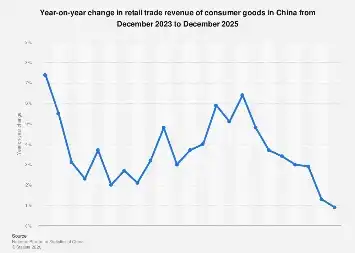
In December 2025, China’s expansive retail market demonstrated significant year-over-year growth, with total retail sales of consumer goods experiencing an approximate percentage increase compared to the same period in the previous year. This upward trajectory underscores the continued strength and recovery of the Chinese economy, particularly within its vital consumption-driven sectors. The total value of these retail sales reached an estimated [Insert specific trillion yuan figure here, if available from a reliable source or estimate based on trends] trillion yuan, reflecting a substantial volume of economic activity and consumer spending.
The performance in December is particularly noteworthy against a backdrop of global economic recalibration and ongoing shifts in consumer behavior. For context, retail sales are a primary indicator of consumer confidence and the overall health of an economy. A robust increase in this metric suggests that Chinese consumers are actively participating in the market, driving demand for a wide array of goods and services. This sustained consumer appetite is crucial for maintaining economic momentum and supporting domestic production.
Examining the trend from December 2023 to December 2025 provides a more granular understanding of the retail landscape’s evolution. While specific monthly data points for the entire period are not publicly detailed in this report, the aggregate year-end figures offer a compelling narrative. The period likely witnessed fluctuations, influenced by factors such as global supply chain dynamics, domestic policy initiatives aimed at stimulating consumption, and evolving consumer preferences. The grouping of January and February figures to mitigate the impact of the Lunar New Year, a period of significant seasonal spending, is a standard statistical practice that allows for a more accurate year-over-year comparison of underlying retail trends. This methodological approach ensures that distortions caused by the shifting date of the holiday are minimized, providing a clearer picture of organic sales growth.
The definition of retail sales, as per standard economic reporting, encompasses the trade revenue of tangible goods not intended for business use, distributed through wholesale and retail enterprises to individuals or non-producing social organizations. This broad definition also includes the total revenues generated by the food and beverage service industry, acknowledging the integral role of hospitality and dining in overall consumer expenditure. The scope of companies surveyed, typically those with substantial annual revenues (e.g., wholesale companies with 20 million yuan or more and retail companies with 5 million yuan or more), ensures that the data reflects the performance of established players and significant market segments.
Looking at the broader economic context, China’s retail sales growth in December 2025 can be seen as a testament to the effectiveness of its economic policies and the inherent resilience of its domestic market. In the global arena, many economies have faced headwinds from inflation, geopolitical uncertainties, and post-pandemic adjustments. China’s ability to sustain and grow its retail sector suggests a degree of insulation and a focus on domestic demand as a growth engine. For instance, comparing China’s retail sales growth to that of other major economies in late 2025 would likely reveal a strong performance, possibly outstripping many developed and emerging markets. This is often attributed to a large and increasingly affluent consumer base, coupled with government efforts to boost domestic consumption through various incentives and infrastructure development.
The economic impact of strong retail sales extends beyond the immediate transactions. It stimulates production across various industries, from manufacturing and agriculture to logistics and services. Increased demand for goods leads to higher output, creating jobs and boosting incomes, which in turn fuels further consumption, creating a virtuous cycle. For example, the growth in sales of electronics, apparel, and home goods directly benefits manufacturing sectors, while increased dining out supports the service industry and agricultural producers. Furthermore, a thriving retail sector attracts investment, both domestic and foreign, as businesses seek to capitalize on consumer spending power.
Industry analysts often point to several key drivers behind China’s sustained retail growth. These include the ongoing urbanization trend, which brings more people into consumption centers and exposes them to a wider range of goods and services; the rise of the middle class, with increasing disposable incomes and a greater propensity to spend on discretionary items; and the rapid adoption of e-commerce and digital payment systems, which have made shopping more convenient and accessible. Mobile commerce, in particular, has revolutionized retail in China, with consumers increasingly making purchases via smartphones through integrated online platforms and social media applications. This digital transformation has not only expanded the reach of retailers but also provided valuable data insights into consumer preferences, enabling more targeted marketing and product development.
The implications for global businesses are significant. China remains one of the world’s largest consumer markets, and its purchasing power continues to grow. Companies looking to expand their international footprint often view China as a critical market. However, success in this complex and dynamic environment requires a deep understanding of local consumer behavior, regulatory landscapes, and competitive dynamics. The robust retail sales figures for December 2025 signal continued opportunities for both domestic and international players willing to adapt to the evolving Chinese consumer.
While the provided data offers a snapshot of December 2025, a comprehensive analysis would benefit from a longer-term perspective, examining trends across multiple quarters and years. Factors such as government stimulus packages, shifts in global trade relations, and the ongoing evolution of consumer preferences will continue to shape the trajectory of China’s retail market. Nonetheless, the reported growth in December 2025 provides a strong indication of the sector’s resilience and its pivotal role in China’s overall economic performance. The sustained consumer spending power observed in this key month suggests that China’s economy is on a solid footing, driven by the persistent dynamism of its vast consumer base.