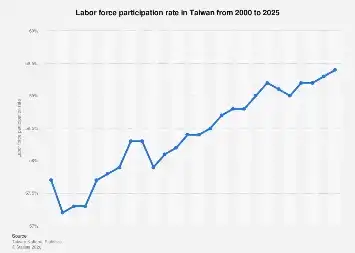
Taiwan’s economic landscape is bracing for a period of nuanced evolution in its labor market, with projections indicating a steady, albeit modest, increase in the labor force participation rate through 2025. This anticipated growth, while seemingly incremental, carries significant implications for the island’s economic dynamism, its capacity for innovation, and its ability to navigate the complexities of an aging population and evolving global economic conditions. Understanding the forces shaping this trend is crucial for policymakers, businesses, and investors seeking to capitalize on Taiwan’s future economic trajectory.
The labor force participation rate, a key indicator of an economy’s productive capacity, reflects the proportion of the working-age population that is either employed or actively seeking employment. For Taiwan, a global leader in semiconductor manufacturing and a vital node in international supply chains, a robust and adaptable labor force is paramount. Current projections suggest a slight upward trend, moving beyond the figures observed in recent years, driven by a confluence of factors that include increased female participation, the continued integration of younger cohorts, and potentially, policy initiatives aimed at boosting employment across various demographics.
Examining the granular components of this forecast reveals a multifaceted picture. While the overall participation rate is expected to climb, the underlying dynamics may differ across age groups and genders. For instance, efforts to encourage greater female participation in the workforce, through improved childcare infrastructure, flexible work arrangements, and combating gender-based wage disparities, are likely to play an increasingly significant role. Historically, while Taiwan has achieved high levels of education among women, their participation in the formal labor market has sometimes lagged behind that of men, presenting a clear opportunity for growth. As societal norms evolve and supportive policies gain traction, a larger segment of Taiwan’s female population is expected to contribute their skills and talents to the economy.
Simultaneously, the influx of new entrants into the labor market, primarily from recent graduating classes, will contribute to the overall participation figures. However, this demographic cohort also presents its own set of challenges and opportunities. Ensuring that these young professionals are equipped with the skills demanded by Taiwan’s high-tech industries, fostering entrepreneurship, and providing pathways for career advancement will be critical to retaining talent and maximizing their economic contribution. The island’s renowned education system produces highly skilled graduates, but bridging the gap between academic learning and industry needs remains an ongoing imperative.
Perhaps the most significant demographic challenge on the horizon for Taiwan, as for many developed economies, is its aging population. The proportion of the population aged 65 and over is steadily increasing, which naturally exerts downward pressure on the overall labor force participation rate as a larger segment of the population exits the workforce. The projected growth in participation, therefore, signifies a partial offset to this demographic headwind, rather than a complete reversal. This necessitates a strategic approach to labor market policy, focusing on extending the working lives of older individuals who are able and willing to continue contributing, as well as maximizing the participation of younger and middle-aged workers.
Economically, an increasing labor force participation rate generally translates to enhanced productive capacity. For Taiwan, this could mean a stronger ability to meet the demands of its export-oriented industries, particularly in sectors like electronics, advanced manufacturing, and biotechnology. A larger pool of available workers can help alleviate labor shortages, potentially moderating wage pressures in specific sectors while also supporting increased output and economic growth. Furthermore, a more engaged workforce often correlates with higher levels of consumption and investment, creating a virtuous cycle of economic expansion.
However, the qualitative aspects of labor force participation are as important as the quantitative ones. The nature of the jobs available, the skills possessed by the workforce, and the overall productivity of labor are critical determinants of economic success. Taiwan’s economic model is heavily reliant on its technological prowess and its ability to innovate. Therefore, simply increasing the number of people in the workforce is insufficient; it is essential that the growing labor force is skilled, adaptable, and capable of driving innovation. This implies a continued focus on lifelong learning, reskilling and upskilling initiatives, and fostering an environment that encourages creativity and technological advancement.
Global comparisons offer valuable context for understanding Taiwan’s labor market trends. Many developed economies, particularly in East Asia, are grappling with similar demographic challenges of aging populations and declining birth rates. Countries like Japan and South Korea, for instance, have long been at the forefront of this demographic shift and have implemented various strategies to address its economic consequences, including promoting automation, encouraging immigration, and incentivizing later-life work. Taiwan’s experience and policy responses will be watched closely by other nations facing comparable situations. The success of its efforts to boost labor force participation will not only impact its own economic vitality but could also serve as a blueprint for other economies navigating the complex interplay of demographics and economic growth.
The projected growth in Taiwan’s labor force participation rate through 2025, while modest, represents a critical juncture. It highlights the island’s ongoing efforts to adapt its economic engine to evolving demographic realities. The success of these efforts will depend on a multifaceted approach, encompassing policies that support female employment, equip the younger generation with future-ready skills, and enable older workers to remain active participants in the economy. As Taiwan continues to solidify its position as a global economic powerhouse, the dynamism and adaptability of its labor force will remain a cornerstone of its sustained prosperity. The coming years will be a testament to Taiwan’s ability to harness its human capital effectively, ensuring that its economic trajectory remains robust and inclusive in the face of significant demographic and global economic transformations.