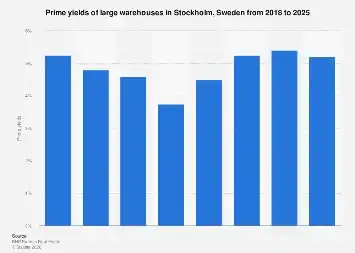
Stockholm’s prime industrial and logistics real estate market is navigating a period of adjustment, with indications pointing towards a stabilization, and potentially a slight recalibration, of investment yields for large-scale warehouse facilities. Data suggests that the prime yields for warehouses exceeding 5,000 square meters in the Swedish capital have shown a consistent upward trend over the past few years, a pattern that appears to be moderating as the market anticipates the end of 2025. This evolution in yields is a critical indicator for investors, developers, and businesses reliant on robust logistics infrastructure, reflecting broader economic currents and sector-specific dynamics.
The trend of increasing prime yields, which denotes the annual return an investor can expect from a property, has been a notable feature in Stockholm’s industrial property landscape. For the third consecutive year leading up to 2024, these yields have ascended. This trajectory marks a departure from the yields observed in earlier periods, with a significant shift occurring from a previous benchmark. By the fourth quarter of 2025, forecasts indicate that prime yields for these substantial warehouse assets are projected to settle at a level marginally lower than that recorded in the final quarter of 2024, suggesting a plateauing effect after a period of growth.
Understanding the concept of prime yields is crucial in the context of commercial real estate investment. Prime yields represent the rental income generated by a property relative to its market value, specifically for the highest quality assets in a given market. In the industrial and logistics sector, this translates to modern, well-located, and efficiently designed warehouses that meet the stringent demands of today’s supply chains. An increase in prime yields generally signifies either a rise in rental income, a decrease in property values, or a combination of both. In a rising interest rate environment, or when perceived risk increases, investors often demand higher yields to compensate for their capital. Conversely, a decrease in yields can suggest strong investor appetite and potentially rising property values or stable, growing rental incomes.
The Stockholm market, like many global logistics hubs, has been profoundly influenced by the e-commerce boom, which accelerated dramatically during the COVID-19 pandemic. This surge in online retail necessitated a significant expansion and modernization of warehousing and distribution networks. As a result, demand for large, strategically located logistics facilities surged, initially driving down yields as investors competed for limited prime stock. However, the subsequent macroeconomic shifts, including inflationary pressures and a tightening monetary policy, have begun to rebalance the market. Higher construction costs, increased financing expenses, and a general recalibration of risk premiums have contributed to the upward pressure on yields observed in recent years.
Examining the broader Nordic region provides a comparative perspective. While Stockholm is a key player, other major Nordic cities also exhibit similar market dynamics, albeit with local nuances. Cities like Gothenburg, Helsinki, Oslo, and Copenhagen are all experiencing heightened interest in their logistics sectors, driven by their strategic geographical positions for trade within Northern Europe and their own burgeoning e-commerce markets. The yields in these markets can vary based on local supply-demand fundamentals, infrastructure development, and investor confidence. Generally, the Nordic region is characterized by its stable economic and political environments, making it an attractive destination for institutional investors seeking long-term, secure returns. However, competition for prime assets remains fierce, and yield compression can occur rapidly in markets with limited supply and high demand.
The projected slight decrease in prime yields for large warehouses in Stockholm towards the end of 2025, from the levels seen in late 2024, suggests a potential stabilization. This could indicate that the market has priced in much of the recent inflationary and interest rate pressures. It might also reflect a growing confidence in the sustained demand for logistics space, underpinned by structural trends such as reshoring initiatives, the need for greater inventory resilience, and the ongoing evolution of last-mile delivery strategies. Furthermore, if rental growth in the sector remains robust, it can help to offset upward pressure on yields, leading to a more balanced return profile for investors.
The economic impact of these yield trends is multifaceted. For developers, the cost of capital and the expected returns directly influence the viability of new projects. Rising yields can make financing more expensive and potentially reduce profit margins, leading to a more cautious approach to speculative development. Conversely, stabilizing or declining yields, coupled with strong rental growth, can incentivize new construction and investment in upgrading existing facilities. For occupiers – the businesses that lease these warehouses – the cost of logistics space is a significant operational expense. Changes in prime yields, which are closely linked to rental levels, directly affect their cost base. Businesses requiring extensive storage and distribution capabilities will closely monitor these trends to manage their supply chain costs effectively.
Global comparisons further illuminate Stockholm’s position. In mature logistics markets across Western Europe, such as Germany or the Netherlands, prime yields for large, modern warehouses have also seen fluctuations in response to similar macroeconomic headwinds. However, these markets often benefit from greater scale, deeper pools of capital, and more extensive transport networks, which can lead to different yield profiles. Emerging markets, on the other hand, may offer higher initial yields but typically come with greater perceived risk and less established infrastructure. Stockholm, as a well-established and sophisticated market, generally commands yields that reflect its stability and strong underlying demand drivers.
The data point concerning warehouses over 5,000 square meters specifically highlights the focus on larger, institutional-grade assets. This segment of the market is particularly sensitive to investor sentiment and capital flows, as it attracts institutional investors and real estate funds. The demand for these larger facilities is driven by the operational efficiencies they offer to logistics companies, enabling consolidation of operations and optimized inventory management. As supply chains become more complex and the scale of e-commerce continues to grow, the importance of these large-format warehouses is only set to increase.
Looking ahead, several factors will continue to shape the trajectory of prime warehouse yields in Stockholm. The ongoing evolution of e-commerce, the pace of economic growth in Sweden and its key trading partners, and the broader interest rate environment will all play significant roles. Additionally, the development of new infrastructure, such as improved road and rail networks, and the availability of suitable land for logistics development will be critical determinants of supply. Investors will likely remain focused on high-quality, well-located assets that offer long-term rental growth potential and capital preservation. The slight dip predicted for late 2025, if realized, could signal a period of equilibrium, offering a potentially attractive entry point for investors seeking exposure to Stockholm’s resilient logistics market, provided that the underlying demand drivers remain robust and the cost of capital begins to stabilize. The market’s ability to absorb new supply while catering to sophisticated tenant requirements will be key to maintaining attractive, yet sustainable, investment returns.