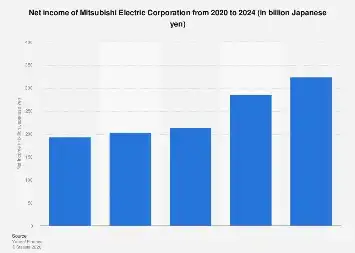
Mitsubishi Electric Corporation, a titan of Japanese industry with a sprawling global footprint, has demonstrated a consistent and robust upward trend in its net income over the recent fiscal years. While specific figures for the current fiscal year ending March 31, 2024, remain proprietary and require subscription access for precise disclosure, available historical data and market indicators suggest a period of sustained profitability. This financial performance is a testament to the company’s diversified business segments, its strategic investments in innovation, and its ability to navigate complex global economic landscapes.
The period from 2020 to the most recently concluded fiscal year has been marked by a significant increase in Mitsubishi Electric’s net income. This growth has not been a sporadic surge but rather a continuous upward trajectory, indicating a healthy and sustainable expansion of its earnings power. Such consistent growth is a key indicator of strong operational efficiency, effective cost management, and successful market penetration across its diverse product and service portfolios, which span from aerospace and defense to home appliances and industrial automation.
Understanding the magnitude of this growth requires a closer look at the company’s operational strengths. Mitsubishi Electric’s business is broadly segmented into areas such as Information and Communication Systems, Electronic Devices, Industrial Automation Systems, Home Appliances, and Energy and Electric Systems. Each of these divisions plays a crucial role in the company’s overall financial health. For instance, the industrial automation segment has likely benefited from the global push towards Industry 4.0, with increased demand for smart manufacturing solutions, robotics, and advanced control systems. Similarly, the energy and electric systems division is well-positioned to capitalize on the global transition towards renewable energy sources and the modernization of power grids.
The continuous increase in net income observed from 2020 onwards can be attributed to several intertwined factors. The post-pandemic economic recovery has undoubtedly provided a tailwind for many industries, and Mitsubishi Electric has been adept at leveraging this resurgence. Furthermore, the company’s commitment to research and development, particularly in areas like artificial intelligence, the Internet of Things (IoT), and advanced materials, has allowed it to introduce innovative products and solutions that command premium pricing and capture market share. This technological edge is crucial in maintaining competitive advantage in fast-evolving sectors.
To contextualize Mitsubishi Electric’s performance, it’s beneficial to compare its trajectory with broader market trends and its peer group. The global industrial conglomerate sector has experienced varied fortunes, influenced by supply chain disruptions, geopolitical tensions, and fluctuating demand. However, companies with strong technological capabilities and diversified revenue streams, like Mitsubishi Electric, have often proven more resilient. For example, while the automotive sector faced significant headwinds due to semiconductor shortages, Mitsubishi Electric’s diverse product lines, including components and systems for various industrial applications, have likely offset some of these challenges.
The Japanese economy itself has been undergoing structural shifts, with a focus on technological advancement and global competitiveness. Mitsubishi Electric, as a leading Japanese manufacturer, embodies this national economic strategy. Its success contributes not only to its own shareholder value but also to the broader economic health of Japan, fostering employment, driving innovation, and bolstering export revenues. The yen’s exchange rate also plays a role; a weaker yen can boost the repatriated profits of Japanese companies with significant overseas earnings, a factor that may have contributed positively to Mitsubishi Electric’s financial results.
The reported continuous increase in net income from 2020 to the fiscal year ending in 2024 suggests a compounded annual growth rate (CAGR) that would be highly attractive to investors. While the exact CAGR is not publicly available without subscription, a consistent upward trend implies a robust growth rate that outpaces inflation and general economic expansion in many regions. This sustained profitability is a key indicator of management’s effectiveness in capital allocation, operational optimization, and strategic market positioning.
The economic impact of a company like Mitsubishi Electric extends far beyond its balance sheet. Its operations support a vast ecosystem of suppliers, distributors, and service providers, both domestically and internationally. Investments in new manufacturing facilities, upgrades to existing infrastructure, and research collaborations all contribute to economic activity and job creation. Furthermore, the company’s products and technologies are integral to the functioning of many critical sectors, from telecommunications infrastructure to advanced manufacturing processes, underscoring its systemic importance.
Looking ahead, the challenges and opportunities for Mitsubishi Electric remain significant. The global push for decarbonization presents immense opportunities for its energy and electric systems division, particularly in areas like high-voltage direct current (HVDC) transmission, renewable energy integration, and energy storage solutions. The ongoing digital transformation across industries will continue to drive demand for its industrial automation and information technology solutions. However, the company must also contend with increasing global competition, evolving regulatory landscapes, and the imperative to adapt to rapidly changing technological paradigms.
The precise financial figures for the fiscal year 2024, once fully disclosed, will offer a more granular understanding of the company’s performance against its strategic objectives and market expectations. However, the overarching trend of continuous net income growth over the past four fiscal years paints a clear picture of a robust and resilient enterprise. This sustained profitability is a testament to Mitsubishi Electric’s diversified business model, its commitment to innovation, and its strategic acumen in navigating the complexities of the global economic environment. The company’s financial health serves as a bellwether for the broader industrial sector and highlights the enduring strength of Japanese manufacturing on the world stage.