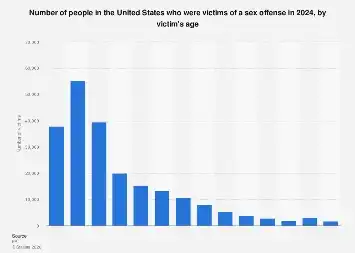
The United States grapples with a persistent and deeply concerning issue: the prevalence of sex offenses and the age at which victims are most vulnerable. While precise, comprehensive, and publicly accessible data on the number of victims of sex offenses broken down by age remains a significant challenge to obtain, existing analyses and related statistics paint a stark picture of widespread harm, with younger demographics disproportionately affected. This complex societal problem carries profound economic, social, and psychological ramifications, impacting individuals, families, and communities across the nation.
Understanding the scope of sex offenses requires acknowledging the multifaceted nature of these crimes. They encompass a broad spectrum, from sexual assault and harassment to child sexual abuse, and the reporting and classification of these incidents can vary. However, when available data points are aggregated and analyzed, a clear pattern emerges regarding the age of victims. While individuals of all ages can be subjected to sexual offenses, the formative years of childhood and adolescence represent periods of heightened risk. This vulnerability is often linked to power imbalances, dependency, and the developmental stages of victims, making them more susceptible to exploitation.
The economic costs associated with sex offenses are staggering and far-reaching. These costs extend beyond the immediate expenses of law enforcement, judicial processes, and victim support services. They include long-term healthcare expenditures for physical and mental health consequences, lost productivity due to trauma and recovery, and the societal burden of addressing the downstream effects of abuse, such as increased rates of substance abuse, homelessness, and involvement in the criminal justice system. For every victim, the path to healing is often arduous and expensive, involving therapy, medical treatment, and potentially legal recourse, all of which place a strain on public and private resources.
Globally, the United States is not alone in facing these challenges. Many developed nations report significant numbers of sex offense victims, with varying degrees of data transparency and reporting mechanisms. However, the scale of the U.S. population and its unique societal dynamics contribute to the sheer volume of incidents. International organizations like the World Health Organization (WHO) and the United Nations Office on Drugs and Crime (UNODC) consistently highlight sexual violence as a critical public health and human rights issue, advocating for improved data collection and prevention strategies worldwide. Comparisons often reveal that while the absolute numbers may differ due to population size, the underlying issues of vulnerability, perpetrator behavior, and victim impact share common threads across borders.
The lack of readily available, granular data on sex offense victims by age in the U.S. presents a significant obstacle for researchers, policymakers, and advocacy groups. While some organizations and government agencies collect and disseminate statistics, these are often aggregated, delayed, or not publicly accessible in a user-friendly format. This data scarcity hinders the ability to conduct precise risk assessments, develop targeted prevention programs, and allocate resources effectively to the most vulnerable age groups. For instance, understanding the specific age brackets within childhood and adolescence that experience the highest rates of specific types of offenses is crucial for tailoring interventions. Is the risk concentrated in early childhood, middle childhood, or adolescence? Are there particular types of offenses that are more prevalent at certain developmental stages? Without detailed age-disaggregated data, answering these questions with certainty becomes an exercise in inference rather than evidence-based analysis.
The implications of this data gap are substantial. Without clear insights into victim demographics, it becomes challenging to identify emerging trends or shifts in the patterns of sexual offending. This can impede the development of proactive measures and leave communities ill-equipped to respond to evolving threats. Furthermore, it can limit the ability of researchers to conduct in-depth studies on the long-term effects of sex offenses on victims at different life stages, from childhood development to adult mental health and well-being. The economic impact of untreated or inadequately addressed trauma can reverberate for decades, affecting an individual’s educational attainment, career prospects, and overall quality of life.
The types of sex offenses also vary in their presentation and impact across different age groups. For younger children, offenses may be more likely to occur within the home or familiar settings, often perpetrated by individuals known to the child. As children enter adolescence, the context of offenses can broaden to include peer interactions, school environments, and online spaces, presenting new avenues for exploitation. Understanding these contextual differences is vital for developing age-appropriate prevention and intervention strategies. For example, educational programs aimed at preventing child sexual abuse need to be tailored to the cognitive and social development of the target age group, focusing on concepts like consent, boundaries, and how to report abuse in a way that is understandable and empowering.
The economic burden on victims and their families is often immense. Beyond direct medical and therapeutic costs, victims may face lost income due to time taken off work for appointments or the inability to perform their duties effectively due to trauma. The legal process, while necessary for accountability, can also be financially draining, even when legal aid is available. The long-term psychological impact can manifest as post-traumatic stress disorder (PTSD), depression, anxiety, and difficulties in forming healthy relationships, all of which can impede an individual’s ability to achieve their full economic potential. The societal cost also includes the strain on social services, child protective agencies, and mental health systems, which are often underfunded and overstretched.
Furthermore, the economic impact extends to the broader community and national economy. High rates of sexual victimization can contribute to a less safe and secure environment, potentially deterring investment and tourism. The cost of incarceration for perpetrators, while a necessary component of the justice system, also represents a significant public expenditure. Investing in robust prevention programs, evidence-based victim support, and comprehensive data collection initiatives could yield substantial long-term economic benefits by reducing the incidence of these crimes and mitigating their devastating consequences.
In conclusion, while specific, publicly accessible statistics on the number of sex offense victims by age in the U.S. are challenging to pinpoint, the available evidence and broader societal understanding indicate a significant problem, particularly affecting younger populations. The multifaceted economic and social consequences underscore the urgent need for improved data collection, transparent reporting, and targeted interventions. Addressing this issue requires a concerted effort from government agencies, non-profit organizations, communities, and individuals to protect the vulnerable, support survivors, and ultimately create a society where such offenses are no longer a pervasive threat. The path forward necessitates a commitment to understanding the full scope of the problem, driven by accurate data, to inform effective strategies for prevention, intervention, and long-term healing.