The number of Canadian students participating in distance education at the Kindergarten to Grade 12 (K-12) level has seen a significant and sustained increase over the past decade, reaching a new high of nearly 400,000 learners in the 2021-2022 academic year. This trend underscores a fundamental shift in educational delivery models, accelerated by recent global events and evolving technological capabilities, pointing towards a more permanent integration of online and blended learning approaches within the traditional education system.
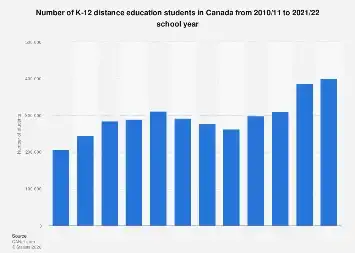
Data tracking K-12 distance education enrollment in Canada from the 2010-2011 school year reveals a dynamic growth trajectory. In the 2010-2011 academic year, approximately 207,096 students were engaged in distance learning. Over the subsequent years, this figure experienced fluctuations but generally trended upwards. By the 2019-2020 school year, just prior to the widespread impact of the COVID-19 pandemic, the number had risen to 310,582. The academic year of 2020-2021 witnessed a substantial jump to 387,385 students, indicating the immediate and widespread adoption of remote learning solutions. The most recent figures for 2021-2022 confirm this elevated level, with the number of K-12 distance education students standing at 399,847. This represents a near doubling of participation since the beginning of the analyzed period.
This surge in distance education enrollment reflects a multifaceted evolution in how educational institutions and families approach learning. While the COVID-19 pandemic served as a powerful catalyst, forcing an unprecedented shift to remote instruction, the underlying demand for flexible and accessible learning options predates this global disruption. Factors such as technological advancements, increased internet penetration, and a growing recognition of the benefits of personalized learning pathways have been instrumental in shaping this trend.
From an economic perspective, the expansion of K-12 distance education has significant implications. It drives demand for educational technology platforms, digital content creation, and specialized training for educators in online pedagogy. Furthermore, it presents new opportunities for educational service providers, curriculum developers, and technology companies looking to cater to the evolving needs of students, parents, and school districts. The sector is likely to see continued investment as institutions seek to optimize their digital learning infrastructure and enhance the quality of online educational experiences.
Globally, Canada’s experience with the growth of K-12 distance education is part of a broader international trend. Many developed nations have observed similar increases in online learning participation, particularly in the wake of the pandemic. However, the specific adoption rates and the integration of distance education into national education strategies vary considerably. Countries that had already invested in robust digital learning frameworks prior to 2020 often experienced smoother transitions and more effective remote learning outcomes. Canada’s experience positions it within this cohort of nations actively adapting its educational systems to incorporate digital modalities.
The substantial increase in distance education students highlights the growing acceptance and efficacy of online learning as a viable educational model. This includes not only fully online programs but also blended learning approaches that combine in-person instruction with online components. The data suggests that a significant portion of these students are not simply engaging in temporary remote learning but are actively choosing distance education as their preferred mode of schooling, either due to geographic constraints, learning preferences, or the desire for more specialized educational offerings not available locally.
The continued presence of nearly 400,000 students in K-12 distance education programs indicates a recalibration of the educational landscape. School boards and provincial governments across Canada are likely to continue investing in and refining their distance education offerings. This includes developing comprehensive online curricula, ensuring equitable access to technology and internet connectivity for all students, and providing ongoing professional development for teachers to equip them with the skills necessary to deliver engaging and effective online instruction. The focus will likely shift from emergency remote learning to structured, high-quality online and blended learning programs that complement traditional classroom settings.
The long-term implications of this trend extend beyond enrollment numbers. It has the potential to redefine the traditional school day, offer greater flexibility for students with diverse needs, and potentially democratize access to specialized courses and educational resources, regardless of a student’s physical location. As Canada continues to navigate the evolving educational landscape, the robust growth in K-12 distance education signals a permanent shift towards a more digitally integrated and adaptable learning future. The sustained engagement of hundreds of thousands of students suggests that e-learning is no longer a niche offering but a significant and integral component of the national educational ecosystem.