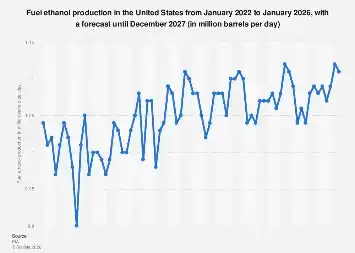
The United States, a dominant force in global biofuel production, is projected to maintain robust fuel ethanol output through 2027, according to current market analyses. This sustained level of production, largely driven by domestic demand and renewable fuel mandates, occurs against a backdrop of evolving energy policies, technological advancements in refining, and a growing emphasis on sustainability within the broader agricultural and energy sectors. While the headline figures suggest stability, underlying market dynamics indicate a complex interplay of factors influencing this critical segment of the American bioeconomy.
Fuel ethanol, primarily derived from corn in the U.S., plays a significant role in the nation’s energy mix. Its integration into gasoline, often at blends like E10 (10% ethanol) and E15 (15% ethanol), serves multiple purposes. Foremost is its function as a renewable component, contributing to the reduction of greenhouse gas emissions compared to unblended gasoline. Furthermore, ethanol production is intrinsically linked to the U.S. agricultural sector, providing a substantial domestic market for corn producers and supporting rural economies. The Renewable Fuel Standard (RFS), a federal mandate requiring a certain volume of renewable fuels to be blended into the nation’s transportation fuel supply, has been a foundational pillar supporting ethanol demand for years.
Projections for fuel ethanol production in the U.S. through 2027 indicate a continuation of recent trends, with output expected to remain within a well-established range. While precise monthly figures are proprietary and subject to market fluctuations, the overall annual production capacity and utilization rates are closely monitored by industry stakeholders. This stability, however, should not be mistaken for stagnation. Several forces are actively shaping the production landscape.
One of the primary drivers of sustained production is the consistent demand from refiners seeking to comply with the RFS. The RFS mandates, though subject to periodic adjustments and political debate, have created a predictable demand signal for ethanol. As the U.S. strives to meet its climate goals and reduce reliance on fossil fuels, biofuels like ethanol remain a key component in the transition strategy, particularly in the light-duty vehicle fleet where electrification is still gaining momentum. The Energy Information Administration (EIA) and the U.S. Department of Agriculture (USDA) regularly publish data and forecasts that underscore the significant contribution of corn-based ethanol to the nation’s fuel supply.
The economic impact of ethanol production extends far beyond the immediate fuel market. The cultivation of corn for ethanol is a multi-billion dollar enterprise. According to USDA data, a substantial portion of the U.S. corn crop is dedicated to ethanol production, directly benefiting farmers through guaranteed demand and price support. This, in turn, stimulates economic activity in rural communities, supporting jobs in farming, transportation, processing, and related industries. A robust ethanol sector helps to stabilize agricultural commodity markets, offering a degree of predictability that is crucial for long-term investment in farming operations.
However, the ethanol industry is not without its challenges and evolving dynamics. The debate around the "food versus fuel" argument, though somewhat abated in recent years due to increased agricultural yields and the dedicated nature of much of the corn crop for fuel, continues to be a point of consideration for policymakers and environmental groups. Critics sometimes point to the land use implications and the potential diversion of food-grade corn. Proponents counter by highlighting advancements in farming efficiency, the co-products of ethanol production (such as distillers’ grains, a valuable animal feed), and the overall environmental benefits compared to fossil fuels.
Technological innovation is also playing a crucial role. While corn remains the dominant feedstock, research and development into cellulosic ethanol, derived from non-food sources like agricultural waste and wood, continues. Although cellulosic ethanol production is currently a smaller fraction of the overall market, future advancements could significantly alter the feedstock landscape, potentially reducing reliance on food crops and opening up new avenues for renewable fuel development. Companies are investing in advanced biorefinery technologies that aim to increase efficiency, reduce water usage, and lower the carbon intensity of ethanol production.
Global comparisons offer further context. The U.S. is by far the world’s largest producer and consumer of fuel ethanol, significantly outpacing other major players like Brazil, which primarily uses sugarcane as its feedstock. This global leadership position is a testament to the scale of U.S. agriculture and the effectiveness of its biofuel policies. However, other regions are also expanding their biofuel capacities, driven by their own energy security concerns and climate objectives. The European Union, for instance, has ambitious renewable energy targets, though its approach often emphasizes a more diversified range of biofuels and advanced technologies.
The future trajectory of U.S. fuel ethanol production will likely be influenced by several key factors. The evolution of vehicle electrification is a significant variable. As electric vehicles become more prevalent, the overall demand for gasoline, and consequently for blended ethanol, could eventually plateau or decline. However, this transition is expected to be gradual, and for the foreseeable future, internal combustion engine vehicles will remain the dominant mode of transportation, ensuring continued demand for ethanol.
Furthermore, policy decisions at both the federal and state levels will continue to shape the industry. Revisions to the RFS, changes in tax incentives for biofuels, and broader climate policy initiatives will all have a material impact. The Biden administration’s emphasis on decarbonization and renewable energy presents both opportunities and challenges for the ethanol sector, pushing for cleaner production methods and potentially greater investment in advanced biofuels.
The price of crude oil also remains a critical determinant. While ethanol production is largely insulated from direct oil price volatility due to the RFS, high oil prices can make ethanol a more economically attractive alternative, boosting demand and potentially production. Conversely, prolonged periods of low oil prices can reduce the economic incentive for blending.
In conclusion, U.S. fuel ethanol production is on a path of sustained output through 2027, underpinned by a robust domestic market and supportive regulatory frameworks. While the headline figures suggest continuity, the industry is actively navigating a dynamic environment characterized by technological innovation, evolving energy policies, and the global imperative to decarbonize. The sector’s ability to adapt to these forces, embrace sustainability, and demonstrate its continued contribution to both energy security and environmental goals will be key to its long-term success. The interplay between agriculture, energy, and environmental policy will continue to define the narrative of this vital segment of the American economy.