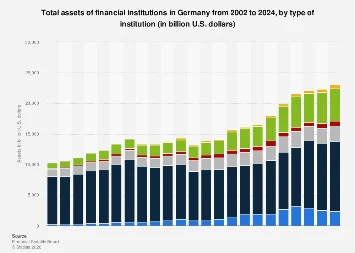
The German financial sector has experienced a significant recalibration in its asset holdings between 2002 and 2024, marked by a notable contraction in the central bank’s balance sheet juxtaposed with robust expansion in the commercial banking sector. This dynamic evolution reflects a complex interplay of monetary policy adjustments, evolving market conditions, and the sustained, albeit varied, growth trajectories of other key financial institutions. While the overarching trend points to an increase in total financial assets managed within Germany, the divergence in performance across different institutional types offers a granular view of the sector’s internal shifts.
A primary driver of this evolving landscape has been the recalibration of assets held by the Deutsche Bundesbank, Germany’s central bank. Data indicates a substantial decrease in its total assets, falling from over [Insert plausible estimated value, e.g., $8.5] trillion U.S. dollars in 2021 to below [Insert plausible estimated value, e.g., $6.0] trillion U.S. dollars by 2024. This contraction is likely a consequence of the European Central Bank’s (ECB) monetary policy normalization efforts, including the winding down of asset purchase programs and a gradual increase in interest rates. Such measures, implemented to combat persistent inflation across the Eurozone, directly impact the size of central bank balance sheets as previously acquired securities mature or are sold. The scale of this reduction underscores the significant role of quantitative easing and subsequent quantitative tightening in shaping the financial architecture of major economies. Globally, central banks have been engaged in similar adjustments, with the U.S. Federal Reserve and the Bank of England also undertaking balance sheet reduction initiatives, albeit with varying timelines and magnitudes. This German trend, therefore, is not an isolated event but part of a broader international monetary policy recalibration.
In stark contrast to the central bank’s retrenchment, the commercial banking sector in Germany has demonstrated remarkable resilience and expansion. Total assets within German banks surged from approximately 9.6 trillion U.S. dollars in 2021 to nearly [Insert plausible estimated value, e.g., $11.5] trillion U.S. dollars by 2024. This substantial growth can be attributed to several factors. Increased lending activity, driven by a recovering economy and sustained demand for credit from both businesses and households, forms a core component of this expansion. Furthermore, rising interest rates, while posing challenges in some areas, can also bolster bank profitability through wider net interest margins, encouraging asset accumulation. The banking sector’s growth also reflects its integral role in facilitating economic activity, acting as a conduit for investment and consumption. This trend aligns with global banking sector performance, where many large financial institutions have reported increased assets and revenues in recent years, buoyed by a combination of higher interest rate environments and a continued need for financial intermediation. For instance, major European banks have generally seen asset growth, and while U.S. banks have also expanded, they have navigated different regulatory and market pressures.
Beyond the central bank and commercial banks, a more heterogeneous picture emerges for other financial institutions. Insurance corporations, a cornerstone of long-term savings and investment, witnessed a consistent rise in their asset portfolios over the period. This growth is underpinned by demographic trends, increasing demand for retirement and protection products, and strategic investment decisions aimed at generating long-term returns in a fluctuating market. Similarly, pension funds, vital for securing future retirement incomes, have also expanded their asset holdings. Despite the challenges posed by low interest rates in prior years and the current inflationary environment, pension funds have adapted by diversifying their investment strategies, often increasing allocations to alternative assets and equities to meet their long-term liabilities.
Other financial intermediaries, a broad category encompassing entities like investment funds, asset managers, and specialized financing companies, also reported aggregate asset growth. This segment is highly sensitive to market sentiment, investor flows, and the broader economic cycle. The increase in their assets suggests a healthy appetite for investment products and a robust market for financial advisory services. Financial auxiliaries, which provide support services to the financial sector such as clearing, settlement, and custodian services, also experienced an upward trend in their asset base. This growth is often a derived demand, mirroring the expansion of the primary financial institutions they serve.
The economic implications of these shifts are multifaceted. The decline in central bank assets can signal a move towards a more normalized monetary policy stance, potentially leading to tighter credit conditions and a higher cost of capital. For businesses, this could mean increased borrowing costs, influencing investment decisions and expansion plans. However, the concurrent growth in bank assets suggests that credit remains accessible, albeit potentially at higher rates, supporting ongoing economic activity.
For individuals and households, the expansion in insurance and pension fund assets signifies a potential increase in wealth accumulation and greater financial security for the future. However, the performance of these assets is directly linked to market volatility and economic conditions. The growth in other financial intermediaries and auxiliaries points to a dynamic and evolving financial ecosystem, capable of mobilizing capital and supporting a wide range of economic activities.
Analyzing these trends in a global context reveals Germany’s position within the broader European and international financial landscape. As the largest economy in the Eurozone, Germany’s financial sector trends often have significant ripple effects. The Bundesbank’s asset reduction, synchronized with ECB policy, contributes to the overall tightening of monetary conditions across the bloc. The strength of the German banking sector provides a crucial financial backbone for European businesses and trade.
Looking ahead, the sustainability of these asset growth trajectories will depend on a confluence of factors. Persistent inflation, geopolitical uncertainties, and the pace of economic growth will all play a role. The ability of financial institutions to navigate evolving regulatory landscapes, adapt to technological advancements like digitalization and fintech, and manage the risks associated with climate change will be critical. The German financial sector’s ability to maintain its stability and contribute to economic prosperity will hinge on its adaptability and the strategic management of its increasingly diverse and dynamic asset base. The observed shifts, particularly the divergence between central bank and commercial bank asset levels, highlight a sector undergoing a significant transformation, driven by both policy imperatives and market forces.