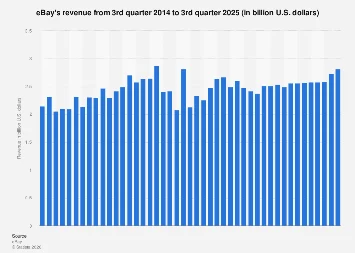
San Jose, CA – eBay’s financial performance in the third quarter of 2025 indicates a period of sustained, albeit incremental, revenue growth, with the e-commerce giant reporting net revenues of approximately $2.82 billion. This figure represents a slight uptick from the $2.73 billion recorded in the preceding second quarter of 2025, suggesting a continued stabilization and expansion of its core marketplace operations. While this quarter’s earnings reflect a positive trajectory, they remain just shy of the company’s historical peak revenue.
The data reveals a trend of modest but consistent revenue generation throughout 2025. After opening the year with $2.59 billion in the first quarter, eBay’s net revenue saw a marginal increase to $2.73 billion in the second quarter and reached $2.82 billion by the third. This pattern suggests a deliberate strategy of consolidation and optimization rather than aggressive expansion, a departure from the more volatile revenue streams observed in earlier years. The company’s performance in 2025 can be contextualized against the broader economic climate, which has seen fluctuating consumer spending patterns and increased competition within the digital retail space.
Looking back over the past decade, eBay’s revenue has demonstrated a complex evolution. The company experienced a significant revenue peak in the fourth quarter of 2018, when net revenue surged to nearly $2.9 billion. This period was marked by different market dynamics and the company’s strategic positioning at the time. Subsequently, the revenue trajectory saw fluctuations, including a notable dip in early 2020, potentially influenced by the initial stages of the global pandemic and its impact on supply chains and consumer behavior. However, the platform showed resilience, with revenues climbing back to $2.67 billion by the second quarter of 2021.
The period between 2022 and 2024 illustrates a phase of recalibration for eBay. Revenues generally hovered in the $2.3 billion to $2.5 billion range for much of this time, with some quarterly variations. For instance, the third quarter of 2022 saw revenues of $2.38 billion, followed by a gradual increase to $2.5 billion in the third quarter of 2023. This sustained performance in the mid-$2 billion range indicates a mature business model that is adept at maintaining its market share and operational efficiency. The careful management of its vast seller network and buyer base appears to be a cornerstone of this steady revenue stream.
The company’s financial reporting for this period explicitly excludes revenue from PayPal, following the fintech giant’s spin-off. This strategic separation, completed in 2015, allowed both entities to pursue independent growth strategies. For eBay, it meant a renewed focus on its transactional marketplace and a drive to enhance the user experience for both buyers and sellers directly within its platform, rather than relying on a subsidiary for payment processing. This has necessitated investments in proprietary payment solutions and a continuous effort to streamline the checkout process.

The current revenue figures for 2025, while not reaching the all-time highs of 2018, represent a significant achievement in a highly competitive and rapidly changing e-commerce environment. Global e-commerce sales have seen robust growth over the past decade, projected to reach trillions of dollars annually. However, this growth is increasingly fragmented, with established players like Amazon and newer disruptors such as Temu and Shein vying for consumer attention and market share. eBay’s ability to maintain a strong revenue base in this environment speaks to the enduring appeal of its unique marketplace model, which caters to a wide range of goods, from everyday items to collectibles and pre-owned merchandise.
Analysts suggest that eBay’s strategy in recent years has centered on improving the buyer and seller experience, enhancing trust and safety features, and optimizing its advertising tools to help sellers reach a wider audience. Investments in artificial intelligence and data analytics are likely playing a crucial role in personalizing recommendations, improving search results, and detecting fraudulent activity, all of which contribute to a healthier marketplace and, consequently, more consistent revenue. The company’s focus on curated categories and niche markets also helps it differentiate from mass-market online retailers.
Furthermore, the company’s operational efficiency, particularly in logistics and customer service, is critical. As consumers increasingly expect fast and reliable delivery, eBay’s ability to leverage its network of sellers and third-party logistics providers remains a key competitive advantage. The ongoing efforts to digitize and streamline the post-purchase experience, from returns to customer support, are vital for customer retention and fostering repeat business.
From a global perspective, eBay operates in diverse markets, each with its own consumer preferences and regulatory landscapes. Its performance in Q3 2025 would reflect the aggregate of these international operations, with key markets in North America, Europe, and Asia likely contributing significantly to the overall revenue. The company’s ability to adapt its offerings and marketing strategies to suit local conditions is paramount to its sustained success. For instance, in markets where second-hand goods are particularly popular, eBay’s platform provides a well-established and trusted channel for transactions.
The modest growth observed in the third quarter of 2025 should be viewed in the context of eBay’s strategic positioning. The company is not aiming for the hyper-growth figures of some venture-backed startups but rather for sustainable profitability and market leadership in its chosen segments. Its business model, which thrives on facilitating transactions between individuals and small businesses, requires a different approach to growth compared to direct-to-consumer e-commerce giants. The emphasis is on building a robust ecosystem where sellers can thrive and buyers can find unique items at competitive prices.
Looking ahead, eBay faces ongoing challenges, including continued competition, evolving consumer expectations, and the need for continuous technological innovation. However, its established brand recognition, vast user base, and diversified product categories provide a strong foundation. The revenue of $2.82 billion in Q3 2025 signals that the company is successfully navigating these complexities, demonstrating a capacity for steady financial performance in the dynamic world of online retail. The company’s ability to attract and retain sellers, while ensuring a positive shopping experience for buyers, will remain the key determinant of its future revenue trajectory.