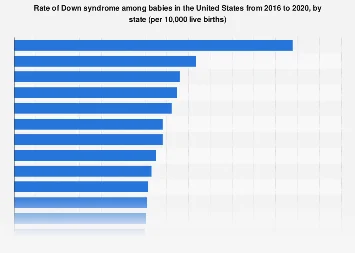
Analysis of birth data from 2016 to 2020 across the United States reveals notable geographical variations in the incidence of Down syndrome, also known as Trisomy 21. During this five-year period, Massachusetts reported the highest rate, with approximately 32 babies per 10,000 live births diagnosed with the condition. This finding underscores the complex interplay of genetic, environmental, and potentially socioeconomic factors that may influence birth defect rates across different regions.
The data, compiled from birth records, provides a state-by-state breakdown of Down syndrome prevalence, offering a granular view of this specific congenital condition. Following Massachusetts, Rhode Island registered the second-highest rate at 20.9 per 10,000 births, followed by Colorado with 19 cases per 10,000. Other states with rates exceeding 18 per 10,000 births include Michigan (18.7) and Utah (18.1). California and Delaware both reported 17.1 cases per 10,000 births, placing them in the upper echelon of incidence rates.
Conversely, states such as New Hampshire exhibited significantly lower rates, with only 2.2 cases per 10,000 births recorded during the same period. Alaska, however, did not provide data for this report, leaving a gap in the comparative analysis for that state. The dataset highlights a spectrum of occurrence, from the highest concentration in the Northeast to lower incidences in other parts of the country.
Understanding these disparities is crucial for public health initiatives, resource allocation, and further research into the underlying causes. While Down syndrome is primarily a genetic condition resulting from an extra copy of chromosome 21, its observed incidence can be influenced by a variety of factors, including maternal age, access to prenatal screening and diagnostic technologies, and reporting methodologies across states.
The economic and social implications of Down syndrome are substantial, impacting healthcare systems, educational services, and family support structures. Early and accurate diagnosis, followed by comprehensive intervention services, can significantly improve the quality of life for individuals with Down syndrome and their families. Therefore, mapping these geographic variations can help identify areas that may require enhanced support services or targeted public health campaigns.
The varying rates observed across states could be attributed to several potential factors. One significant determinant is maternal age at conception, as the risk of having a child with Down syndrome increases with the mother’s age. Differences in the age demographics of expectant mothers across states could therefore contribute to observed incidence rate variations. For instance, states with a higher proportion of older mothers might naturally exhibit higher rates.
Furthermore, the availability and utilization of prenatal screening and diagnostic tests play a critical role. Advanced maternal age, in particular, often prompts more frequent screening. States with robust prenatal care programs and widespread access to technologies like amniocentesis or chorionic villus sampling (CVS) may lead to earlier and more accurate detection. This can, in turn, influence the recorded incidence rates, as diagnoses are made more consistently. Conversely, in areas with limited access to such services, diagnoses might be missed or made later, potentially affecting the official statistics.
Environmental factors, though less understood in relation to Down syndrome specifically, are always a consideration in public health. Exposure to certain environmental toxins or variations in lifestyle factors could theoretically play a role, although extensive research is needed to establish any definitive links.
The economic impact of Down syndrome, while difficult to quantify precisely on a state-by-state basis, is significant. Healthcare costs associated with managing associated medical conditions, such as congenital heart defects, gastrointestinal issues, and hearing or vision impairments, can be substantial throughout an individual’s life. Educational and therapeutic services also represent a considerable investment. Therefore, understanding the prevalence at a regional level can inform budget allocations for disability services, early intervention programs, and specialized healthcare facilities.
Globally, the incidence of Down syndrome is estimated to be around 1 in every 700 to 1,000 live births. While the U.S. data focuses on state-level variations within a single country, international comparisons can offer further insights. For example, studies in Europe and Asia have also reported variations in Down syndrome rates, often linked to differences in healthcare access, screening practices, and cultural attitudes towards disability. The U.S. data provides a valuable domestic benchmark against which these global trends can be compared.
The period from 2016 to 2020, during which this data was collected, predates some of the most significant impacts of the COVID-19 pandemic. Future analyses will be necessary to determine if the pandemic had any discernible effect on birth rates or the incidence of congenital conditions due to disruptions in healthcare access or other unforeseen circumstances.
The methodology behind such data collection is critical. Variations in how births are registered, how diagnoses are confirmed, and the completeness of data reporting across different states can introduce complexities into the analysis. The absence of data from certain states, like Alaska in this instance, highlights the challenges in achieving a truly comprehensive national picture.
In conclusion, the geographic distribution of Down syndrome incidence in the U.S. between 2016 and 2020 presents a complex mosaic. Massachusetts stands out with the highest reported rate, while other states show varying levels of prevalence. This data serves as a vital tool for public health officials, researchers, and policymakers to better understand, address, and support the needs of individuals with Down syndrome and their families across the nation. Continued monitoring and in-depth research into the contributing factors are essential for informed decision-making and the promotion of equitable health outcomes.