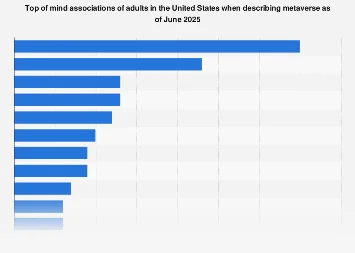
A mid-2025 survey reveals that for a significant portion of the U.S. adult population, the concept of the metaverse remains intrinsically linked to social media giants, particularly Facebook and Instagram. This finding, emerging from a comprehensive study conducted between late May and mid-June 2025, underscores the pervasive influence of established digital platforms in shaping public perception of emerging technologies. Over three in ten adults surveyed, precisely 35 percent, identified Facebook or Instagram as their primary association when the term "metaverse" was presented. This highlights a powerful branding effect, where the parent company, Meta, has successfully cemented its platforms in the minds of consumers, even as the metaverse concept itself remains somewhat amorphous for many.
Following closely behind these social media behemoths, virtual reality (VR) emerged as the second most prominent association, cited by 23 percent of respondents. This indicates a lingering, yet substantial, connection between the metaverse and its most technologically advanced manifestation. VR, with its immersive headsets and simulated environments, represents the more tangible, albeit still niche, embodiment of the metaverse for many. The juxtaposition of these top two associations – a dominant social media brand and a specific, advanced technology – paints a complex picture of public understanding. It suggests that while the public recognizes the metaverse as something beyond current digital experiences, their frame of reference is heavily influenced by both established social networks and the hardware that promises deeper immersion.
The survey, which polled 1,305 adults aged 18 and over via an online methodology, allowed respondents to offer up to three initial thoughts upon hearing the word "metaverse." This open-ended approach provides valuable qualitative insights into the public’s subconscious associations. Beyond the leading social media and VR connections, a notable 13 percent of respondents expressed a "negative opinion general." This sentiment, appearing as a significant third category, suggests that concerns about privacy, the potential for addiction, or the general perceived dystopian nature of a fully virtual existence are already deeply ingrained in the public consciousness. This negative framing is a critical challenge for any entity seeking to promote widespread adoption and investment in metaverse technologies.
Interestingly, the figurehead of Meta, Mark Zuckerberg, also garnered a 13 percent association. This indicates that for many, the metaverse is not just a technological concept or a suite of platforms, but is also personified by its most prominent proponent. This personal connection, or at least recognition, further solidifies the link between Zuckerberg’s vision and the public’s understanding of the metaverse. The overlap between "Facebook or Instagram," "Meta," and "Mark Zuckerberg" associations clearly demonstrates the powerful brand equity and individual recognition Meta has cultivated in this nascent space.
Artificial intelligence (AI) registered as the fifth most frequent association, with 12 percent of respondents linking it to the metaverse. This connection is logical, as AI is expected to play a crucial role in populating virtual worlds with intelligent non-player characters, personalizing user experiences, and managing complex virtual economies. The growing public awareness of AI’s capabilities and its potential integration into various digital spheres naturally extends to its perceived role within the metaverse.
Further down the list, "another universe / world" was mentioned by 10 percent of participants, suggesting a fundamental understanding of the metaverse as a distinct, parallel digital realm. This abstract association points to the aspirational and imaginative aspects of the metaverse, a place where new realities can be constructed and explored. Complementing this, "social / community" was also cited by 9 percent, highlighting the inherent human desire for connection that is expected to be a core driver of metaverse engagement, mirroring the success of current social platforms.
A contrasting 9 percent offered a "positive opinion general," indicating that alongside negative sentiments, there are individuals who view the metaverse with optimism and anticipation for its potential benefits. This positive outlook is crucial for fostering innovation and investment, suggesting a segment of the population is receptive to the metaverse’s promised advancements.
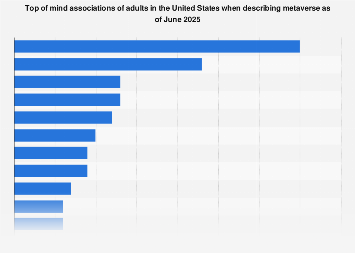
The parent company "Meta" itself, distinct from its specific social media platforms, was named by 7 percent of respondents. This indicates a level of brand awareness for the overarching entity that is driving much of the metaverse’s development. "Innovation" was associated by 6 percent, reflecting the perception of the metaverse as a frontier of technological advancement, while "augmented reality" (AR), a related but distinct immersive technology, was also mentioned by 6 percent, showing some understanding of the broader immersive technology landscape.
The remaining associations, each at 4 percent, offer a glimpse into more granular perceptions. "Reality" suggests a contemplation of the metaverse’s relationship with the physical world, perhaps hinting at concerns about escapism or blurring lines. "Fun" points to the entertainment and recreational potential, a key driver for adoption in gaming and social experiences. "Modern or New" frames the metaverse as a cutting-edge development, while "Internet or Online" anchors it within the existing digital infrastructure. Finally, "Fake" represents a skeptical view, potentially stemming from the negative opinions or a perception of the metaverse as an artificial construct detached from genuine experience. "Gaming" also appeared at 4 percent, underscoring its established role as a primary gateway to immersive digital worlds and a strong precursor to broader metaverse adoption.
From a global economic perspective, these associations in the U.S. have significant implications for investment and market development. The dominance of Facebook/Instagram and VR as primary associations suggests that companies aiming to capture market share will need to leverage these existing touchpoints. Meta’s strong brand recognition positions it favorably, but the significant "negative opinion" percentage highlights the critical need for transparent communication, robust privacy controls, and ethical development practices to build trust and mitigate public apprehension.
The 13 percent association with Mark Zuckerberg indicates that the metaverse narrative is, to some extent, tied to individual leadership. While strong leadership can be a driving force, a broader, more decentralized narrative might be necessary for widespread organic growth and to avoid the perception of a single entity controlling the future digital landscape. The 12 percent link to AI underscores the symbiotic relationship between these technologies. Companies investing in AI development will likely find synergistic opportunities within the metaverse ecosystem, whether for creating dynamic virtual environments, powering intelligent agents, or personalizing user journeys.
The "another universe / world" and "social / community" associations, while abstract, are vital for understanding user motivation. Future metaverse development must focus on fostering genuine human connection and offering compelling, distinct digital experiences that go beyond simple replication of the physical world. The 9 percent positive sentiment is a crucial indicator for investors and developers, suggesting a receptive audience for innovative and beneficial metaverse applications.
The economic impact of the metaverse is projected to be substantial, with various market research firms forecasting trillions of dollars in value creation over the next decade. However, this potential hinges on overcoming the challenges highlighted by the survey. The perception of the metaverse as "fake" or associated with negative opinions could deter consumer spending and business investment. Conversely, the association with "innovation" and "gaming" points to strong foundational elements upon which to build.
Global comparisons reveal that awareness and association patterns can vary significantly. While the U.S. shows a strong tie to social media platforms, other regions might have different primary associations, perhaps more rooted in gaming culture or specific technological advancements. For instance, in South Korea and Japan, gaming has long been a dominant force in online entertainment, and this might translate into a stronger gaming-centric association with the metaverse in those markets.
The fact that only three responses were permitted per respondent in the survey emphasizes the most salient initial thoughts. This constraint makes the 35 percent association with Facebook or Instagram particularly impactful, signifying its top-of-mind status. The survey period, spanning May 28 to June 18, 2025, captures a snapshot of public sentiment at a specific point in time, suggesting that these perceptions are dynamic and will likely evolve as the metaverse itself matures and more tangible applications become widespread. The continued development of VR and AR hardware, coupled with advancements in AI and network infrastructure, will undoubtedly shape future public associations and drive the trajectory of the metaverse economy.